Your chatbot promised a customer something wrong. Do you have to honour it?
By Validure team · · 14 min read
A contested question with both sides at full strength. What the Air Canada tribunal actually decided, why "liable" and "bound" are different answers, how Indian consumer law is likely to treat a bot's wrong answer, where the business has a fair defence, and a table for deciding what to do when it happens to you.
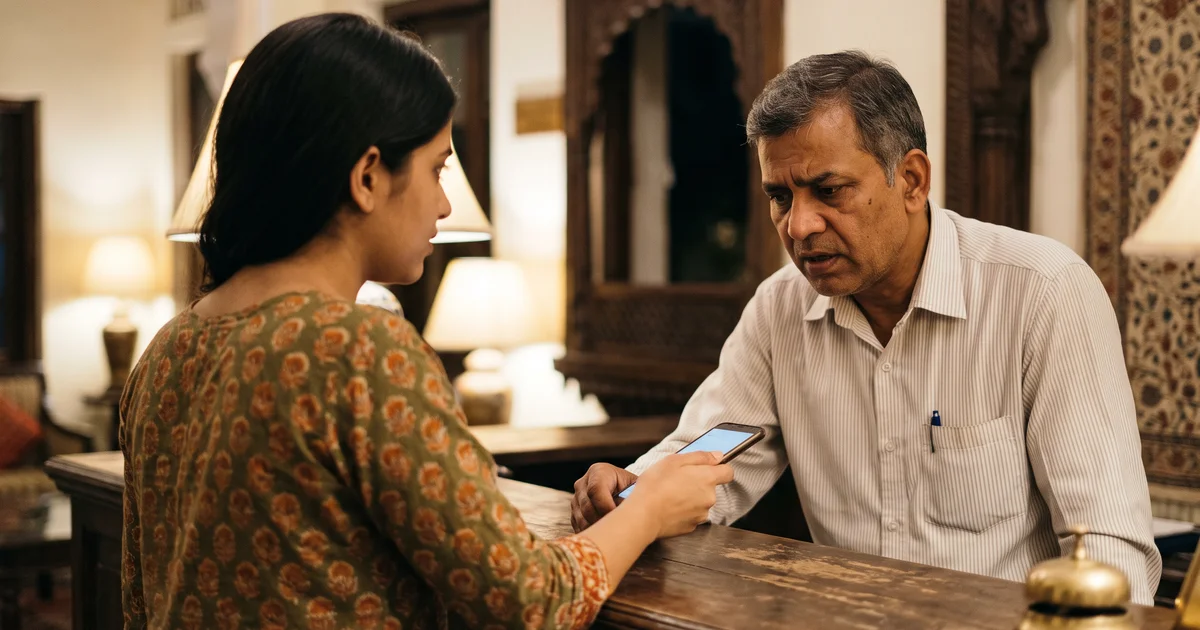
Say a 30-room hotel in Jaipur puts an AI chatbot on its website. A guest asks about cancellation and the bot says, politely and confidently, that cancellations are free up to 24 hours before arrival. The hotel's actual policy, on the booking page two clicks away, says 72 hours. The guest books three nights at 4,200 a night, cancels 48 hours out, and the hotel charges the first night as its policy allows. The guest sends a screenshot of the chat and asks for the 4,200 back.
The owner's first instinct is often "the bot made a mistake, our policy is on the website". The guest's instinct is "your website told me, in writing". Who's right is a live argument, and the answer isn't the same in every case. This post lays out both sides at full strength, separates what's settled from what isn't, and ends with what we'd do.
We build software and use AI in our own work, so we have an interest here. Nothing below is legal advice. Consumer law in India depends on the facts, the forum and the amount, so for a real dispute talk to a lawyer or your nearest consumer commission's help desk.
The one case everyone cites, and what it actually decided
In Moffatt v. Air Canada, 2024 BCCRT 149, decided on 14 February 2024 by British Columbia's Civil Resolution Tribunal, a customer whose grandmother had died used Air Canada's website chatbot to ask about bereavement fares. The bot told them they could book at the normal fare and claim the reduced bereavement rate within 90 days of the ticket being issued. The airline's own "Bereavement travel" page, which the bot even linked to, said the policy didn't apply after travel.
The customer booked two one-way flights, paid 794.98 and 845.38 Canadian dollars, and applied for the reduction afterwards. Air Canada refused. An airline representative later admitted by email that the bot had used "misleading words".
Air Canada argued, among other things, that it couldn't be held liable for what its chatbot said. The tribunal called the airline's position "a remarkable submission", said the chatbot is still just part of Air Canada's website, and added that it makes no difference whether information comes from a static page or a chatbot. It also said the airline hadn't explained why customers should have to double-check one part of its website against another.
Here's the detail most summaries skip. The tribunal didn't enforce the chatbot's promise as a contract. It found negligent misrepresentation, a claim in tort: the airline owed the customer a duty of care, made an inaccurate statement carelessly, the customer reasonably relied on it, and lost money as a result. The remedy put the customer where they'd have been if the statement hadn't been made.
| Item | Canadian dollars |
|---|---|
| Paid for both flights (794.98 + 845.38) | 1,630.36 |
| What the tribunal said they should have paid at bereavement rates | 979.48 |
| Damages (1,630.36 minus 979.48) | 650.88 |
| Pre-judgment interest | 36.14 |
| Tribunal fees | 125.00 |
| Total ordered | 812.02 |
We checked each sum. The totals add up as the tribunal wrote them, though our own addition of the first leg (380 fare, 62.12 charges, 22.11 GST) comes to 464.23 rather than the 474.23 in the decision, so the award may be ten dollars low. It doesn't change anything about the reasoning.
So the precise answer from the best-known case is "liable for the loss caused", not "bound to the promise". That difference matters more than the headline.
Bound versus liable: two different questions
"Bound" means the bot's statement became part of a contract and you must deliver what it said: the free cancellation, the discounted price, the extra night.
"Liable" means you pay for the harm caused by relying on a wrong statement, which can be less than, equal to or more than the value of the promise.
In the Jaipur example both give 4,200. But suppose the bot quoted a room at 2,000 instead of 4,200. "Bound" means you give the room at 2,000. "Liable" means you ask what the guest lost by relying on the quote: nothing if they'd have paid 4,200 anyway, more if they turned down another hotel at 2,500.
The case for "the business should honour it"
The bot is on your website, in your brand, answering on your behalf. You chose to deploy it instead of a person or a static page. You chose the model, the prompt and what it can read. If a human agent told a guest "free cancellation up to 24 hours", nobody would argue the agent was a separate legal person. A chatbot is a cheaper agent, and the savings go to the business, so the risk should too.
The customer has no way to tell which part of your site is reliable. The Air Canada tribunal said exactly this: there's no reason a customer should know one section of a webpage is accurate and another isn't.
Disclaimers like "the assistant may make mistakes, please verify" try to shift the cost of your tool's errors to the person least able to check. In India, the Consumer Protection Act, 2019 lets consumer commissions treat one-sided standard terms as unfair contract terms, and a line in small print telling customers not to trust what you just told them is an easy target.
And there's the incentive argument. If businesses can walk away from whatever the bot says, they'll deploy bots that sell hard and correct nothing. Holding them to it is what makes them test the thing properly.
The case for "the business shouldn't always be held to it"
Some errors are obvious. If a bot agrees to sell a ₹40,000 phone for ₹40 because a customer spent twenty minutes coaxing it, very few people would say the customer reasonably believed that was a real offer. Contract law in most common law systems, including India's, doesn't usually enforce a deal where one side knew the other was making a mistake about a basic term. Reliance has to be reasonable for a negligent misrepresentation claim too.
Some customers try to break the bot on purpose. Generative chatbots can be talked into saying things nobody programmed. A rule that every sentence the bot can be pushed into saying binds the business turns prompt tricks into a way to extract money.
It's also unclear whether a generative bot's output is a "statement by the business" the way a printed price is. The most careful judgment on automated contracting we found, the Singapore Court of Appeal's in Quoine v B2C2 ([2020] SGCA(I) 02), dealt with trading software following fixed rules, and looked to the programmer's knowledge from when the program was written up to when the contract was made. A large language model isn't deterministic, and nobody wrote the sentence "free cancellation up to 24 hours". How the law treats that is not settled.
And small businesses can't absorb unlimited exposure. A 30-room hotel that runs a chatbot because it can't staff a night desk can't afford to treat every misstatement as a binding term.
Where Indian law is likely to land (established, and what isn't)
As of 19 November 2026, India has no AI-specific liability law, and we found no Indian court or consumer commission ruling on a chatbot giving a customer wrong information. What follows is how existing law applies, which is analysis, not case law.
Start with the Consumer Protection Act, 2019. Two definitions do most of the work. "Deficiency" in a service includes any fault, shortcoming or inadequacy in its performance, and covers acts of negligence that cause loss to the consumer. "Unfair trade practice" includes making a statement, in writing or "by means of electronic record", that falsely represents a service to promote its sale. A chat transcript is an electronic record. The Act doesn't care whether a person or a model typed the sentence. A consumer commission can order a refund, compensation and costs, so in practice it can deliver either the "bound" or the "liable" outcome.
On contract formation, section 10A of the Information Technology Act, 2000 says a contract isn't unenforceable merely because the proposal and acceptance were made electronically. It doesn't say what a chatbot's statement means; ordinary contract law under the Indian Contract Act, 1872 still decides whether there was an offer, an acceptance and agreement on the terms. A price shown by a bot is probably closer to an invitation to make an offer than an offer, the same as a price tag, but a specific assurance about a booking the customer is about to make looks much more like a term of that contract.
On policy direction, the India AI Governance Guidelines published by MeitY in November 2025 aren't binding. They favour "graded" liability, where responsibility follows the function you perform, the risk and the due diligence you did. Nothing in them suggests a business that deploys a chatbot gets to point at the bot. Any claim you have against the AI vendor depends on your contract and doesn't reduce what you owe the customer.
For customers in the EU, Article 50 of the AI Act has required since 2 August 2026 that people be told they're interacting with an AI system unless that's obvious. Telling them doesn't excuse a wrong answer.
What the evidence settles, and what it doesn't
Settled, at least where the question has been tested: a business can't defend itself by saying the chatbot is responsible for its own words.
Contested: whether the business must deliver exactly what the bot promised, or only cover the loss from relying on it; whether a visible "AI may make mistakes" notice changes what's reasonable reliance; and how obvious an error has to be before the customer can't rely on it.
Open: how mistake and intention apply to generative systems that say things nobody wrote, and how often customers deliberately manipulate bots into promises. We found no reliable data on either.
Our position (opinion)
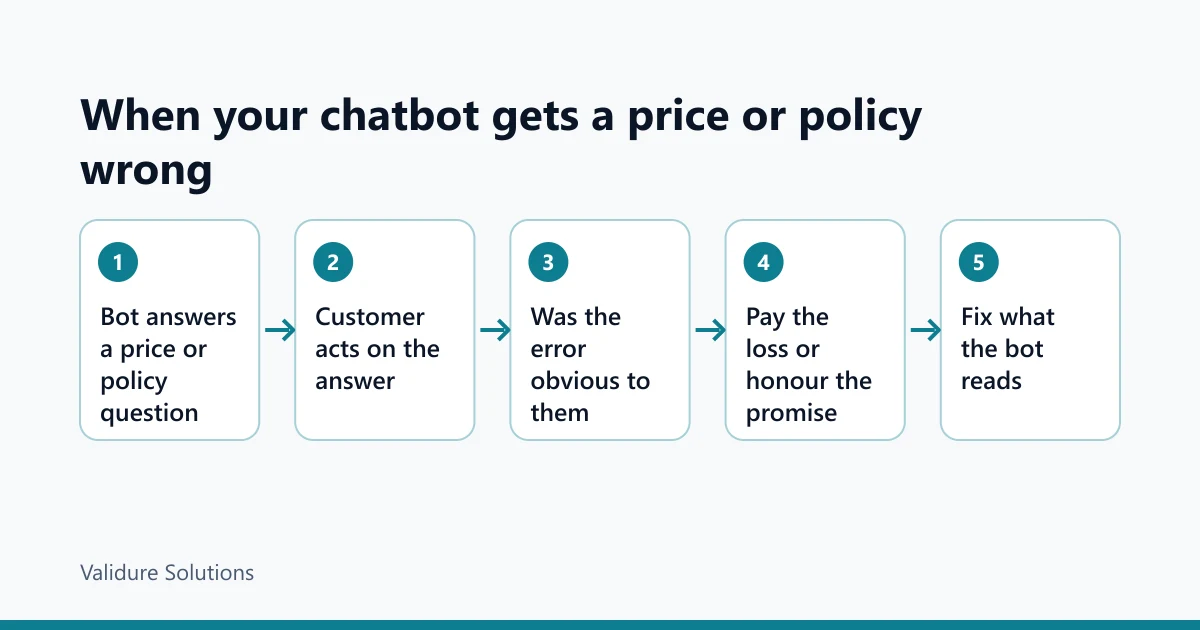
We think the default should be that the business honours, or compensates, anything its bot tells a customer about prices, policies, refunds, eligibility or dates, unless the error was so obvious that no reasonable customer could have believed it or the customer manipulated the bot into saying it. That's roughly where we expect an Indian consumer commission to end up, and it's also the fairer rule: you picked the tool and you keep the savings.
Our second view is that the bigger mistake is upstream. Most of these disputes come from bots that are allowed to answer policy questions from memory, or from a policy document that's out of date. If your bot can't be wrong about cancellation terms because it quotes them word for word from the same text the booking engine uses, there's nothing to argue about.
Where we're unsure: on a big-ticket error, we'd offer a reasonable middle and talk to a lawyer before refusing outright, because how a commission sees "obvious" is hard to predict.
The arithmetic of being liable
An example, with made-up but plausible numbers, of what this costs a mid-size hotel or clinic each month.
| Step | Number |
|---|---|
| Chatbot conversations a month | 3,000 |
| Conversations touching price, policy or refunds (20 per cent) | 600 |
| Wrong answers among those (say 3 per cent) | 18 |
| Customers who act on the wrong answer (say one in three) | 6 |
| Average cost to put each right | ₹2,500 |
| Monthly exposure (6 × 2,500) | ₹15,000 |
Reviewing every reply defeats the point of the bot. Making it quote policy text instead of paraphrasing, and handing money and eligibility questions to a person, targets only the 600 risky conversations. If that brings wrong answers from 18 to 3, one customer acts on one and exposure falls to about ₹2,500 a month.
The percentages are assumptions. Run the table on your own logs: sample 50 money and policy conversations and check each answer against your written policy.

What to do when a customer shows you the screenshot
| What the bot said | Was it reasonable to rely on? | What we'd do |
|---|---|---|
| A policy term that differs from your written policy (cancellation window, refund rule) | Usually yes | Honour it for this customer, fix the source, log it |
| A price within a normal range for that product, just wrong | Usually yes | Honour it, or offer the difference plus a small goodwill amount |
| A price or benefit that's absurd (90 per cent off, free stay) | Usually no | Explain politely, offer a fair alternative, keep the transcript |
| Something it was clearly pushed into saying through repeated instructions | No | Decline, keep the full transcript, don't argue in public |
| Eligibility (who qualifies for a rate, a scheme, a discount) | Usually yes | Treat like a policy term; this is where Air Canada lost |
| Anything about health, legal rights or safety | Depends heavily | Escalate to a person and a lawyer the same day |
Keep the full conversation log, not only the last message, because "they pushed it into saying that" needs proof. And reply within days.
Checks for your own bot
| Check | What to look for | What a hit means |
|---|---|---|
| Ask it your top ten policy questions | Answers that paraphrase instead of quoting your policy text | It will eventually say something you don't offer |
| Ask about a price that changed last month | The old price | It's reading a stale document |
| Ask it to "make an exception just this once" | Any agreement, discount or promise | It can be talked into commitments |
| Search logs for "refund", "free", "guarantee", "waive" | Promises nobody approved | You already have exposure; review those customers |
| Check who gets the handover | No named person or no response time | Money questions are going unanswered or answered by the bot |
Who this doesn't apply to
If your chatbot only answers questions like opening hours, directions and "where's my order", and it can't quote prices, policies or eligibility, your exposure is small. The same is true if every reply is drafted by AI but read and sent by a person, because then it's that person's statement in the ordinary way, with the same responsibility as any email.
Sources and checks
The Air Canada decision: Moffatt v. Air Canada, 2024 BCCRT 149, on CanLII, and the Civil Resolution Tribunal. The Singapore automated-contract judgment: Quoine Pte Ltd v B2C2 Ltd [2020] SGCA(I) 02, via the Singapore Courts. Indian law: the Consumer Protection Act, 2019 and the Information Technology Act, 2000 on India Code; the Department of Consumer Affairs and the e-Daakhil complaint portal at edaakhil.nic.in; the India AI Governance Guidelines from the Ministry of Electronics and Information Technology and the Press Information Bureau. EU: the AI Act (Regulation (EU) 2024/1689) on EUR-Lex. Checked on 19 November 2026. The Jaipur hotel and the monthly exposure table are examples, not data from a real business.
Frequently asked questions
If our chatbot quotes the wrong price, do we have to sell at that price?
Not automatically. A price quote is closer to an invitation to buy than a binding offer, and an obviously absurd price is unlikely to hold. But if the price was plausible and the customer relied on it, a consumer commission may treat the wrong quote as a deficiency or an unfair trade practice. Honouring a plausible price is usually cheaper than defending it.
Does an "AI may make mistakes" disclaimer protect us?
It helps a little at most. The Air Canada tribunal didn't accept that customers should have to check one part of a website against another, and Indian consumer law lets commissions set aside unfair standard terms. A disclaimer won't turn a confident, specific wrong answer into the customer's problem.
Can we blame the AI vendor instead?
Not as a defence against the customer. The customer dealt with you. Whether you can recover the cost from the vendor depends on your contract with them, so read the liability and indemnity clauses before you deploy.
What if the customer tricked the bot into the promise?
Keep the whole conversation. A promise extracted through repeated instructions or role-play is very unlikely to count as something the customer reasonably relied on. Decline politely and offer whatever your real policy gives.
What's the single best fix?
Stop the bot paraphrasing policies and prices. Have it quote the same text and figures your booking or billing system uses, and send anything about refunds, eligibility or exceptions to a named person.