
Ransomware locked your office files. Who do you have to tell in India, and by when?
By Validure team · · 13 min read
What a small Indian company has to report after a ransomware attack, to whom and how fast. The CERT-In six-hour rule with the clock worked out, the 180-day log duty in numbers, where the police complaint goes, when the DPDP breach notice starts, and a first-day checklist. Checked on 20 November 2026.

Say it's 7:45 on a Monday morning at a 30-person distributor in Pune. The accounts clerk switches on her PC and every file in the shared folder has a strange new extension. There's a text file on the desktop explaining how to pay in cryptocurrency to get the files back. She calls the office manager, who calls the person who looks after the computers, who gets in at 9:15. By 10:00 three people are arguing about whether to pay, whether to call the police, and whether anyone has to be told at all.
The last question has a clearer answer than most owners expect. Yes, a small private company in India generally has to report a ransomware attack to CERT-In, within six hours of noticing it. There's no size exemption. A police complaint is your choice but usually wise, and a separate duty to tell people whose personal data was hit arrives in 2027.
This is information, not legal advice. If you're in a regulated sector (banking, insurance, securities, telecom, health) your regulator has its own rules on top of these, and a lawyer who handles cyber incidents is worth a call on day one.
The six-hour rule, and why it reaches small companies
The rule comes from the Cyber Security Directions CERT-In issued on 28 April 2022 under section 70B(6) of the Information Technology Act, 2000. They took effect 60 days later, on 27 June 2022. Service providers, intermediaries, data centres, body corporate and government organisations must report the incidents listed in Annexure I to CERT-In within six hours of noticing them or being told about them.
"Body corporate" is the phrase that catches small firms. Every private limited company is one, and the IT Act's definition in section 43A is wide enough to include a firm or a sole proprietorship carrying on a business. CERT-In's FAQ on the Directions says individual citizens aren't covered. Neither document sets a minimum size or turnover.
Ransomware is named in Annexure I, under attacks by malicious code. So are unauthorised access to email accounts, website defacement, and data breaches and leaks.
There's one wrinkle. The CERT-In FAQ lists criteria for which Annexure I incidents need the six-hour report: severe incidents such as ransomware on public information infrastructure, data breaches or leaks, large-scale or frequent intrusions, and incidents affecting human safety. Some lawyers read that as narrowing the duty. Others treat every Annexure I incident as due in six hours, which is how the Directions are worded.
Our view, and it's an opinion: don't rely on the narrow reading. If ransomware touched files holding customer or staff details, it's very likely also a data breach, which is on the FAQ's list either way. A short first report costs half an hour. Arguing later that you didn't need to file costs far more.
When does the six hours start?
From "noticing" the incident or being "brought to notice" of it. Not from when the attacker got in, which could have been weeks earlier, and not from when your IT person finally looked.
In our reading, the first person to see it starts the clock. Here's the Pune example:
| Event | Time |
|---|---|
| Clerk sees encrypted files and the ransom note | 7:45 AM |
| IT person arrives and confirms it's ransomware | 9:15 AM |
| Six hours from first noticing | 1:45 PM |
| Six hours from IT confirming (the reading you shouldn't rely on) | 3:15 PM |
The safe deadline is 1:45 PM, and the morning will vanish into unplugging machines. So write down the time the clerk saw the screen before anything else happens. A note made at the time is the only evidence that counts if the start is ever disputed.
The FAQ also says you can report what you know and send more details later, within a reasonable time. That's what makes six hours workable. The first report doesn't need a root cause.
How to report to CERT-In
The Directions give three routes: email to incident@cert-in.org.in, phone on 1800-11-4949, and fax to 1800-11-6969. CERT-In also publishes an incident reporting form on its website, which is the easiest way to give them what they'll ask for.
A first email can be this short. It's an example with made-up details:
Subject: Cyber incident report: ransomware, [company name], noticed 7:45 AM 16 Nov 2026
Files on our file server and four PCs were encrypted; ransom note found. Noticed 7:45 AM by staff. Possibly affected: customer invoices and staff salary files on the server. Affected machines disconnected at 8:05 AM, no ransom paid, backups being checked. Contact: [name, role, mobile]. More details to follow.
Keep the sent copy. If you phone, note the time, the person and any reference number.
Two more duties in the Directions should be set up before an attack. Each covered entity names a Point of Contact for CERT-In and sends those details to info@cert-in.org.in in the format in Annexure II. In a small firm that's usually the owner or whoever runs IT. The second is logs.
The 180-day log duty, in real numbers
The Directions require logs of all your ICT systems, kept securely for a rolling 180 days within India, and handed to CERT-In when asked. They also ask you to sync system clocks to the time servers of the National Informatics Centre or the National Physical Laboratory, or servers traceable to them, so times in different logs line up.
After an attack these logs are how anyone works out how the attacker got in. Without them you restore from backup and hope the same door isn't still open.
Storage is rarely the obstacle. An example for a 30-person office, with illustrative daily sizes (measure your own for a week):
| Log source | Example size per day | For 180 days |
|---|---|---|
| Firewall and router | 150 MB | 27,000 MB |
| Windows server event logs | 40 MB | 7,200 MB |
| Email and cloud account sign-in and audit logs | 10 MB | 1,800 MB |
| Total | 200 MB | 36,000 MB, about 36 GB |
36 GB fits on a cheap external drive. What actually goes wrong: the firewall overwrites its logs every few days, Windows event logs sit at a default size that rolls over quickly, cloud email audit logs are kept only as long as your licence tier allows, and the only copy lives on the server the ransomware just encrypted. Send logs to a separate machine or service, check where it stores them, and once a month confirm the oldest entry is at least 180 days old.
What happens if you don't report
Non-compliance falls under section 70B(7) of the IT Act. The original text allowed up to one year in prison, a fine of up to one lakh rupees, or both. The Jan Vishwas (Amendment of Provisions) Act, 2023 changed this section, and commentators report the fine ceiling rose to one crore rupees; copies circulating online disagree on whether the prison term remains. Read the current text on India Code before relying on either version.
We haven't found published figures on how often small firms are prosecuted for late reporting, so we won't guess. The practical risk is different: if customer data leaks and a client or bank later asks whether you reported it, "we didn't think we had to" is a weak answer.
The police complaint and the cybercrime portal
A CERT-In report isn't a police complaint. CERT-In is a technical agency. If you want the crime investigated, or need a complaint number for an insurer or bank, file separately on cybercrime.gov.in, the national portal run by the Indian Cyber Crime Coordination Centre under the Ministry of Home Affairs. Complaints go to the police of the state concerned. If money has actually left an account (say the attacker also changed a supplier's bank details on an invoice), call the 1930 helpline straight away; it's for financial fraud and speed matters. You can also go to your local police cyber cell with a photo of the ransom note, the encrypted file extension, your notes of times and the CERT-In report.
Here's the whole picture for a typical small private company outside regulated sectors:
| Who | When | Required or optional | Applies if |
|---|---|---|---|
| CERT-In | Within 6 hours of noticing | Required under the 2022 Directions (see the FAQ wrinkle above) | Ransomware or any Annexure I incident |
| Police, via cybercrime.gov.in or the cyber cell | Same day if you can | Optional, usually needed for insurance and bank claims | Any criminal attack |
| 1930 helpline | Immediately | Strongly advised | Money has moved out of an account |
| Your cyber insurer | As the policy says | Required by most policies before you pay anyone | You have cover |
| Sector regulator | As its rules say | Required | You're regulated |
| Data Protection Board and affected people | Without delay, detailed report in 72 hours | Required once Rule 7 of the DPDP Rules is in force (expected mid-2027) | Personal data was breached |
The DPDP breach notice: coming, not here yet
Section 8(6) of the Digital Personal Data Protection Act, 2023 requires a data fiduciary (anyone deciding why and how personal data is processed, which includes a small company holding staff and customer records) to tell the Data Protection Board and each affected person about a personal data breach. Rule 7 of the DPDP Rules, 2025, notified on 13 November 2025, sets out how: a plain-language notice to each affected person without delay, saying what happened, the likely consequences and what they can do; a first notice to the Board without delay; and a detailed report to the Board within 72 hours of becoming aware, unless the Board allows longer on a written request.
The catch is timing. The government's release describes an 18-month phased timeline, and Rule 1 brings Rule 7 into force 18 months after publication. Counting from 13 November 2025, that's around 13 May 2027. Confirm the exact date as it nears.
If you're hit before then, the CERT-In report is still due, and telling affected customers and staff is still what a client or court will expect. From mid-2027, one ransomware incident can mean two clocks: six hours to CERT-In and 72 hours for the detailed report to the Board. The information overlaps, so plan for both now.
Should you pay?
The Directions say nothing about paying, and we haven't found an Indian provision that plainly makes it illegal, so we won't claim it is. What we can say is narrower. Paying doesn't change any reporting duty. It doesn't prove the files come back, or that copied data gets deleted. If you have cyber insurance, most policies want to be told before you pay anyone. And check No More Ransom (nomoreransom.org), a project run by law enforcement and security companies, for a free decryptor that matches your strain. It's a long shot that costs nothing.
In practice the decision turns on one thing: whether you have a backup the attacker couldn't reach.
Restore time is the number nobody checks
Most small offices have a backup. Fewer had it disconnected when the attack hit, and fewer still know how long a full restore takes. The backup side is in backups and recovery for small firms; here's the arithmetic that matters on the day.
Say your file server holds 400 GB and your USB backup disk copies at about 50 MB per second in practice. 400 GB is about 400,000 MB, and 400,000 / 50 = 8,000 seconds, about 2 hours 13 minutes for the copy alone.
If the backup is in the cloud and your line really delivers 100 megabits per second, that's 12.5 MB per second. 400,000 / 12.5 = 32,000 seconds, close to 9 hours, before you rebuild the server and check the files open.
Two hours against most of a working day is often what pushes an owner towards paying. Time a test restore of a real folder once a quarter and write the speed down. If you're a five-person firm with everything already in cloud email and hosted accounting, there's far less to restore, but the CERT-In duty still applies.
The first-day checklist
Print this and keep it next to the router.
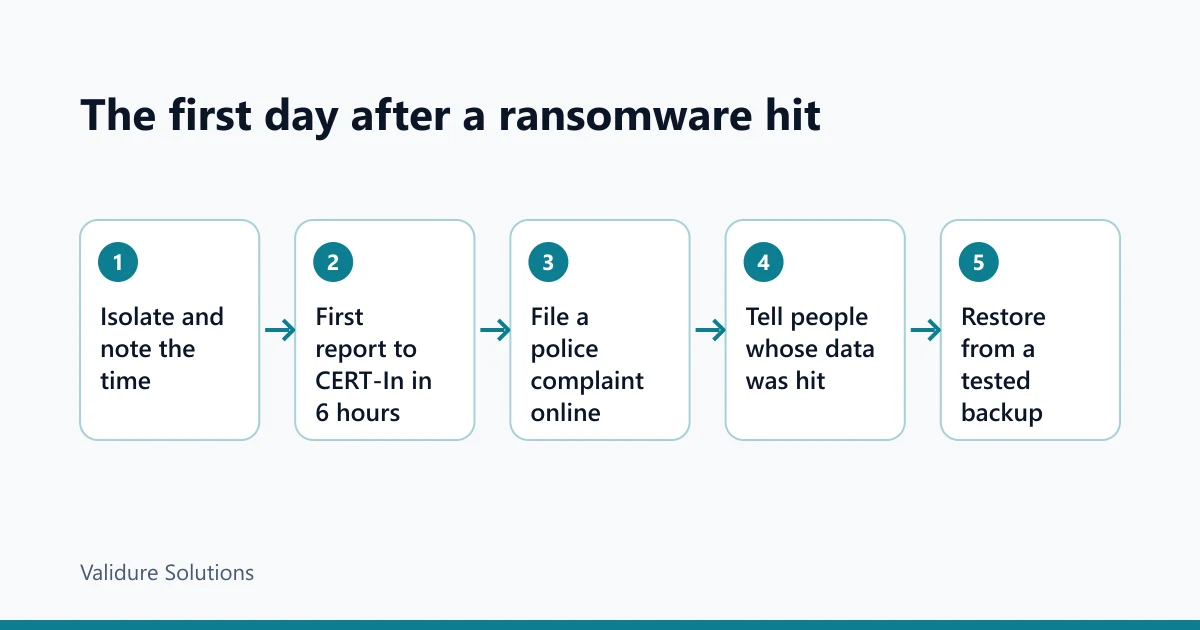
| Check | What to look for | What a hit means |
|---|---|---|
| Time noticed | Who saw it first, and when, written down | Your six-hour deadline starts here |
| Network | Affected machines unplugged from cable and Wi-Fi, but left powered on | Switching off can lose evidence in memory; staying connected spreads the damage |
| Backups | Backup drives disconnected; is the latest backup also encrypted? | If so, you're restoring an older copy, and need to know how old |
| Accounts | Admin, email and bank passwords changed from a clean device | The attacker may still be in through a stolen password |
| Data affected | Which folders held customer, staff or payment details | A data breach as well as an outage; decides who else you tell |
| CERT-In report | First email or call made, sent copy and time kept | Overdue after six hours |
| Insurer and police | Notified as the policy requires; complaint number noted | A late notice can void the claim |
| Logs | Firewall, server and email logs copied somewhere safe before anyone "cleans up" | Without them nobody can say how they got in |
Frequently asked questions
Does the six-hour rule apply to a sole proprietor or a partnership firm?
Probably, though it's less clear-cut than for a company. The Directions cover a "body corporate", the IT Act's section 43A definition includes firms and sole proprietorships in business, and CERT-In's FAQ excludes only individual citizens. Plan as if it applies and check with a lawyer.
What if we only discover the attack days after it happened?
The six hours run from when you noticed or were told. Report within six hours of finding it and say when you think it started, if you know.
We fixed it ourselves within an hour. Do we still have to report?
The Directions don't exempt incidents you've already contained. A short report saying what happened and that it's contained is the safe course.
Is there a fee or a set form?
No fee. Email, phone or fax all count. CERT-In's incident reporting form covers what they'll ask, but a clear email is accepted.
Do we have to tell our customers now, before the DPDP rules apply?
As a fixed legal deadline for most private firms, from about May 2027. But if their data was taken, they're the ones who'll get the phishing calls next. Telling them early is what we'd do.
Sources and checks
Checked on 20 November 2026. Confirm the current text on the official sites before relying on it.
- CERT-In, Cyber Security Directions under section 70B(6) dated 28 April 2022, the FAQs on those Directions (May 2022), and the incident reporting form: cert-in.org.in
- Information Technology Act, 2000, sections 43A and 70B: indiacode.nic.in
- Digital Personal Data Protection Act, 2023 and DPDP Rules, 2025 (Rule 1 commencement, Rule 7 breach intimation): meity.gov.in
- Press Information Bureau release on the DPDP Rules and the 18-month phased timeline, November 2025: pib.gov.in
- National Cyber Crime Reporting Portal and the 1930 helpline, Ministry of Home Affairs: cybercrime.gov.in
- No More Ransom project: nomoreransom.org
