How much energy does AI really use? Per prompt, per office and per grid
By Validure team · · 15 min read
A contested question with both sides at full strength. What one prompt costs in watt-hours according to the companies that run the models, what a small office's AI use adds up to, why data centre demand is still a real problem for grids, and which choices actually change the total.
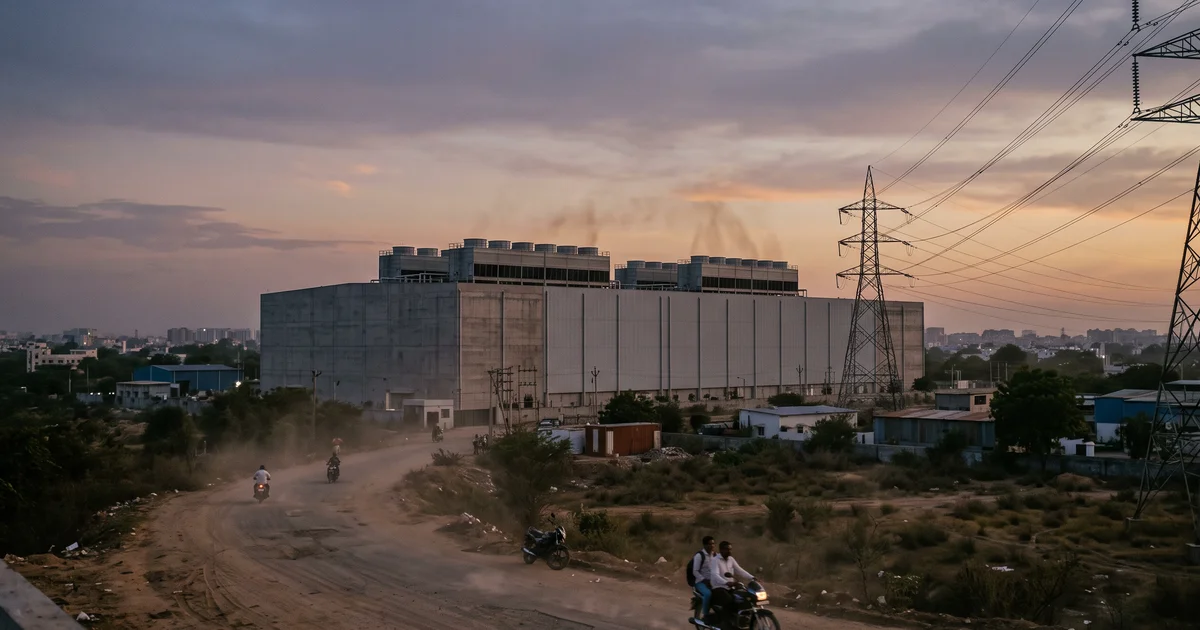
Say a 20-person accounts firm has just started using an AI assistant for drafting emails and summarising notices. At the Monday meeting one partner brings a printout: an article saying every chatbot answer wastes a bottle of water and ten times the power of a web search. She wants the tool switched off. Another partner says that's nonsense, it's less than boiling a kettle. Both have read something. Neither has a number they'd defend.
Here's the short answer. Per prompt, the published figures are small, around a third of a watt-hour for a typical text query. In aggregate, data centre demand is growing fast and concentrating in a few places, and that strain is real. The two partners are each right about a different number, which is why this argument never ends.
We'll put both sides at full strength, work the arithmetic for an office like this one, and say plainly what is measured, what is disputed and what is our opinion. We build software and use AI tools ourselves, so we have an interest in the answer. We'd rather you check our numbers than take our word.
Two questions wearing one coat
"Is AI bad for energy?" is really two questions.
The first is about use: what does my prompt, or my team's month of prompts, cost? That's a question about watt-hours per task.
The second is about the system: what happens to grids, water supplies and emissions when the whole world adds AI servers at the current pace? That's a question about terawatt-hours per year, and where they land.
Most heated exchanges mix the two. Someone quotes a national grid figure to shame one person's chatbot use, or quotes a tiny per-prompt figure to dismiss a grid operator's worry. Keep them apart and most of the heat goes out of it.
The small side: what one prompt costs
Until 2025, the number most people repeated was about 3 watt-hours per chatbot query. It came from early estimates built on older hardware and long answers. Since then, two operators have published their own figures and an independent research group has redone the sums.
| Source | What it measured | Energy per query |
|---|---|---|
| Google technical paper, August 2025 | Median Gemini Apps text prompt, counting chips, host machines, idle capacity and data centre overhead | 0.24 Wh |
| Same paper, narrow boundary | Active AI chips only | 0.10 Wh |
| OpenAI chief executive, blog post, June 2025 | Average ChatGPT query, stated without a published method | about 0.34 Wh |
| Epoch AI estimate, February 2025 | Typical GPT-4o query, about 500 output tokens | about 0.3 Wh |
| Epoch AI, same article | 10,000 input tokens plus a 500-token answer | about 2.5 Wh |
| Epoch AI, same article | 100,000 input tokens plus a 500-token answer | about 40 Wh |
A few things jump out.
The first three rows agree within a factor of about one and a half. That's why the old 3 Wh figure has mostly been retired.
The boundary matters. Google's own paper gives 0.10 Wh or 0.24 Wh for the same median prompt depending on whether you count only the chips or the whole facility. Google argues the wider figure is the honest one, and we agree. When someone quotes a per-prompt number, ask what it includes.
Length matters far more than the brand of chatbot. Pasting a 200-page document into a model is a different job from asking it to fix a sentence. Going by Epoch's figures, the 100,000-token job costs over a hundred times the short query. Reasoning models that "think" at length before answering also cost more per answer, though public figures for them are thinner.
To put 0.3 Wh in household terms: a 10-watt LED bulb uses that in under two minutes (0.3 divided by 10 is 0.03 hours, or 1.8 minutes). Google's paper compares its median prompt to under nine seconds of watching television.
Water follows the same pattern. Google reports about 0.26 millilitres per median prompt, roughly five drops, against earlier outside estimates of 45 to 50 millilitres. Water use depends heavily on how a site is cooled and where it is, so treat any single figure as a property of that operator, not of AI in general.
Worked example: what the accounts firm actually uses
This is an example with assumed figures, not a measurement of any real firm. Change the inputs to your own.
Say 20 people each send 40 ordinary prompts a working day, at 0.3 Wh each.
| Step | Sum | Result |
|---|---|---|
| Prompts per day | 20 x 40 | 800 |
| Energy per day | 800 x 0.3 Wh | 240 Wh, or 0.24 kWh |
| Energy per month (22 working days) | 0.24 x 22 | 5.28 kWh |
| Emissions per month | 5.28 kWh x 0.727 kg CO2 per kWh | about 3.84 kg CO2 |
The 0.727 figure is the Central Electricity Authority's all-India weighted average grid emission factor for 2023-24, 0.727 tonnes of CO2 per megawatt-hour, which is the same as kilograms per kilowatt-hour. The model doesn't run on Indian power, of course. The data centre could be anywhere, on a cleaner or dirtier grid. We use the Indian figure only to put the number in a frame the firm knows.
Now compare it with something already in the office. One 1.5 kW air conditioner running 8 hours a day for 22 days uses 1.5 x 8 x 22 = 264 kWh. The whole firm's chat use is 5.28 kWh, which is 2 per cent of one air conditioner (5.28 divided by 264 is 0.02).
Next, add heavy use. Say five people each run four long-document jobs a day, the 100,000-token kind, at 40 Wh each.
| Step | Sum | Result |
|---|---|---|
| Long jobs per day | 5 x 4 | 20 |
| Energy per day | 20 x 40 Wh | 800 Wh, or 0.8 kWh |
| Energy per month | 0.8 x 22 | 17.6 kWh |
That's 17.6 kWh, more than three times the whole firm's ordinary chat use (17.6 divided by 5.28 is about 3.3), produced by a quarter of the staff. It's still well under a tenth of one air conditioner. But it shows where the lever is: not in how many short questions people ask, in how much they paste in and how often they rerun the same long job.
So the partner with the printout is wrong about her office.

The large side: why grid operators are worried anyway
None of the arithmetic above makes the system question go away. The strongest version of the worried side goes like this.
The totals are large and climbing. The International Energy Agency estimates data centres used about 415 terawatt-hours in 2024, around 1.5 per cent of the world's electricity, and projects that will more than double to around 945 TWh by 2030 in its base case, just under 3 per cent of global use. It expects electricity used by accelerated servers, the machines that run AI, to grow about 30 per cent a year. By 2035, its scenarios span 700 to 1,700 TWh, which tells you how unsure even the agency is.
The growth is concentrated. In the United States, a Lawrence Berkeley National Laboratory report for the Department of Energy put data centres at about 4.4 per cent of national electricity in 2023 and projected 6.7 to 12 per cent by 2028. In Ireland, the Central Statistics Office found data centres used 22 per cent of all metered electricity in 2024, up from 5 per cent in 2015, and 23 per cent in 2025. A share like that changes what a grid has to build.
Efficiency hasn't stopped totals from rising. Google's paper reports a 33-fold cut in energy per median prompt in one year, May 2024 to May 2025. In the same period, Google's own 2025 environmental report showed total emissions about 51 per cent above its 2019 baseline and data centre electricity up 27 per cent in 2024. A cheaper prompt invites more prompts, longer prompts and AI added to products that never had it. Per-unit falls, total rises. That pattern is old, and it's the centre of the worried case.
The per-prompt figures leave things out. Training a model, building the chips and constructing the buildings all have energy and emissions costs that don't show up in a per-query number. Most of a tech company's footprint sits in these indirect categories. And only a few operators publish anything at all, so the figures we have come from the companies with the best story to tell.
Every point in this section is fair. None of it is answered by "my prompt is only 0.3 Wh".
Why both sides are right
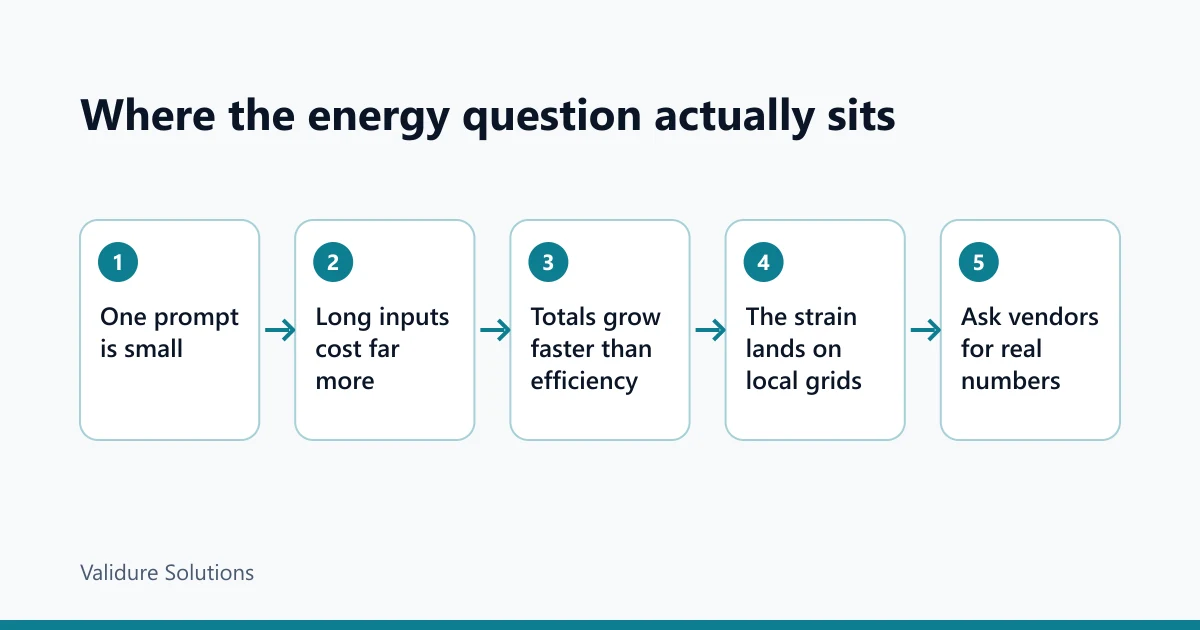
The two partners are measuring the same activity at two scales.
At the scale of one office, AI use is a rounding error next to cooling, lighting and commuting. At the scale of a country that is adding large data centre campuses, it's a planning problem for the grid, the water board and the climate target. Neither scale cancels the other.
| Claim | Status |
|---|---|
| A typical short text prompt uses roughly 0.2 to 0.35 Wh on current systems | Established for the operators that publish, with stated methods for two of three |
| Long inputs and reasoning-heavy answers cost many times more | Established in direction; exact multiples vary by model |
| Data centre electricity demand will roughly double by 2030 | Projection; the IEA's own range is wide |
| Efficiency gains will outrun demand growth | Contested; the evidence so far says no |
| Per-prompt figures from vendors are complete | Contested; they leave out training and hardware, and few vendors publish |
| An individual office should cut AI use to save energy | Our opinion: not a strong lever on its own |
A position, labelled
This is our opinion, not settled fact.
For a small business, guilt per prompt is the wrong frame. The office arithmetic is clear, and a ban gives up real time saved for almost nothing. If you want your AI use to cost less energy, three habits do more than counting prompts: use the smallest model that does the job well, don't paste whole documents when a section will do, and stop rerunning a long job because the first answer was nearly right. They also cut your bill, which is why firms actually follow them.
At the system level, the worried side has the stronger case today. Totals are rising, concentrated and only partly disclosed. The fix there isn't individual restraint. It's disclosure, grid planning and the price of power, which regulators, utilities and large buyers can move and a 20-person firm can't.
Where we're unsure: nobody outside the operators knows the true mix of short and long queries, or how much reasoning-model use is growing. If long and reasoning-heavy jobs become the norm, the per-prompt picture changes, and so would our view of the office arithmetic.
When to care, and how much
| Your situation | What matters | What to do |
|---|---|---|
| Small office, ordinary chat and drafting | Almost nothing at grid scale | Use it; pick sensible defaults |
| Team running long documents or batch jobs every day | Input length and reruns | Trim inputs, cache results, use a smaller model where it's good enough |
| You're building a product that calls a model on every page view | Volume times length | Measure tokens per user action before launch; it's your cost line too |
| You report emissions to customers or under a scheme | Method and boundary | Ask vendors for per-unit figures and what they include; state your assumption |
| You're choosing where to host or which vendor to use | Grid mix and disclosure | Prefer a vendor that publishes figures and a method |
The checks, in one table
| Check | What to look for | What a hit means |
|---|---|---|
| What does the per-prompt figure include? | Chips only, or the whole facility | A chips-only number understates the real cost by about half or more |
| How long are your typical inputs? | Tokens sent, not prompts sent | Long inputs, not prompt counts, drive your use |
| How often are jobs rerun? | Same document sent three or four times | Fix the instruction, not the number of tries |
| Is the model bigger than the job needs? | A large model doing classification or short replies | A smaller model will usually do it for less power and less money |
| Does your vendor publish energy data? | A stated figure and method | No figure means you're estimating; say so in any report |
| Which grid serves the data centre? | Region named by the vendor | The same kWh can carry very different emissions |
Where we don't need a system
This is one of the few topics where you don't need software at all. A spreadsheet with four inputs (people, prompts per day, average input length, Wh per query) answers the office question in five minutes. If you're building something that calls a model at scale, log tokens per request from day one, because the energy line and the cost line are the same line.
Sources and checks
Checked on 7 November 2026.
- IEA, Energy and AI, executive summary and Energy demand from AI, for 415 TWh in 2024, around 945 TWh by 2030, accelerated server growth and the 2035 range.
- Google, Measuring the environmental impact of delivering AI at Google scale (arXiv 2508.15734), for 0.24 Wh, 0.10 Wh, 0.26 mL and the 33-fold fall. This is the operator's own paper about its own systems.
- Epoch AI, How much energy does ChatGPT use?, for the 0.3 Wh estimate and the long-input figures. This is an independent estimate, not a measurement.
- The OpenAI figure of about 0.34 Wh comes from a June 2025 blog post by the company's chief executive, with no published method. Treat it as a stated figure.
- Lawrence Berkeley National Laboratory, 2024 United States Data Center Energy Usage Report, for 4.4 per cent in 2023 and 6.7 to 12 per cent by 2028.
- Central Statistics Office Ireland, Data Centres Metered Electricity Consumption, for 22 per cent in 2024 and 5 per cent in 2015; the 2025 release gives 23 per cent.
- Google sustainability reports, for emissions against the 2019 baseline and data centre electricity growth. Google has since published a newer report; check it for the latest year.
- Central Electricity Authority, CO2 Baseline Database, Version 20.0, for the 0.727 tCO2/MWh weighted average for 2023-24. Later versions give lower figures for later years.
The office numbers are examples with assumed inputs. The opinion section is ours and labelled. This isn't engineering, legal or investment advice.
Frequently asked questions
Does one ChatGPT question use a bottle of water?
Not on the figures operators now publish. Google reports about 0.26 millilitres for its median text prompt, a few drops. Earlier outside estimates were 45 to 50 millilitres. Water use depends on the site's cooling and climate, so figures vary between operators and places.
Is an AI query really ten times a web search?
That claim rested on an old estimate of about 3 Wh per chatbot query. Current published and independent figures for a typical short text query are about a tenth of that. Long inputs and reasoning-heavy answers can still cost many times more.
Should our office limit AI use to save energy?
For ordinary chat and drafting, the saving is tiny. In our example, a 20-person firm's monthly chat use came to about 2 per cent of one air conditioner. If you want a real cut, trim long inputs, avoid repeated reruns and use smaller models where they're good enough.
If prompts got 33 times more efficient, why are emissions rising?
Because use grew faster. Cheaper prompts lead to more prompts, longer ones and AI added to more products. Per-prompt figures also leave out training, chip manufacture and construction, which sit in the indirect part of a company's footprint.
Which number should I use in an emissions report?
Use a figure your vendor publishes with a stated method, say what it includes, and multiply by your measured volume. If the vendor publishes nothing, say your figure is an estimate and give the source. Check the reporting rules that apply to you with your adviser.
Is AI's energy use a big deal or not?
Both, at different scales. For one office it's small. For grids adding large data centres, it's a planning problem: the IEA expects global data centre use to roughly double by 2030, and in Ireland data centres already take over a fifth of metered electricity.