Are AI agents ready to run business tasks unattended? Both sides, and the sums
By Validure team · · 14 min read
Vendors say agents can run whole processes on their own. The benchmarks say they still fail the same task on a second try. The strongest case for and against unattended agents, what the research and security guidance actually say, a worked cost comparison, and a way to remove human approval one action at a time.

Say a 40-person trading company has had an AI agent drafting replies to dealer enquiries for two months. A person reads each draft before it goes, and the drafts are good. Then someone in accounts asks: if it's this good, why not let it chase overdue invoices on its own, and release the supplier payments that match a purchase order?
One side says agents are ready and approval is just a person clicking "yes" all day. The other says agents fail in ways nobody predicted, and one bad payment wipes out a year of saved time.
Our view, labelled as opinion below: both are right about different actions. "Is the agent ready?" is the wrong question. "Is this action ready?" is one you can answer. This post sets out both cases at full strength, a worked comparison you can redo, and a way to remove approval in steps.
Where we stand: we build business software and use AI tools ourselves, so we have an interest in AI being useful. We also support systems after things go wrong, which makes us cautious.
What "unattended" actually means
Anthropic's guide on building agents draws a line we'll use. A workflow joins a language model and tools through fixed code paths that a person wrote. An agent decides its own steps and which tools to call. Unattended is a separate question: nobody approves an action before it happens. So there are four combinations, with very different risk:
| A person approves each action | Nobody approves before it happens | |
|---|---|---|
| Fixed workflow with a model step | Low risk, slow | The common sweet spot for routine work |
| Agent choosing its own steps | Useful for exploring, tiring for the reviewer | The one the argument is about |
The bottom right box is what vendors mean when they say an agent "runs the process".
The case for letting agents run (at full strength)
First, approval is often theatre. A reviewer who sees 300 drafts a day and finds a problem in two of them stops reading carefully long before the end. You pay for their time without getting the checking you think you're getting. A proper sample, read by someone who isn't tired, may catch more.
Second, the capability trend is real and fast. METR, a research group, published a study in March 2025 tracking the length of tasks (in skilled-person time) that AI agents complete with 50 per cent success. That length had doubled roughly every seven months for six years. What an agent can't do today, the argument goes, it will probably do next year.
Third, many business actions are cheap to undo. A draft can be rewritten, a ticket re-routed. If a mistake costs ten minutes of someone's time, approving every action costs more than the mistakes do.
Fourth, people make errors too. Payments get released twice by hand, invoices get keyed with a digit swapped. The fair comparison is the agent against your current error rate, not against perfection.
The case against (also at full strength)
First, agents are inconsistent, and the best-known benchmark shows it. The τ-bench paper (Yao and others, 2024) tested agents on customer-service tasks with tools and written policies, like a retail returns desk. State-of-the-art function-calling agents, gpt-4o among them, succeeded on fewer than half the tasks, and succeeded on the same retail task eight times in a row under 25 per cent of the time. The second number matters more for unattended work, because your agent runs the task every day.
Second, errors compound over steps. Anthropic's guide warns of higher costs and "the potential for compounding errors", and recommends extensive testing in sandboxed environments with guardrails.
Third, agents can be steered by what they read. This is prompt injection: an instruction hidden in an email, web page or document that the agent treats as a command. OpenAI wrote in December 2025, about its own browser agent, that prompt injection, like scams and social engineering, is unlikely to ever be fully "solved". An agent that reads supplier emails and can release payments is exactly the setup an attacker wants.
Fourth, the security guidance says to keep a person on high-impact actions. The OWASP Top 10 for LLM Applications (2025 edition) lists "Excessive Agency" as a risk with three causes: too much functionality, too many permissions and too much autonomy. Its controls: a human approves high-impact actions, the agent gets only the tools and permissions it needs, and the downstream system enforces authorisation instead of trusting the model.
Fifth, accountability doesn't move to the software. If an agent pays the wrong supplier, the business answers for it, just as it does when a chatbot promises a customer something wrong.
What's established, what's argued, what's opinion
Established: current agents are measurably inconsistent on multi-step tasks with tools, and repeat success is lower than single-run success (τ-bench, and later papers that use its pass^k measure). Prompt injection is an open problem that the largest vendors say they can reduce but not eliminate. The main security guidance (OWASP) recommends human approval for high-impact actions and least privilege for tools.
Argued over: how fast reliability will improve. The METR trend is about the length of tasks at 50 per cent success, mostly on software and research tasks. A 50 per cent success rate is nowhere near good enough for releasing payments, and the trend for 99 per cent reliability on messy business data is far less clear. Some read the trend as "wait a year"; others think the last few per cent of reliability is the slow part. Nobody knows yet.
Our opinion: decide per action, and remove approval only when your own logs show that action is reliable on your own data.
Why "it worked when we tried it" isn't evidence
Two pieces of arithmetic show why a good demo or a good week misleads.
Repeat success. Say an agent completes a task correctly 80 per cent of the time, independently each run. The chance it gets the task right eight times in a row is 0.8 to the power 8:
0.8 x 0.8 = 0.64, x 0.64 = 0.4096, x 0.4096 = 0.1678
So about 17 per cent. Run it eight times and you'll more likely than not see a failure. That's the gap τ-bench measures with pass^k, the chance that all k tries succeed, as opposed to pass@k, the chance that at least one does. A demo shows you pass@k. Unattended work needs pass^k.
Steps multiply. Say each step of a ten-step process is right 95 per cent of the time, independently. The whole process is right 0.95 to the power 10 of the time:
0.95 squared = 0.9025; to the 4th = 0.8145; to the 5th = 0.7738; to the 10th = 0.7738 x 0.7738 = 0.5987
So just under 60 per cent of runs are fully correct, though every step looks good. At 99 per cent per step, ten steps come to about 90.4 per cent. Real steps aren't perfectly independent, so treat these as the direction, not a forecast: a long chain of "pretty good" steps is not a reliable process.

A worked comparison: two actions, same agent
Here's the calculation we'd do for the trading company in the opening. The numbers are an example, not data from any business; replace them with your own.
The formula for each action:
Expected monthly loss without approval = volume x error rate x cost per error x share you can't undo
Monthly cost of approval = volume x minutes per review / 60 x cost per hour of the reviewer
Action A: drafting replies to dealer enquiries.
| Input | Example value |
|---|---|
| Volume | 600 replies a month |
| Error rate (from two months of logs) | 3 per cent, so 18 replies |
| Cost per error | 200 rupees (a correction email and someone's time) |
| Share you can't undo | Close to all of it is fixable, but call the cost real |
| Loss without approval | 18 x 200 = 3,600 rupees |
| Review time | 1.5 minutes each, 900 minutes, 15 hours |
| Approval cost at 300 rupees an hour | 15 x 300 = 4,500 rupees |
Approval costs more than the mistakes it prevents. Replace it with a daily sample: 20 at random, plus every reply that mentions price, credit or a complaint.
Action B: releasing supplier payments that match a purchase order.
| Input | Example value |
|---|---|
| Volume | 400 payments a month |
| Error rate | 1 per cent, so 4 payments |
| Cost per error | 40,000 rupees average payment |
| Share you can't undo | Say half is never recovered, 0.5 |
| Loss without approval | 4 x 40,000 x 0.5 = 80,000 rupees |
| Review time | 2 minutes each, 800 minutes, about 13.3 hours |
| Approval cost at 300 rupees an hour | 800 / 60 x 300 = 4,000 rupees |
Here approval costs a twentieth of the expected loss, before counting prompt injection, where a fake "updated bank details" email turns an error into theft. Keep the person. Let the agent match and prepare the batch, and have a person release it.
Same agent, same month, opposite answers.
A decision table for each action
| Action looks like this | Undo is | Our default |
|---|---|---|
| Reading, searching, summarising, drafting for a person | Free | Unattended, with spot checks |
| Classifying or routing (tickets, documents, leads) | Cheap | Unattended once logs show steady accuracy; sample weekly |
| Writing to your own records (status, tags, notes) | Possible if logged | Unattended only with an audit trail and a way to roll back |
| Sending anything to a customer, supplier or regulator | Hard, it's been read | Approval, or a narrow template with sampling |
| Moving money, changing bank details, deleting data | Often impossible | Always a person, enforced by the system, not the prompt |
| Anything triggered by content from outside (emails, web pages, uploaded files) | Varies | Treat as untrusted; no high-impact action without approval |
The last row overrides the others. An agent that only reads your own records is far safer than one that reads incoming email, because incoming email is where injected instructions arrive.
How to remove approval, one action at a time
It's slower than switching everything on, and it's how you find out which actions are ready.
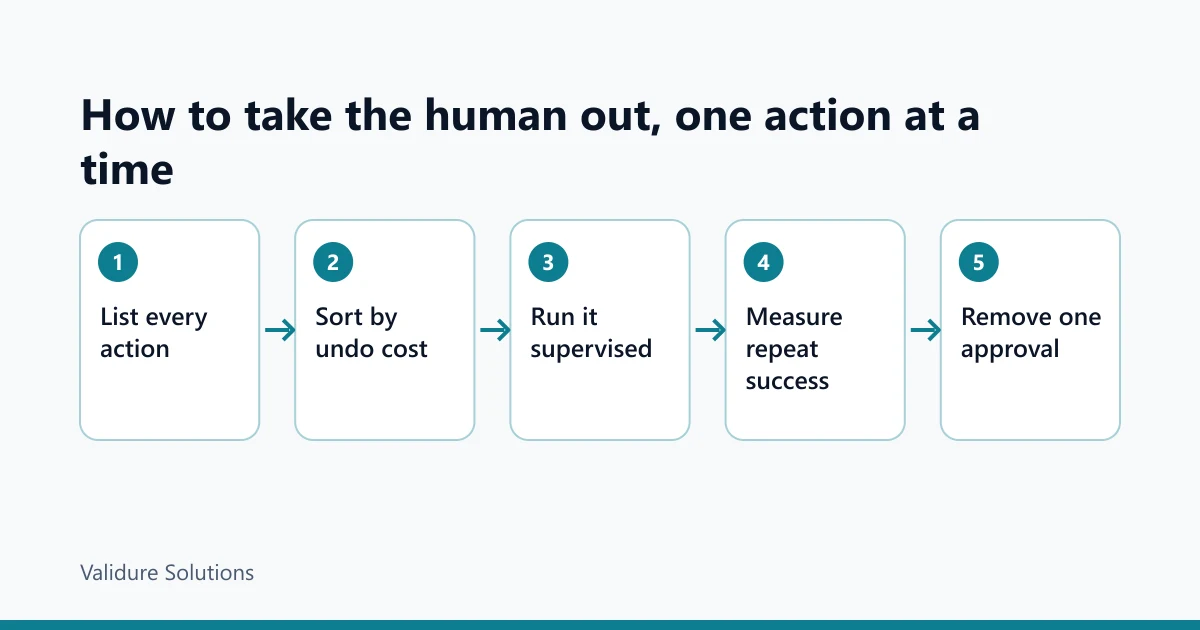
- List every action the agent can take. If it's hard to list, it has too many tools; cut them first, which is what OWASP means by limiting functionality.
- Give it the narrowest permissions that work. A reconciliation agent needs to read bank lines and purchases, not create suppliers. Give it its own user and role, so the system, not the prompt, refuses what it shouldn't do.
- Run it supervised for a few weeks and log the proposed action, the approved action and any edit. Edits are your error rate.
- Group the log by type of case and look at how often each type was right every time, not at least once.
- Remove approval for one action, the one with the cheapest undo and the best record. Replace it with sampling and an alert on anything unusual: an amount above a limit, a new counterparty, out-of-hours activity.
- Re-check after every model or prompt change. A new model version starts at "error rate unknown".
A checklist for the weekly review after step 5:
| Check | What to look for | What a hit means |
|---|---|---|
| Sampled actions this week | Any wrong action in a random sample of 20 to 50 | Put approval back for that action until you know why |
| Actions on new counterparties | First-time suppliers, customers or accounts touched by the agent | Possible manipulation or a gap in the rules |
| Volume against last month | A sudden rise in actions per day | A loop, a bug, or someone feeding it work it shouldn't get |
| Actions the system refused | Permission errors in the log | The agent tried something outside its role; find out what led it there |
| Model or prompt version | Any change since the last review | Your measured error rate no longer applies |
The audit trail is the part people skip, and it makes the rest possible. Validure ERP keeps a full audit trail of entries, so an agent working under its own login shows up as itself; any system that logs changes per user does the same job.
The agent prepares, a person commits
The uses that hold up without approval share one trait: the undo is free or the action never leaves the building. Overnight reconciliation that leaves exceptions for a person in the morning. Sorting incoming bills or CVs into queues. First drafts of anything a person then sends. That split gets you most of the time saved without the payment risk.
HR works the same way. An agent can draft a leave reply or flag an attendance gap, but approving leave should sit with a named person. Validure HR's role-based permissions fit that: an automated helper can hold a role that reads and drafts but can't approve.
When you don't need an agent at all
Many tasks pitched as "agentic" are fixed sequences: download the bank file, match on amount and reference, flag the leftovers. A script or your software's built-in rules do that cheaper and the same way every time. Anthropic's guide says the same: start with the simplest solution. And if a person handles 30 of something a month in an hour, an agent saves less than its setup and checking cost.
Where we'd land today (opinion)
Agents are ready to run unattended for actions that are cheap to undo, don't leave the business and don't take instructions from outside content. They are not ready to move money, change master data or talk to customers alone; the benchmarks, the security guidance and the vendors' own statements agree. That may change. But "it will be ready next year" is a reason to keep good logs now, not to switch approval off today.
Sources and checks
Checked on 24 November 2026. Benchmarks and vendor guidance change; re-check before relying on a specific number.
- τ-bench: A Benchmark for Tool-Agent-User Interaction in Real-World Domains, Yao and others, 2024: arxiv.org/abs/2406.12045
- OWASP Top 10 for LLM Applications 2025, LLM06 Excessive Agency: genai.owasp.org
- Anthropic, Building effective agents (workflows versus agents, compounding errors, starting simple): anthropic.com
- OpenAI, Continuously hardening ChatGPT Atlas against prompt injection, December 2025: openai.com
- METR, Measuring AI ability to complete long tasks, March 2025: metr.org
The cost comparison uses example figures, not data from any business. Redo it with your own volumes, error rates and review times.
Frequently asked questions
Can an AI agent run a business process with no human approval?
For actions that are cheap to undo and stay inside the business, such as drafting, sorting, summarising and flagging, yes, with sampling and logs. For moving money, changing bank details, deleting data or messaging customers, current benchmarks and security guidance both say to keep a person approving.
What is pass^k and why does it matter?
It's the chance that an agent succeeds on all of k tries at the same task, introduced in the τ-bench paper. Unattended work repeats every day, so repeat success matters more than whether the agent can do the task once. An agent that's right 80 per cent of the time gets eight in a row right only about 17 per cent of the time.
Isn't human approval just a rubber stamp?
It can be, when one person approves hundreds of low-risk items a day. That argues for sampling low-risk actions properly and keeping approval on the few high-impact ones, where a reviewer can actually read them.
What is prompt injection, in plain words?
Instructions hidden in an email, web page or PDF that the agent mistakes for yours. OpenAI says it is unlikely ever to be fully solved, so limit what an agent can do after reading outside content.
How do we stop an agent doing something it shouldn't?
Few tools, narrow permissions, its own user and role, and systems that refuse what the role doesn't allow. Don't rely on the prompt. Log every action.
When will agents be reliable enough to leave alone?
Nobody knows. Capability is rising fast, but most measurement is at 50 per cent success on software tasks. Keep logs now so your own records show when a specific action is ready.