Are OTA commissions worth it for a small hotel? The maths, and both sides
By Validure team · · 15 min read
A worked break-even for small Indian hotels paying 15 to 25 per cent to booking sites. What a commission really costs after GST at 5 per cent without input credit, how to tell new guests from guests you would have had anyway, what the CCI said about parity clauses, and where we land.

It's the first week of the month at a 12-room hotel, and the owner is looking at last month's statement from the booking sites. The commission line, with GST on top, is bigger than the electricity bill and the laundry bill put together. The obvious thought follows: what if we turned the OTAs off and kept that money?
Some owners who try it get a quiet month and switch the listings back on. Others find their regulars kept booking directly. Which one you get depends on a number most small hotels never work out: how many of the guests who come through an OTA would never have found you otherwise.
This post works that number out with an example, puts both sides at full strength, and says where we land. We build hotel software, including Validure HMS, so we have an interest in hotels running their own bookings. We've kept that out of the maths.
What a commission actually costs you
Start with the rate. Indian hotel-software and consulting guides commonly report OTA commissions in the range of 15 to 25 per cent of the booking value, with extra points for visibility or "preferred" programmes. Those are industry reports, not published tariffs. Your own rate is in your contract and on your monthly statement, and it's the only number that counts. Check one more thing in the contract while you're there: whether commission is worked out on the room price before GST or on the total the guest paid. The two give different sums.
Then add GST. The OTA charges 18 per cent GST on its commission, which most hotels used to take credit for. From 22 September 2025, following the 56th GST Council meeting, hotel rooms priced up to 7,500 a night are taxed at 5 per cent without input tax credit (rooms above that stay at 18 per cent with credit; check the notification for the exact boundary if your rate sits right at 7,500). Without input credit, the GST you pay on services used for those rooms stops being recoverable. The commission GST is one of those services, so for most budget and mid-range hotels it's now a straight cost. That's our reading and the common practitioner reading; confirm it for your own registration with your CA.
So the true cost of a commission for a hotel in the 5 per cent bracket looks like this.
| Item | Example: room sold at 3,000, commission 18% on the room price |
|---|---|
| Commission | 3,000 x 18% = 540.00 |
| GST on commission, not recoverable | 540 x 18% = 97.20 |
| Cost of the booking to you | 637.20, which is 21.24% of the room price |
Two other deductions on the statement aren't costs, if you claim them. OTAs collect GST TCS under section 52 of the CGST Act at 0.5 per cent of the net value (the rate since 10 July 2024; it was 1 per cent before), and deduct income-tax TDS at 0.1 per cent on the gross amount (the rate since 1 October 2024). On 4,20,000 of OTA bookings in a month, that's 2,100 of TCS and 420 of TDS. Both come back as credits, but only if they reach your GST cash ledger and tax statement, so match them monthly.
The question that decides it: was the guest new?
A commission only hurts when it's paid on a guest you'd have had anyway. When the OTA brings a guest who would otherwise never have stayed, you're paying a share of revenue you'd never have earned, for a room that would have been empty.
So there are two kinds of OTA booking.
- An incremental booking: a guest who found you only because you were listed. The room would have been empty.
- A displaced booking: a guest who would have booked with you directly (they stayed before, they drove past, a friend told them) but happened to book through the app.
Here's the maths for each, using the same example. The direct booking isn't free: say a payment gateway fee of 2 per cent plus GST, and about 150 per booking of marketing (a website, a booking engine, some search ads). The room itself has a cost once it's sold: say 700 for housekeeping, laundry, power, water and breakfast. All of these are example numbers; put in your own.
| Per room night, example | Value |
|---|---|
| Room price | 3,000.00 |
| Cost of a sold room (housekeeping, laundry, utilities, breakfast) | 700.00 |
| OTA cost (commission plus unrecoverable GST) | 637.20 |
| Direct cost: gateway 3,000 x 2% = 60, plus GST 10.80, plus marketing 150 | 220.80 |
| Gain from an incremental OTA booking: 3,000 - 700 - 637.20 | 1,662.80 |
| Loss from a displaced OTA booking: 637.20 - 220.80 | 416.40 |
The gain from a new guest is four times the loss from a displaced one, which is why OTAs make sense for most small hotels most of the time.
The break-even share
Call p the share of your OTA bookings that are genuinely incremental. The OTA pays for itself when
p x 1,662.80 is greater than (1 - p) x 416.40
which works out to p greater than 416.40 / (1,662.80 + 416.40) = 416.40 / 2,079.20, or about 20 per cent.
So if more than one OTA guest in five would never have found you, the channel earns its commission. That's a low bar, but it's an average, and the average hides the dates when it fails.
The same sum in a slow month
Say the off-season rate drops to 1,800. Commission is 324.00, unrecoverable GST 58.32, total 382.32. The direct cost is 36.00 gateway plus 6.48 GST plus 150 marketing, so 192.48. An incremental booking gains 1,800 - 700 - 382.32 = 717.68. A displaced one loses 382.32 - 192.48 = 189.84. The break-even is 189.84 / 907.52, about 21 per cent. Nearly the same.
What changes with the season isn't the break-even, it's p. Off-season, most OTA guests are people you'd never have reached. On a festival weekend you'd sell out anyway, p for the last few rooms is close to zero, and each of those bookings costs you about 416.
A month in the life of a 12-room hotel
Take a whole month of the same example hotel. 12 rooms x 30 nights = 360 room nights. It sells 234 (65 per cent occupancy) at an average of 3,000: 7,02,000 of room revenue. 140 nights come through OTAs and 94 direct.
The OTA cost is 140 x 637.20 = 89,208, or 12.7 per cent of all room revenue. That's the figure that makes owners want to switch off.
Now picture two different next months. In one, the hotel moves 30 of its OTA bookings to direct: past guests and phone enquiries nudged to the hotel's own booking route instead of the app. That saves 30 x 416.40 = 12,492. In the other, the hotel delists, and 50 of its OTA guests turn out to have been incremental and simply don't come. That loses 50 x 1,662.80 = 83,140.
The first move is almost free money. The second can cost six times as much as the first one saves. Most of the argument about OTAs comes down to confusing these two.
The case for paying OTAs
Here it is at full strength.
A small hotel can't buy reach any cheaper. Building a brand that a traveller from another city or another country will search for takes years and a marketing budget most 12-room hotels don't have. The OTA is paid only when someone actually stays (or, under some policies, cancels late), so the hotel carries no risk for empty advertising.
Listing also seems to send guests to your own channels. Research by Chris Anderson at Cornell's School of Hotel Administration found what he called the billboard effect: hotels listed on Expedia saw more bookings through their own channels, between 7.5 and 26 per cent more for the four hotels in his 2009 study, because travellers found them on the OTA and then booked direct. A 2017 update by Anderson and Saram Han found the effect was still there, though smaller in that data set. These are US studies with modest samples, so treat the size of the effect as uncertain for Indian hotels. The direction is well supported: some of your direct bookings are OTA bookings that didn't pay commission.
OTAs also collect prepaid money, run reviews a new hotel can't build alone and take customer calls at 2 am. A small hotel would pay for each of those separately.
The case against
Also at full strength.
The commission is large and growing in practice. Guides report that higher placement costs extra points, and promotions that the platform runs are often funded from the hotel's rate. On top of that, the change to 5 per cent GST without input credit has turned the GST on commission into a cost for most budget and mid-range hotels.
The OTA owns the relationship. The guest's contact details may be masked or limited, so the hotel can't easily invite a happy guest back directly. Every return visit through the app pays commission again, and those are exactly the displaced bookings that cost 416 each in the example.
Dependence is a risk too: when one platform brings most of your bookings, its changes in ranking or terms hit your income directly.
And hotels have had real problems with contract terms. In October 2022 the Competition Commission of India found that MakeMyTrip and Goibibo had abused a dominant position, including through price and room-availability parity clauses that stopped hotels offering lower prices or more rooms on other channels. It imposed a penalty of 223.48 crore on MakeMyTrip-Goibibo and 168.88 crore on OYO, and directed MakeMyTrip-Goibibo to drop those parity obligations with respect to other OTAs. The companies appealed to the NCLAT and the case was still pending when we checked, so the findings aren't final. The CCI also drew a line between "wide" parity (across all channels) and "narrow" parity (only against the hotel's own website), and saw narrow parity as justifiable in some circumstances. In plain words: an OTA's contract may still restrict how much cheaper your own public website can be. Read your current contract rather than assuming.
What's established, what's argued, and what we think
Established. Commission plus GST is a real cost, largely unrecoverable in the 5 per cent bracket. New guests are worth far more than displaced ones cost. The CCI parity order exists and is under appeal. The billboard effect has been measured in published research.
Argued. How big the billboard effect is in India today, how many OTA guests are incremental for a given hotel, and how far rankings reward commission and discounts. We haven't seen Indian data we'd trust on these, so we won't put a number on them.
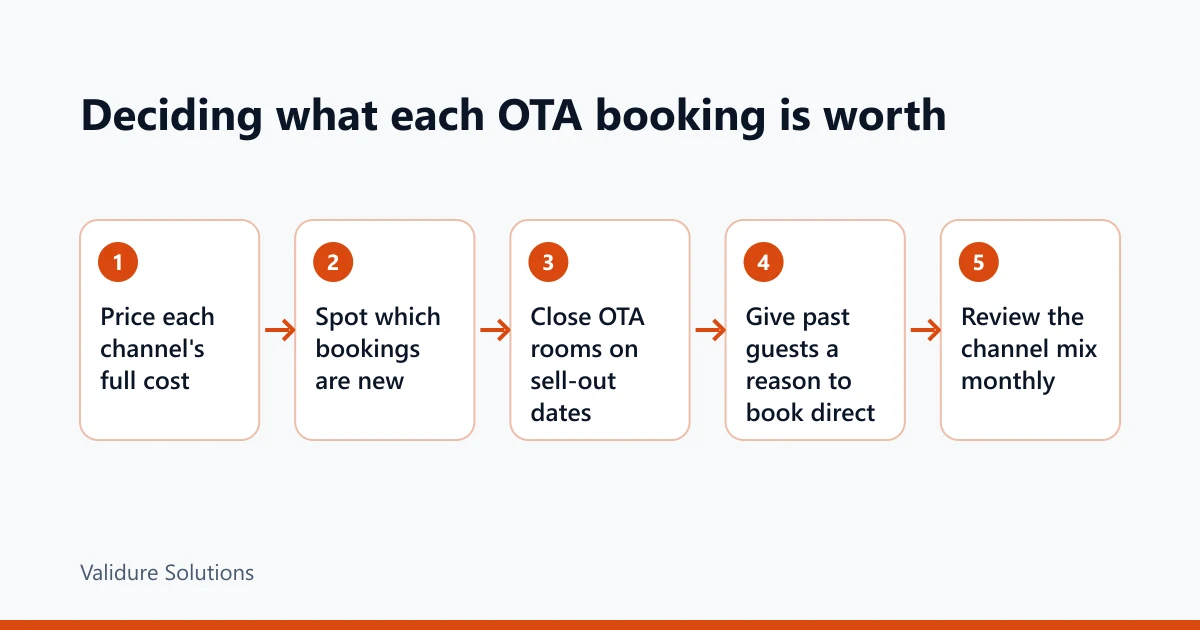
Our opinion, labelled as such. For a small independent hotel, switching OTAs off is usually the wrong fight. The better fight is to stop paying commission on guests who are already yours, and to stop selling your last rooms on the busiest nights through the most expensive channel.
How to tell new guests from guests you'd have had
You can't know p exactly, but you can get a usable estimate from your own records.
| Check | What to look for | What a hit means |
|---|---|---|
| Repeat guests booking through an OTA | Same name and phone in an earlier stay | A displaced booking; invite them direct next time |
| Local or corporate guests on OTAs | Guests from your own city, or from companies you already serve | Likely displaced; offer them a direct rate or a corporate arrangement |
| OTA share by date | OTA bookings on dates you sold out | On sell-out dates, many of these were displaceable |
| Direct bookings that mention the app | Guests who say they "saw you on" an OTA | Billboard effect; the OTA is earning part of your direct business |
| Lead time | OTA bookings made months ahead vs last-minute | Last-minute OTA bookings in low season are often truly new |
| Cancellations by channel | Cancellation and no-show rates per OTA | A cheap channel with high cancellations may cost more than it looks |
None of this needs special software: a register with the source, phone number and date of every booking is enough, as long as the source is recorded every time, walk-ins and phone bookings included. If your property system keeps guest profiles across stays, as Validure HMS does, finding repeat guests who came back through an OTA becomes a quick search rather than a manual hunt through registers.
What to actually do
| Situation | Our suggestion | Why |
|---|---|---|
| New hotel, few reviews, off-season | Stay on OTAs, even at a higher commission | Almost every booking is incremental |
| Dates you will sell out | Close OTA availability for the last few rooms, if your contract allows | Those bookings are mostly displaced |
| Repeat and corporate guests | Give them a direct booking route and a reason: a better room, breakfast, late checkout | Moves displaced bookings to your cheapest channel |
| Paying extra points for visibility | Test it for a month, then compare incremental bookings with the extra cost | Visibility is worth it only if it brings new guests |
| One OTA brings most of your business | Add a second OTA and your own booking engine slowly | Lowers dependence without losing reach |
| You can't track the source of bookings | Fix the register first | Without it, every decision here is a guess |
Closing OTA rooms on some dates, and giving repeat guests a better deal than the public OTA price, can touch parity terms, so check each contract. Benefits such as breakfast or an upgrade, rather than a lower public price, are the usual way round it.
When the guest does book direct, make it easy to pay. A payment link sent from the folio does the job without a full booking engine; Validure HMS supports folio billing with GST and cash, UPI, card or link payments, so a phone booking can be confirmed with money in hand.
Who this isn't for: a hotel that's full most nights from long-standing corporate contracts or a pilgrimage crowd that books by phone doesn't need much OTA business, and probably knows it already. And a new property with no reviews shouldn't be cutting OTAs at all.
Sources and checks
Checked on 22 November 2026. Rates and rules change; confirm against the current text before acting.
- Competition Commission of India, order of 19 October 2022 in Case Nos. 14 of 2019 and 01 of 2020 (FHRAI and others against MakeMyTrip-Goibibo and OYO): cci.gov.in
- GST rate on hotel accommodation from 22 September 2025, Notification 15/2025-Central Tax (Rate), and CBIC FAQs on the rate changes: cbic-gst.gov.in and gstcouncil.gov.in
- Section 52 of the CGST Act (TCS by e-commerce operators) and Notification 15/2024-Central Tax on the 0.5 per cent rate: cbic-gst.gov.in
- TDS on e-commerce operators at 0.1 per cent from 1 October 2024 (Finance (No. 2) Act, 2024): incometaxindia.gov.in
- Chris K. Anderson, "The Billboard Effect: Online Travel Agent Impact on Non-OTA Reservation Volume", Cornell Hospitality Report, 2009, and the 2017 update with Saram Han: ecommons.cornell.edu
- OTA commission ranges are from industry and software-vendor guides, not official tariffs. Use the rate in your own contract.
This is information, not tax or legal advice. GST treatment, especially of input credit, depends on your registration and the mix of rooms you sell; check with your CA. Contract questions about parity belong with a lawyer who reads your actual agreement.
Frequently asked questions
How much commission do OTAs charge hotels in India?
Industry guides commonly report 15 to 25 per cent of the booking value, with extra points for visibility programmes. These aren't published tariffs. Your rate is in your contract and statement, and you should check whether it's charged on the price before or after GST.
Can a hotel on 5 per cent GST claim credit for the GST on OTA commission?
For rooms taxed at 5 per cent without input tax credit, which is rooms up to 7,500 a night from 22 September 2025, the common reading is no: the GST on services used for those rooms, including commission, becomes a cost. Hotels that also sell rooms above 7,500 at 18 per cent apportion credit. Confirm your case with your CA.
Can an OTA stop me selling cheaper on my own website?
The CCI found MakeMyTrip-Goibibo's wide price and room parity clauses anti-competitive in 2022, and that order is under appeal. It treated narrow parity, which only restricts the hotel's own website, as justifiable in some circumstances. Your own contract decides what applies, so read it or ask a lawyer.
Should a small hotel stop using OTAs?
Usually not. In our worked example an OTA pays for itself if about one in five of its guests would never have found the hotel otherwise. The better move is to bring repeat and local guests to direct booking and to hold back the last rooms on dates you'll sell out.
What is the billboard effect?
It's the finding, from Cornell research by Chris Anderson, that being listed on an OTA increases bookings through the hotel's own channels, because travellers discover the hotel on the OTA and then book direct. The size of the effect varies and hasn't been measured well for Indian hotels.