The hotel asked for more at check-in than the OTA price. Who is right?
By Validure team · · 14 min read
Why the amount at a hotel front desk can differ from the price an OTA showed, which extra charges are legitimate and which are drip pricing under the CCPA dark patterns guidelines, the GST maths at the 7,500 rupee line, and what guests and hotels should each do.
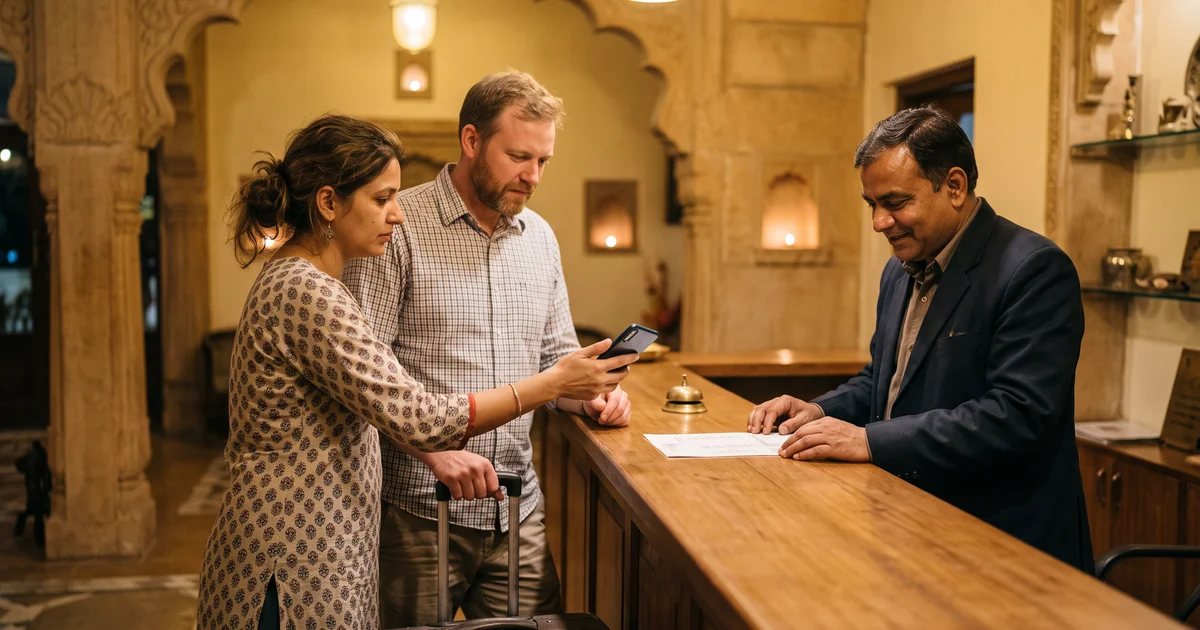
It's 10 pm at a 30-room hotel in Udaipur. A couple walks in with a confirmation on their phone: two nights, 3,800 a night, "pay at hotel". The night manager prints the bill and it says 7,980, not 7,600. The guest says the app showed 7,600. The manager says GST is extra. The guest says nobody told them. Both are tired, a queue is forming, and whoever gives in will feel cheated.
Sometimes the hotel is right. Sometimes it's the OTA's screen that misled the guest. And sometimes the hotel is trying it on. The way to tell them apart is to read the confirmation carefully, do the sums, and know which charges the rules allow to appear late and which they don't.
This post is for both sides of that desk: the guest who wants to know whether to pay, and the hotel that wants to stop having this argument at 10 pm. We build hotel software, so we have an interest in how hotels bill. It's information, not legal or tax advice; for a specific dispute, talk to a consumer lawyer, and for GST, your adviser.
The short answer
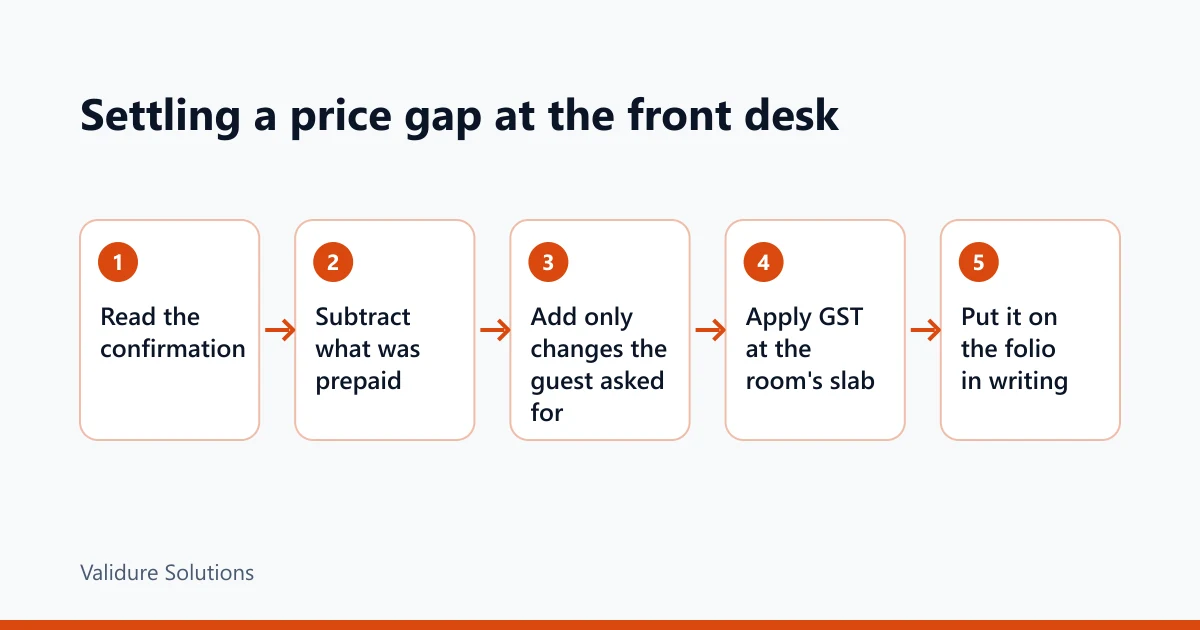
The amount you owe at the desk is what your confirmation says you owe, minus anything you already paid, plus charges for things you changed or asked for after booking. That's it. Everything else is either a mistake or a problem between the hotel and the OTA that the guest shouldn't be asked to fund.
Written as a formula:
Due at desk = confirmed total − amount already paid + charges for changes the guest requested
The disagreements come from three places: the confirmed total wasn't clear (taxes shown as "payable at property" in small print), the guest changed something (an extra adult, early check-in), or the hotel and the OTA disagree about money between themselves.
What the rules say about the price you were shown
Two sets of rules matter here, both made under the Consumer Protection Act, 2019.
The Consumer Protection (E-Commerce) Rules, 2020 require a seller on a marketplace to give the platform the total price in a single figure, with a breakup showing compulsory and voluntary charges and the applicable tax, for display to the buyer. A hotel listed on an OTA is a seller on a marketplace for this purpose. So the total, including tax, is supposed to be visible before you book.
The Guidelines for Prevention and Regulation of Dark Patterns, 2023, notified by the Central Consumer Protection Authority on 30 November 2023, list "drip pricing" as one of 13 dark patterns. Read the official text for the exact wording, but in plain terms it covers hiding parts of the price until later, revealing the price only after the purchase is confirmed, and charging more than the amount disclosed at checkout. There's a carve-out for marketplaces when a third-party seller changes the price or the change is outside their control, which matters for who you complain to, not for whether the guest should pay.
Neither says a hotel can never charge more than the first number on the screen. Add a third adult at the desk and you're buying something different. What they say is that the price of what you booked must be disclosed upfront.
GST at the desk, with the numbers
Most "they charged me more" stories are about GST. Since 22 September 2025, after the 56th GST Council meeting and Notification 15/2025-Central Tax (Rate), hotel rooms are taxed in two slabs:
| Value of the room per night | GST | Input tax credit for the hotel |
|---|---|---|
| 7,500 rupees or less | 5 per cent | Not available |
| Above 7,500 rupees | 18 per cent | Available |
The slab follows the actual price charged for the room per night, not a tariff card on the wall. A couple of commentators read the boundary differently at exactly 7,500; check the notification text if your rate sits right on it.
Example 1: pay at hotel, taxes "payable at property"
This is the Udaipur booking, as an example. Two nights at 3,800 a night, booked on an OTA with nothing paid upfront.
| Line | Amount |
|---|---|
| Room, 2 nights x 3,800 | 7,600 |
| GST at 5 per cent | 380 |
| Total at the desk | 7,980 |
If the confirmation showed 7,980 as the total, or 7,600 with a clear "plus taxes of 380 payable at the property", the hotel is right and the guest owes 7,980. If the OTA showed 7,600 as the price to pay with no tax line, the guest was shown an incomplete price. The hotel still has to charge GST, because the tax is owed on the room, but the gap of 380 is a disclosure failure, and the place to raise it is with the OTA, which displayed the price.
Our view: a guest in that position should pay what's lawfully due on the room, ask for a proper GST invoice, and then complain to the OTA with a screenshot. Refusing to pay tax that's really owed rarely ends well at 10 pm.
Example 2: an extra adult that moves the room into 18 per cent
Say a room is booked at 7,200 a night for two adults, and three adults arrive. The hotel's extra-adult charge is 800 a night.
| As booked | With the third adult | |
|---|---|---|
| Room value per night | 7,200 | 8,000 |
| GST rate | 5 per cent | 18 per cent |
| GST per night | 360 | 1,440 |
| Total per night | 7,560 | 9,440 |
The extra adult costs 800, but the bill per night rises by 1,880, because the whole value crossed 7,500 and the higher rate now applies to all of it. That surprises guests and front-desk staff alike. Several tax commentators say compulsory charges that are part of the same accommodation, such as a required extra bed, count in the room's value for the slab. That's a secondary-source reading, not a circular we could find, so confirm it with your GST adviser before you rely on it.
Two things follow. If the guest booked for two and brought three, the extra charge is legitimate, provided the hotel's extra-person rate was disclosed in the listing. If the guest booked for three and the OTA priced it for two, that's a listing or booking error, and it belongs with the OTA.
If a price is quoted "inclusive of taxes"
Some hotels quote all-in prices. To find the tax inside an inclusive price, use price x rate / (100 + rate). At 5 per cent, 7,980 x 5 / 105 = 380, which leaves 7,600 as the room value. If a hotel quotes an inclusive price and then adds GST again on top, that's a double charge, and it's an easy one to prove with the invoice.
Which extra charges are fair, and which aren't
Here's how we'd sort the usual surprises. The test in every row is the same: was it disclosed before booking, and did the guest ask for it?
| Charge at the desk | Fair when | Not fair when |
|---|---|---|
| GST on a pay-at-hotel booking | The confirmation shows the tax, or the total including it | The OTA showed a total with no tax and the hotel adds it as a surprise (pay the tax, complain to the OTA) |
| Extra adult or child | More guests arrive than were booked, and the rate was in the listing | The booking already had the right number of guests |
| Early check-in or late checkout | The guest asks for it and is told the price first | It's added without being asked for |
| Compulsory meal or gala dinner on festival dates | Shown as compulsory in the listing before booking | Introduced at the desk |
| Refundable security deposit | A receipt is given and it's returned at checkout | It's kept without a reason in writing |
| "The OTA hasn't paid us" | Never the guest's problem on a prepaid booking | Always unfair to ask the guest to pay twice |
| "The rate was loaded by mistake" | The hotel honours it and fixes the rate for future bookings | The guest is asked to pay the difference |
The last two rows deserve their own section, because they cause the worst arguments.
"The OTA didn't pay us"
As an example: a guest pays an OTA 6,300 for two nights at 3,000 plus 5 per cent GST. At the desk the hotel says it hasn't received the money and asks for 6,300 again.
The guest has paid. How and when the hotel gets the money, by bank transfer after checkout or a virtual card it charges itself, is set by the OTA's terms with the hotel and isn't the guest's concern. The guest should show the confirmation and payment record, call the OTA from the desk, and refuse to pay twice. If the hotel won't let them in, get the refusal in writing and ask the OTA to rebook or refund.
For the hotel, the fix is the evening before. Prepaid OTA bookings usually show their payment method in the extranet, often a virtual card valid only from a certain date. Check tomorrow's prepaid arrivals tonight and call the OTA about any that look unpaid.
"The rate was a mistake"
If 4,500 was meant and 1,500 was loaded, it's tempting to ask the guest for the difference. Usually that's the hotel's loss. The guest booked the price they were shown, and charging more than the amount disclosed at checkout is what the drip pricing guideline describes. OTA contracts often have a process for obvious pricing errors; it's raised with the OTA, not argued with the guest.
What a guest should do at the desk
Keep it calm and keep it written:
- Show the confirmation and, if you prepaid, the payment record. Screenshots of the price page help if you took them.
- Ask for the breakup in writing: room value per night, number of nights, guests, GST rate, and any extra line.
- Pay what the confirmation and any change you asked for justify. If you're paying more than that to get into the room, say so and write "paid under protest" on the bill or in an email that night.
- Ask for a GST tax invoice. It shows what you were charged and on what.
Then complain in order: the OTA's support and then its grievance officer, whose details the E-Commerce Rules require it to publish; then the National Consumer Helpline on 1915 or at consumerhelpline.gov.in; then the District Consumer Commission, online through e-Jagriti, which replaced e-Daakhil in January 2025. The District Commission hears claims up to 50 lakh rupees, you can file without a lawyer, and the general limit is two years. Which commission and city depends on the amount and where things happened, so read the portal's guidance.
What a hotel should check so this never reaches the desk
This is the part a hotel controls. Run it on each OTA once, then every time you change rate plans.

| Check | What to look for | What a hit means |
|---|---|---|
| Tax display per channel | Make a test booking on each OTA and read the final screen and the confirmation email as a guest would | If the total doesn't include GST or clearly say it's payable at the property, guests will arrive expecting less |
| Compulsory charges | Any charge a guest can't decline (festival dinner, extra bed for a room type) loaded in the rate, not added later | A charge that's only in your house rules will look like drip pricing |
| Extra-person rates | Extra adult and child rates in each listing, with the occupancy the base price covers | Disputes about the third guest |
| Rooms near 7,500 | Rate plans between about 6,500 and 7,500 where an extra charge pushes the value over the line | A small extra charge that changes the GST rate on the whole night |
| Prepaid arrivals | Tomorrow's prepaid bookings with their payment status in the extranet | Unpaid or unchargeable cards to chase with the OTA tonight, not at the desk |
| Folio matches confirmation | At check-in, the folio's room rate and tax equal the booking's | A wrong rate entered by hand when the booking was copied across |
The last row is where many of these disputes start. If someone retypes an OTA booking into the hotel system, the rate, the guest count or the prepaid flag can be wrong before the guest even arrives. Validure HMS keeps bookings and availability in one place, so the booking the desk sees is the one that was made, and its folio billing applies GST and records cash, UPI, card or link payments against the stay. That means the breakup the guest asks for is already on the folio, and a deposit taken by link sits on the same bill.
You don't need a system for this if you have a handful of rooms and one channel. A careful register and the checks above do the job. It starts to matter when you have several OTAs, several staff on the desk and rates that change by date.
Where we land
This is our opinion, not a settled rule. A guest pays for what they booked, what they changed and the tax the room carries. A hotel asks for nothing else at the desk, even when the OTA owes it money or the rate was a mistake, because those are arguments with the OTA. Load the full price, tax included, on every channel, check prepaid arrivals the night before, and most of these arguments never start.
Sources and checks
Display of total price with a breakup of charges and tax: the Consumer Protection (E-Commerce) Rules, 2020, and drip pricing: the Guidelines for Prevention and Regulation of Dark Patterns, 2023, both on the Department of Consumer Affairs site; the Consumer Protection Act, 2019 is on India Code. Hotel room GST slabs: Notification No. 15/2025-Central Tax (Rate), effective 22 September 2025, on CBIC GST, following the 56th meeting of the GST Council. Complaints: the National Consumer Helpline and e-Jagriti. Whether a compulsory extra charge counts in the room's value for the slab comes from tax commentators, not an official circular we found, so confirm it with your adviser. OTA payment and rate-error terms are in each OTA's contract and partner help pages, and they change. Everything was checked on 18 November 2026, and every booking and figure in this post is an illustration.
Frequently asked questions
Can a hotel charge GST at check-in if the OTA didn't show it?
The hotel has to charge GST on the room, because the tax is owed on the stay. If the OTA showed you a total without it, that's a disclosure problem to take up with the OTA, with screenshots. Pay the tax that's due and ask for a GST invoice.
Can a hotel ask me to pay again because the OTA hasn't paid them?
Not if you prepaid. Show your confirmation and payment record, call the OTA from the desk, and don't pay twice. Getting paid by the OTA is the hotel's arrangement, not yours.
What GST rate applies to a hotel room now?
Since 22 September 2025, rooms valued at 7,500 rupees or less per night are taxed at 5 per cent without input tax credit, and rooms above that at 18 per cent with credit. The rate follows the actual price charged per night.
Can an extra guest change the GST rate on my room?
It can. If the extra-person charge takes the room's value per night above 7,500, the 18 per cent rate may apply to the whole night, not only the extra charge. Check how the hotel's adviser treats compulsory extra charges.
The hotel says the price was a mistake. Do I have to pay the difference?
Usually no. You booked the price you were shown, and charging more than the disclosed amount is what the drip pricing guideline describes. The hotel's route is through its OTA contract.
Where do I complain if the OTA and the hotel both refuse?
Start with the OTA's grievance officer, then the National Consumer Helpline on 1915. If it still isn't settled, you can file with the District Consumer Commission online through e-Jagriti, without a lawyer.