The hotel night audit, step by step, with the checks and the numbers
By Validure team · · 14 min read
What a night auditor should check before the business date rolls over. Arrivals and no-shows, room status against the system, room and tax posting under the 5 and 18 per cent GST slabs, cash and UPI counts, the guest ledger identity, and the reports the owner reads in the morning.

It's 1:40 am at a 40-room hotel. The night auditor has a list of three arrivals who haven't turned up, a housekeeping sheet that says room 214 is empty while the system says it's occupied, and a cash drawer that's 300 rupees short. The owner will look at last night's revenue at 9 am. Whatever the auditor closes in the next hour is what the owner sees, and what the accountant books.
Most hotels run some version of a night audit. Fewer run it as a set of checks with a known order, where each step has a number that must agree with another number. That's the difference between an audit and a ritual. This post walks through the steps, works the numbers for a sample night, and gives you checks that catch the usual errors before the date rolls over. It's written for the person who does the audit, the manager who reviews it and whoever chooses the system it runs in.
What the audit is for
A hotel's day doesn't end at midnight. It ends when someone closes the business date in the property system. Until then, guests are still checking in, folios are still open and a late arrival might still turn up. The audit is the point where you say: these were the rooms we sold, these were the charges, this is what we collected, and these three numbers agree.
Three things come out of it. Room revenue and tax are posted to every in-house folio for the night. Payments are matched to what actually reached the drawer, the UPI account and the card batch. And the reports the owner and accountant rely on are produced from a closed day that nobody can quietly edit afterwards.
If your system closes the date automatically at a fixed time with nobody looking, you still have a night audit. It just has no auditor.
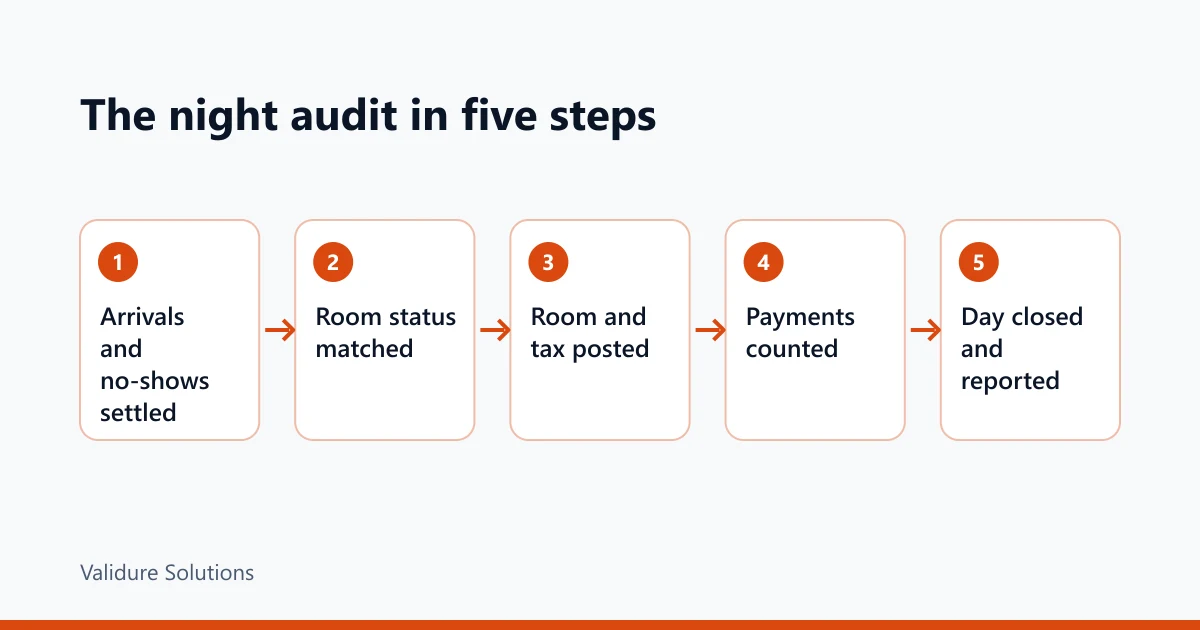
Step 1: settle arrivals and no-shows first
Start here because every later number depends on who is actually in the building. Pull the list of reservations due to arrive today that are not checked in. Each one is one of three things: a late arrival who called, a no-show, or a booking that should have been cancelled.
Call or message the late arrivals you can reach. For the rest, apply the policy you published, not one you decide at 2 am. A guaranteed booking (prepaid, or held with a card or advance) usually carries a no-show charge, often the first night. A non-guaranteed booking is released. Write down which rule you used against each booking.
OTA bookings need one more step. Mark them as no-shows in the OTA's extranet as well, inside the time the OTA allows, or the commission and the charge can go wrong. Check each OTA's own rules for that window. They differ, and they change.
Here's an example of the night's arrivals for our sample hotel:
| Booking | Source | Guarantee | What the auditor does |
|---|---|---|---|
| A | Direct, phone | None | Release the room, no charge |
| B | OTA, prepaid | Prepaid | Mark no-show in the extranet, keep the room on hold till the policy cut-off |
| C | Corporate | Company letter | Post the no-show charge per the company agreement, note it on the folio |
The mistake to avoid is leaving A sitting as "due in". It keeps a room out of inventory, so the room looks sold tonight and unavailable tomorrow.
Step 2: match room status to the system
Next, compare what the system thinks against what housekeeping saw. Housekeeping's evening report gives a status for every room: occupied, vacant clean, vacant dirty, out of order. The system has its own view, built from check-ins and check-outs. They should agree. When they don't, one of them is wrong, and it's usually the system.
| Check | What to look for | What a hit means |
|---|---|---|
| Occupied in the system, vacant on the floor | Room shows an in-house guest, housekeeping found it empty with no luggage | A guest left without checking out. If the folio is paid, check them out. If not, it's a walk-out, and the manager needs it tonight |
| Vacant in the system, occupied on the floor | Housekeeping found luggage or a guest in a room the system shows as free | Someone is staying without a registration, or a room move wasn't recorded. Either way the room can be sold twice |
| Out of order with a booking | A room marked out of order still has a reservation for tomorrow | Move the booking now, not when the guest is at the desk |
| Rate on the folio differs from the booking | Posted rate is not the rate the guest booked | An override with no reason, or a wrong rate plan |
The first row is the expensive one. Our sample hotel's room 214 is a typical case: the guest left at 6 pm, the folio was settled by card at the desk, nobody pressed check-out. Without the audit, room 214 gets charged another night and sits unsold.
If you have a developer and the system keeps housekeeping status in a table, the whole check is one query:
-- rooms where the floor and the system disagree
SELECT r.room_no, r.hk_status, s.guest_name
FROM   rooms r
LEFT JOIN stays s
       ON s.room_id = r.id
      AND s.status  = 'in_house'
WHERE  (r.hk_status = 'occupied' AND s.id IS NULL)
   OR  (r.hk_status LIKE 'vacant%' AND s.id IS NOT NULL);
Run it after housekeeping's last update of the evening. A clean night returns nothing.
This is the step Validure HMS is built to make short. Room status from housekeeping and the bookings sit on the same records, so the disagreement shows up as a list on screen, not a walk down every corridor.
Step 3: post room and tax, and watch the 7,500 line
Once you know who's in the building, post tonight's room charge and its GST to every in-house folio. Most systems do this as one action. The auditor's job is to check the result, and in India the check has a sharp edge in it.
Since 22 September 2025, GST on hotel accommodation is charged per unit per day on the value of supply. As CBIC's published FAQs describe it, a room with a value of 7,500 rupees or less per day is taxed at 5 per cent without input tax credit, and a room above 7,500 is taxed at 18 per cent with credit. The slab is decided room by room, not for the whole hotel. Before that date the lower band was 12 per cent with credit.
Two consequences matter at the audit.
First, the slab follows the rate actually charged. An example: a suite with a rack rate of 8,000 sold at a 10 per cent discount comes to 7,200, which falls in the 5 per cent band. The same suite sold at rack falls in the 18 per cent band. If your system picks the slab from the room type rather than from the posted rate, it will be wrong for every discounted suite. How you treat discounts, extra beds and packages in the value is a question for your GST adviser, so settle it in writing once and configure it.
Second, the jump at the line is large. Here's an example of what the guest pays:
| Room rate per night | GST rate | GST | Guest pays |
|---|---|---|---|
| 7,500 | 5% | 375 | 7,875 |
| 7,600 | 18% | 1,368 | 8,968 |
A 100 rupee higher rate puts 1,093 rupees on the bill. That's why a rate of 7,550 posted by mistake gets noticed by the guest before it's noticed by the hotel.
Now the sample night. Our 40-room hotel has 31 rooms occupied after the no-shows are settled:
| Rooms | Rate | Room revenue | GST rate | GST |
|---|---|---|---|---|
| 18 Standard | 3,200 | 57,600 | 5% | 2,880 |
| 9 Deluxe | 5,500 | 49,500 | 5% | 2,475 |
| 4 Suites | 9,000 | 36,000 | 18% | 6,480 |
| 31 rooms | 1,43,100 | 11,835 |
Room revenue plus GST is 1,54,935. That total should match the sum of tonight's room and tax postings across all folios. If it doesn't, one folio got posted twice or not at all, and you'll find it by sorting folios by tonight's room charge and looking for zeros and doubles.
One more check belongs here. A room posted at zero rate is either a complimentary stay or an error. Complimentary stays need an approval with a name on it. Anything else at zero gets corrected tonight.
Step 4: count the money, method by method
Payments are where small gaps turn into arguments a week later. Count each method on its own and match it to the system's own total for that method. Don't net them together. A cash surplus and a card shortfall of the same size cancel on paper and hide two mistakes.
An example for the night shift's cash:
| Line | Amount |
|---|---|
| Opening float | 5,000 |
| Cash received from guests (system) | 38,400 |
| Cash refunds paid out (system) | 2,000 |
| Expected in the drawer | 41,400 |
| Counted | 41,100 |
| Short | 300 |
Expected is 5,000 plus 38,400 minus 2,000, which is 41,400. A short of 300 gets a note with the shift's name and an explanation, even a guess, tonight. Small unexplained shorts that repeat are the pattern a manager needs to see.
For UPI, match the system's UPI total to the payment app's settlement or transaction list for the same hours. For cards, match the system's card total to the terminal's batch settlement before you close the batch. The usual hits are a payment taken on the terminal and never posted to a folio, or posted twice because the first attempt looked like it failed.
One legal point about cash. The Income-tax Act limits cash receipts of 2 lakh rupees or more from one person in a day, for one transaction, or for one event (section 269ST of the 1961 Act; the Income-tax Act, 2025 now carries the rule, so check the current section with your accountant). A long stay or a wedding block paid in cash can cross it across several days. The audit is a good place to flag a folio where cash received is building toward that line.
Step 5: prove the guest ledger, then close the day
The guest ledger is the total of every open folio: what in-house guests owe right now. It obeys one identity, and if the identity holds, the day's postings are complete.
Closing balance = opening balance + today's charges - today's payments
Example: the guest ledger opened at 2,10,000. Today's charges, room, tax, food and anything else posted to folios, were 1,98,600. Today's payments were 1,72,350. The closing balance should be 2,10,000 plus 1,98,600 minus 1,72,350, which is 2,36,250. If the system's closing balance for open folios says anything else, a posting is missing or was made outside a folio, and you shouldn't roll the date until you find it.
Two short checks finish the ledger:
| Check | What to look for | What a hit means |
|---|---|---|
| High balance | Any in-house folio whose balance is above your credit limit or above the deposit taken | Ask for a payment at breakfast, before the balance grows |
| Due-out with a balance | Guests due out tomorrow whose folio isn't settled | Have the bill ready, or the checkout queue is where you find out |
Then close the business date. After the close, the day is read only. Corrections found tomorrow go into tomorrow as adjustments with a reason and a name, not as edits to last night. That keeps the reports the owner saw at 9 am true to what was closed.
The reports the morning needs
Owners don't need twenty reports. They need the few that come out of the steps above, from the same closed day:
| Report | Our sample night |
|---|---|
| Rooms occupied | 31 of 40 |
| Occupancy | 77.5% |
| Average daily rate (room revenue / rooms sold) | 1,43,100 / 31 = 4,616.13 |
| RevPAR (room revenue / rooms available) | 1,43,100 / 40 = 3,577.50 |
| Room revenue and GST | 1,43,100 and 11,835 |
| Cash over or short | 300 short, explained |
| No-shows and how each was handled | 3: released, held, charged |
A quick sanity check: ADR times occupancy should equal RevPAR. 4,616.13 times 0.775 is 3,577.50, so the three agree. If you run more than one property, add the group figures by summing rooms and revenue first, never by averaging the hotels' percentages.
Validure HMS shows occupancy, arrivals and revenue on a live dashboard, and folios carry GST with cash, UPI, card or link payments recorded against them. That gives the auditor the totals for steps 3 and 4 without a separate sheet. It's still the auditor's count of the drawer that proves them.
Who doesn't need all of this
A homestay with five rooms and one person who checks everyone in can do this on a single page in ten minutes, and should. The steps still apply. They just get shorter. The case for a proper system and a written audit grows with rooms, with OTA channels and with the number of people who handle money in a day, because that's where the gaps hide.
If you're choosing a system, ask how it handles each step above. Can it show room status against bookings as one list? Does it pick the GST slab from the posted rate? Does it total payments by method for a shift? Does it lock the closed day and log every later adjustment with a name? And can you export your data if you leave?
Sources and checks
GST on accommodation: the rate notifications and the rate rationalisation FAQs are published by CBIC, following the 56th meeting of the GST Council. Check the current notification for how your rooms are valued, and confirm discounts, extra beds and packages with your GST adviser. Cash receipt limits: Income Tax Department. OTA no-show rules are in each OTA's partner extranet and change often. Rates and rules were checked on 7 November 2026. Every figure for the sample hotel is an illustration, not advice.
Frequently asked questions
What time should the night audit run?
After the last expected arrival and after housekeeping's final evening status, usually between 1 am and 3 am. Pick a time, write it down and keep it, so every day covers the same hours.
What is the difference between a guaranteed and a non-guaranteed booking at the audit?
A guaranteed booking is prepaid or held with a card or advance, so your published no-show charge can apply. A non-guaranteed booking is released with no charge. The policy has to be the same on your website, the OTAs and the confirmation message.
Which GST rate applies to a room sold at exactly 7,500 rupees?
As CBIC's FAQs describe it, 5 per cent without input tax credit, because the lower slab covers 7,500 or less per unit per day. Anything above 7,500 is 18 per cent with credit. Confirm against the current notification.
Can we correct a mistake after the day is closed?
Yes, but as an adjustment in the current day, with a reason and a name. Don't reopen the closed day. Otherwise yesterday's reports stop matching what was actually closed.
What should we do about a guest who left without checking out?
If the folio is settled, check them out and release the room. If it isn't, it's a walk-out. Record it the same night, tell the manager and follow whatever recovery your policy and the booking guarantee allow.
Does a small hotel need a dedicated night auditor?
Not always. In a small property the night desk person usually does the audit along with check-ins and security. What matters is that the checks happen in order every night, whoever does them.