Should a small hotel charge for no-shows, or does the fee cost more than it saves?
By Validure team · · 14 min read
Both sides of the no-show fee argument for small Indian hotels, with the break-even maths for prepayment, GST on a retained amount under CBIC Circular 178, what the Consumer Protection Act says about disproportionate penalties, and a policy you can apply by booking type.

It's a Saturday in August at a 24-room hotel outside Lonavala. Four rooms are blocked for guests who booked "pay at hotel" on an OTA three weeks ago. By 9 pm none of them has arrived, and two calls go to voicemail. The front desk turned away a family at 6 pm because the hotel showed full. By morning the hotel has four empty rooms, no money for them, and nothing to charge.
The owner's first instinct is a hard rule: no more pay-at-hotel, everything prepaid, first night charged on a no-show. The revenue manager's instinct is the opposite: half our bookings come from pay-at-hotel, and if we force prepayment the guest just books the place next door. Both of them are partly right, and the argument is worth having with numbers.
Here are both cases at full strength, what the law and GST say, and the arithmetic that decides it. We build hotel software, so we have an interest in how hotels run bookings. Nothing here is legal or tax advice; for a specific case ask your GST adviser or a lawyer.
What counts as a no-show, and why the booking type decides everything
A no-show is a guest with a confirmed booking who neither arrives nor cancels before the cut-off in your policy. A late cancellation at least tells you, and sometimes you can resell the room. A no-show tells you nothing until it's too late.
Whether you can charge depends less on your policy and more on how the booking was paid:
| Booking type | Money you hold before arrival | Can you actually collect a no-show charge? |
|---|---|---|
| Prepaid on OTA or your website | Full amount | Yes, you keep it under the rate's terms |
| Advance or deposit by UPI or payment link | The deposit | Yes, up to the deposit |
| Card details given as a "guarantee" | Usually nothing | Often not, see below |
| Pay at hotel, no guarantee | Nothing | In practice, no |
| Corporate booking on company letter | Nothing yet | Per the company agreement, billed later |
That last column is where most policies quietly fail. "First night charged" means nothing when you hold no money and no way to take it.
On card guarantees in India: Since 1 October 2022 the Reserve Bank of India's card-on-file rules have barred merchants from storing card numbers for later transactions, and domestic card payments online generally need the cardholder's extra authentication. As we understand it, that means a small hotel can rarely charge a card days later without the guest taking part. Ask your OTA or payment gateway how they handle guarantees before relying on one.
The case for charging
Here is the argument at full strength.
A confirmed room is a promise both ways. The hotel holds stock that expires at midnight. When a guest doesn't come, the hotel loses that night and often the guest it turned away, while the guest who booked loses nothing. A fee puts some of the cost back on the person who caused it.
Pay-at-hotel bookings with no consequence invite speculative booking: two or three places held for the same night, decided on the way. A charge, or even a small deposit, changes behaviour. People who have paid something cancel when plans change, which gives you a chance to resell.
It's also fairer to the guests who show up. If no-shows cost nothing, the hotel prices that risk into everyone's rate or overbooks, and the honest guest pays. Airlines, rail and event organisers already work this way, and CBIC's circular on cancellation charges treats hotel bookings, journeys and events alike.
The case against charging
Most independent hotels in India get the bulk of their bookings through OTAs, and pay-at-hotel is a big reason guests pick them. Make every rate prepaid and you may lose more bookings than you save. The guest doesn't argue with your policy; they book elsewhere, and you never see the booking you lost. The cost is invisible while the no-shows are very visible.
Fees create disputes, and disputes become reviews. A guest who missed a train or had a medical emergency won't accept a charge quietly, and one angry review can cost more in future bookings than the night was worth. Small hotels live on ratings far more than chains do. Enforcement also costs staff time: chasing a corporate client, raising an OTA dispute, invoicing the retained amount.
And there is a legal limit. The Consumer Protection Act, 2019 defines an "unfair contract" in section 2(46) to include a term "imposing any penalty on the consumer, for the breach of contract thereof which is wholly disproportionate to the loss occurred due to such breach", and separately any unreasonable charge that puts the consumer at a disadvantage. State and national consumer commissions can declare such terms void. A policy that keeps the full amount of a five-night stay when the guest cancelled a month ahead is the kind of term that invites that challenge.
What is settled, what is argued, and what is opinion
Established, from primary sources: CBIC Circular 178/10/2022-GST, dated 3 August 2022, says amounts forfeited when a customer fails to use hotel accommodation are taxed at the same rate as the accommodation, because they are ancillary to it. Since 22 September 2025, under Notification 15/2025-Central Tax (Rate), rooms valued at 7,500 rupees or less per unit per day are taxed at 5 per cent without input tax credit, and rooms above that at 18 per cent with credit. Consumer law limits disproportionate penalties, and the RBI rules stop merchants storing card data.
Contested: how many bookings a prepayment rule loses, and whether fees cost more in reviews than they save. Vendor blogs quote high single-digit no-show rates for Indian pay-at-hotel bookings, but they cite each other and we found no independent study. Use your own data. Our opinion, labelled, comes after the maths.
The break-even maths for prepayment
One comparison settles it for your hotel. Ignore resale and commission for a moment.
Let B be the bookings you get on a rate in a month, n the share that no-show, d the share of bookings you'd lose by making that rate prepaid, and R the room rate.
Pay at hotel earns B x (1 - n) x R, because no-shows pay nothing. Prepaid earns B x (1 - d) x R, because everyone who books pays, no-shows included.
So prepayment wins when d is smaller than n. If more of your bookings no-show than you would lose by asking for money upfront, prepay. If not, don't.
A worked example. Say a 24-room hotel takes 300 room-nights a month on its OTA pay-at-hotel rate at 3,200 rupees, with 8 per cent no-shows.
| Policy | Bookings | Room-nights paid | Revenue at 3,200 |
|---|---|---|---|
| Pay at hotel, 8 per cent no-show | 300 | 276 | 8,83,200 |
| Prepaid, lose 5 per cent of bookings | 285 | 285 | 9,12,000 |
| Prepaid, lose 10 per cent of bookings | 270 | 270 | 8,64,000 |
Losing 5 per cent of bookings beats an 8 per cent no-show rate by 28,800. Losing 10 per cent leaves you 19,200 worse off than doing nothing. The whole argument turns on two numbers you probably don't know yet: your no-show rate by channel and how bookings respond to a rule change. Both are measurable in a month or two.
Two adjustments make the comparison fairer. Commission: OTAs typically charge commission on stayed bookings, and how they treat no-shows and retained amounts varies by OTA and contract, so check yours. Resale: a no-show who doesn't tell you can rarely be resold, but a guest who cancels two days ahead often can. That second point is why the best policy is usually not "charge everyone" but "make it cheap to cancel early and costly to vanish".
The middle path: charge the risky bookings, remind the rest
Most hotels don't need to pick a side for every booking. Risk isn't spread evenly. Long-lead pay-at-hotel bookings, weekend nights in lean season and bookings with no phone number that answers are where no-shows cluster. A short stay booked yesterday by a guest who called the hotel is low risk.
Continuing the example, say the hotel keeps pay-at-hotel but sends a reminder three days before arrival with a one-tap cancel link, and asks for a one-night deposit by payment link only on weekend bookings made more than 14 days ahead. Suppose half the 24 no-show room-nights become cancellations at least two days out, and the hotel resells half of those 12. That's 6 x 3,200 = 19,200 recovered, and the deposit touches only the risky slice, so far fewer bookings walk away than under a blanket rule. These percentages are examples, not benchmarks.

Here is the policy as a table, for a hotel like the example:
| Booking | Risk | What to ask for | No-show rule |
|---|---|---|---|
| OTA prepaid or non-refundable rate | Low (already paid) | Nothing more | Keep per the rate terms, mark no-show in the extranet |
| OTA pay at hotel, under 7 days lead | Low to medium | Reminder 1 day before | Release room at the stated cut-off |
| OTA pay at hotel, 14+ days lead, weekend | High | Deposit by payment link, or switch to a prepaid rate | Keep deposit, release room |
| Direct booking by phone | Medium | Advance by UPI or link | Keep up to the advance as per published policy |
| Corporate on company letter | Low | Agreement with a no-show clause | Bill per the agreement |
| Peak dates, festivals, long weekends | High | Prepaid or non-refundable only | Keep per terms |
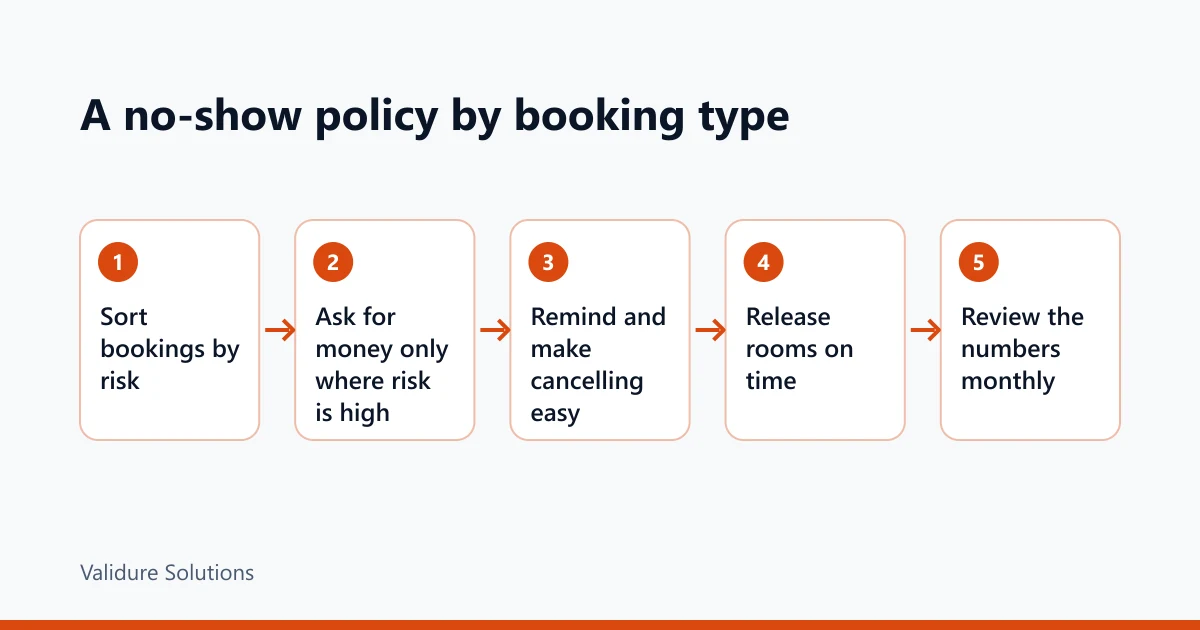
The diagram below shows the same thing as a sequence you can run every week.
GST on a retained amount, with numbers
If you keep money for a no-show, it's taxable at the rate of the room it was for. Two examples; confirm how your rooms are valued with your GST adviser.
A room at 3,200 rupees a night, prepaid at 3,360 including 5 per cent GST. The guest no-shows and the policy keeps the first night. The tax inside the retained amount is 3,360 x 5 / 105 = 160, and the taxable value is 3,200. You don't get to treat the 3,360 as a GST-free "penalty".
A suite at 8,000 rupees, above the 7,500 line, so 18 per cent with input tax credit. The guest prepaid one night at 8,000 + 1,440 = 9,440. On a no-show you keep 9,440, of which 1,440 is GST.
For a smaller deposit, or a part refund, work out the tax inside whatever you keep at the room's rate. Make sure the folio shows what was kept and why, so a later dispute has one clear record.
Checks before you change your policy
| Check | What to look for | What a hit means |
|---|---|---|
| No-show rate by channel, last 3 months | Count no-shows over confirmed bookings, per OTA and rate plan | The channel with the highest rate is where to act first |
| Same policy text everywhere | Website, each OTA rate plan, confirmation message, reminder | A guest can dispute any charge the confirmation didn't state |
| Money actually held | For each booking type, what you hold before arrival | A charge you can't collect is a policy in name only |
| Charge size against loss | Retained amount compared with one night's rate | Keeping several nights for one missed night invites an unfair-contract complaint |
| GST on retained amounts | Retentions booked with tax at the room's rate | Retentions booked as untaxed income are a GST exposure |
| Resale after early cancellations | Rooms resold within 48 hours of a cancellation | If it's near zero, reminders won't recover revenue; deposits might |
The first row needs every booking's channel, rate plan and final status recorded, no-shows included, never deleted. Validure HMS keeps bookings and availability in one place with double-booking blocked, so a no-show released at the cut-off goes straight back on sale. Its folio billing records GST and takes cash, UPI, card or link payments, which covers a deposit by link and a record of what was retained.
You don't need a system to start. A spreadsheet with one row per booking, channel, rate plan, lead time and outcome, filled in at each night audit, will give you the no-show rate by channel in a month. The night audit post covers where that fits in the nightly routine.
Overbooking is a different bet
Some hotels skip the fee argument and overbook by the expected no-show count instead. For a small hotel, one night when everyone turns up means walking a guest and taking the review, so a deposit on the risky slice is usually the cheaper insurance. The double-bookings post covers why you should only ever overbook on purpose.
Our opinion
This is our view, not a settled fact. For a small Indian hotel, a blanket no-show fee on every booking is usually a mistake, and no policy at all is a bigger one. The version we'd pick has four parts: a prepaid or non-refundable rate that's a little cheaper, so guests who are sure can choose it; a deposit only on the high-risk slice; a reminder with an easy cancel link; and a fixed release time. Keep any charge to one night, say it in the same words on every channel, and charge GST on whatever you keep.
Where we're unsure: we have no good public data on how much prepayment rules cut bookings in Indian leisure markets, and it will differ between a hill station in monsoon and a business hotel near an industrial estate. Measure it for a month before and after any change.
Who this doesn't apply to: a hotel that already sells mostly prepaid or corporate business, or runs near full on most nights with a waiting list, has little to gain from changing anything here.
Sources and checks
GST on cancellation and forfeited amounts: CBIC Circular No. 178/10/2022-GST dated 3 August 2022, paragraph 11, on CBIC GST. Room rate slabs: Notification No. 15/2025-Central Tax (Rate), effective 22 September 2025, on the same site, following the 56th meeting of the GST Council. Unfair contract definition: section 2(46) of the Consumer Protection Act, 2019, on India Code and the Department of Consumer Affairs. Card-on-file tokenisation: Reserve Bank of India notifications. OTA no-show, guarantee and commission rules are in each OTA's partner extranet and contract, and they change, so check yours. No-show rates by booking type circulate mainly on vendor blogs; we didn't use any as a fact. Everything was checked on 14 November 2026, and every figure for the sample hotel is an illustration.
Frequently asked questions
Can a hotel in India legally charge for a no-show?
Generally yes, if the charge was in the terms the guest accepted when booking and it isn't wildly out of line with the loss. The Consumer Protection Act, 2019 lets consumer commissions strike down penalties that are wholly disproportionate to the loss. One night for a missed night is the common, defensible level.
Is GST payable on a no-show charge or a forfeited deposit?
Yes. CBIC Circular 178/10/2022-GST says amounts forfeited when a customer doesn't use hotel accommodation are taxed at the same rate as the accommodation, so 5 or 18 per cent depending on the room's value per night. Confirm the details with your GST adviser.
Can I charge the card a guest gave me as a guarantee?
Often not, in India. Merchants can't store card numbers under the RBI card-on-file rules, and domestic card payments usually need the cardholder's authentication. If you want a real guarantee, take a deposit by UPI or payment link, or sell a prepaid rate.
Should we stop offering pay-at-hotel on OTAs?
Only if your numbers say so. Compare your pay-at-hotel no-show rate with the share of bookings you'd lose by removing it. If the no-show rate is higher, prepay wins; if it's lower, keep pay-at-hotel and target deposits at long-lead weekend bookings.
What's a fair cut-off time to release a no-show room?
There's no legal figure. Pick a time that fits your area's arrival patterns, often the evening of arrival, publish it in the confirmation, and apply it every night. A guest who calls before the cut-off to say they're late should be held.
Do reminders actually reduce no-shows?
They turn some silent no-shows into cancellations, which is what you want, because a cancellation two days ahead can be resold. Make cancelling one tap from the reminder. A reminder with no easy way to cancel mostly gets ignored.