
Why your bank balance never matches your books, with a worked reconciliation
By Validure team · · 14 min read
A step-by-step bank reconciliation for a small Indian business, with a full worked example, UPI and payment gateway settlements, the tricks that find a stubborn difference, and a monthly routine that keeps it short.

It's the 3rd of the month. The books say the current account held 4,82,350 on 31 October. The bank statement says 5,57,030. The owner asks which one is right, and the honest answer is "both, probably, but I can't prove it yet". Somebody then spends an afternoon scrolling through two lists of numbers, finds most of the gap, and writes the rest off to "bank difference" so the month can close.
That last line is how small errors become big ones. A difference you can't explain this month is still there next month, sitting under new transactions, and by March nobody remembers what it was.
This post walks through a full reconciliation with real numbers, shows where UPI and gateway settlements fit, and gives you the checks that find a stubborn difference fast. It's written for whoever closes the books in a small or mid-size business, and for the owner who wants to know what a clean reconciliation actually looks like.
The two balances are both right, about different things
Your books record a payment when you make it. The bank records it when the money moves. Between those two moments sit cheques nobody has deposited yet, deposits that haven't cleared, charges the bank took without telling you, and the odd typing mistake.
So reconciliation isn't about deciding which balance wins. It's about listing every reason they differ until the list adds up exactly to the gap. If it adds up, you've proved both records. If it doesn't, something is missing from one of them.
Every difference falls into one of four kinds, and the kind tells you what to do with it:
| Kind of difference | Example | Who is "behind" | What you do |
|---|---|---|---|
| In the books, not yet in the bank | Cheque issued but not presented; cheque deposited but not cleared | The bank | Nothing in the books. List it, with its date, and expect it next month |
| In the bank, not in the books | Bank charges, interest, a customer paying by NEFT without telling you | The books | Pass the entry in the books now |
| A mistake in the books | Receipt typed as 18,540 instead of 18,450 | The books | Correct the entry, with a note |
| A mistake by the bank | A charge reversed twice, a credit to the wrong account | The bank | Raise it with the bank in writing. Don't touch your books |
The second and third rows change your books. The first and fourth never do. Mixing these up is the most common reason a reconciliation "works" this month and falls apart next month.
A worked reconciliation, line by line
Here's an example. Say a 15-person trading company keeps one current account. On 31 October 2026 the books show 4,82,350 and the statement shows 5,57,030. The gap is 74,680, with the bank higher.
After ticking off every entry that appears on both sides with the same amount, six items are left:
- A cheque for 85,000 issued to a supplier on 28 October. The supplier hasn't deposited it.
- A customer's cheque for 42,500 deposited on 31 October. The bank shows it as cleared on 3 November.
- Bank charges of 1,180 on the statement (1,000 plus 180 GST on the charge, per the bank's advice). Not in the books.
- A customer paid 31,000 by NEFT on 30 October and didn't send a remittance advice. Not in the books.
- Interest of 2,450 credited by the bank. Not in the books.
- A receipt of 18,450 was entered in the books as 18,540.
Do it in two steps. First, fix the books for everything the bank knows and you didn't, plus your own mistake:
| Amount | |
|---|---|
| Balance as per books | 4,82,350 |
| Less bank charges (item 3) | 1,180 |
| Add NEFT receipt not recorded (item 4) | 31,000 |
| Add interest credited (item 5) | 2,450 |
| Less receipt over-recorded by 90 (item 6) | 90 |
| Adjusted book balance | 5,14,530 |
Then take the bank balance and adjust it for the items the bank hasn't caught up on yet:
| Amount | |
|---|---|
| Balance as per bank statement | 5,57,030 |
| Less cheque issued, not presented (item 1) | 85,000 |
| Add cheque deposited, not yet credited (item 2) | 42,500 |
| Adjusted bank balance | 5,14,530 |
Both sides land on 5,14,530. That figure is the real cash in the account at month end, and it's the number your balance sheet should show after the four entries are passed. The check on the whole thing: 85,000 minus 42,500 minus 1,180 plus 31,000 plus 2,450 minus 90 is 74,680, which is exactly the gap you started with.
Notice what the two-step layout does. Items 1 and 2 never touch the books, so next month they should simply appear on the statement and drop off the list. If the 85,000 cheque is still outstanding in December, that's a question for the supplier, not an accounting entry.
A one-step version, from the book balance straight to the bank figure, gives the same arithmetic. Two steps are easier to review because "entries I need to pass" and "things I'm waiting for" are different jobs.
UPI and gateway money arrives in lumps
Most small businesses now take a good share of payments through UPI or a payment gateway, and this is where reconciliations get messy. The customer pays 2,400 at 7:40 pm. The bank statement shows nothing that evening. The next day a single credit of 48,820 arrives with a reference number and no customer names.
That one line is a settlement: the gateway has bundled a day's payments, taken its fee and the GST on the fee, and paid you the net. You can't match it to sales one by one against the bank, because the bank never saw the individual sales.
The fix is a clearing account, one per gateway. Here's an example with three card and UPI payments through a gateway on 30 October, totalling 50,000, and a fee of 2 per cent plus GST at 18 per cent on the fee. Your actual fee and its tax treatment are on the gateway's contract and invoice, so use those, not these.
| Date | Entry | Debit | Credit |
|---|---|---|---|
| 30 Oct | Sales received through gateway | Gateway clearing 50,000 | Customers or sales 50,000 |
| 31 Oct | Settlement lands in the bank | Bank 48,820 | Gateway clearing 50,000 |
| Gateway fee | Fee expense 1,000 | ||
| GST on the fee | GST input 180 |
The sums: 2 per cent of 50,000 is 1,000; 18 per cent of 1,000 is 180; 50,000 minus 1,180 is 48,820. After the settlement the clearing account is back to zero.
That zero is your check. At month end the clearing account should hold exactly the payments taken but not yet settled, usually the last day or two, and the gateway's own settlement report should show the same unsettled total. If the clearing account holds anything older than the gateway's normal settlement cycle, you have a missing settlement, a refund booked on one side only, or a payment that failed after the customer thought it went through.
On that last one: the Reserve Bank's rules on failed transactions, in force since 15 October 2019, set deadlines for reversing money that left a customer's account without reaching the other side. For UPI the time limit depends on the case, and the bank owes the customer compensation for every day past it. For your books, the practical point is that a "paid" screenshot from a customer isn't proof the money reached you. Check the settlement, not the screenshot.

Cheques move faster now, but they still lag
Cheque timing used to be the biggest reconciling item. It's smaller now. The Reserve Bank moved cheque clearing from batches to continuous clearing, with the first phase starting on 4 October 2025, so a cheque presented in the morning can be settled the same day instead of over a couple of working days. A second, faster phase was due in January 2026 and was postponed in December 2025. Check the RBI site for where it stands when you read this.
Two cheque rules still matter at month end. A cheque you issue isn't in the bank until the payee deposits it, and some payees sit on cheques for weeks. And a cheque is valid for three months from its date, a rule in force since 1 April 2012. So a cheque you issued that's still outstanding after three months won't be honoured if it's presented. Don't leave it on the list forever. Contact the payee, cancel it in the books with a note, and reissue if the money is still owed.
NEFT and RTGS have run round the clock since 16 December 2019 and 14 December 2020 respectively, so a transfer made on a Sunday can land on a Sunday. If your books only record transfers on working days, you'll see weekend timing items that aren't really timing items. Date the entry when the money moved.
When a small difference won't go away
Sometimes everything's ticked and 90 rupees remain. Don't write it off. Small differences have a few classic shapes, and each one points somewhere.
| Check | What to look for | What a hit means |
|---|---|---|
| Divide by 9 | The unexplained difference divides exactly by 9 | Two digits swapped, like 18,540 for 18,450. Look for an amount with those digits |
| Halve it | Half the difference equals one transaction amount | That entry went on the wrong side, a receipt posted as a payment or the reverse |
| Match the amount | The difference equals one line on the statement or in the books | One entry was missed entirely, on one side |
| Round numbers | The difference is 100, 1,000, 10,000 | A digit dropped or added, or a slip in an opening balance |
| Opening balance | Last month's adjusted balance doesn't equal this month's starting point | Someone edited a closed month. Fix that first, everything after it depends on it |
In the worked example, 90 divided by 9 is 10, which points to a swap in the tens and hundreds digits: 18,450 typed as 18,540. Any swap of two digits gives a difference that's a multiple of 9.
The last row is the one that wastes the most time. If someone changed an entry dated in September after September was reconciled, October's reconciliation can't work, however carefully you tick. Lock reconciled months, and if a change is unavoidable, make it in the current month with a reference back.
If you have a developer and your statement and ledger are both in tables, this query lists statement lines with no book entry of the same amount within five days, which is usually most of the work:
-- statement lines with no book entry of the same amount within 5 days
SELECT s.txn_date, s.narration, s.amount
FROM   bank_statement s
WHERE  NOT EXISTS (
  SELECT 1 FROM bank_ledger b
  WHERE  b.amount = s.amount
    AND  b.entry_date BETWEEN s.txn_date - INTERVAL '5 days'
                          AND s.txn_date + INTERVAL '5 days'
);
It will miss settlements that bundle many sales, which is why the clearing account matters.
A monthly routine that keeps it short
Reconciliation is quick when it's done every month and painful when it's done once a year for the auditor. This is the order that works for most small businesses:
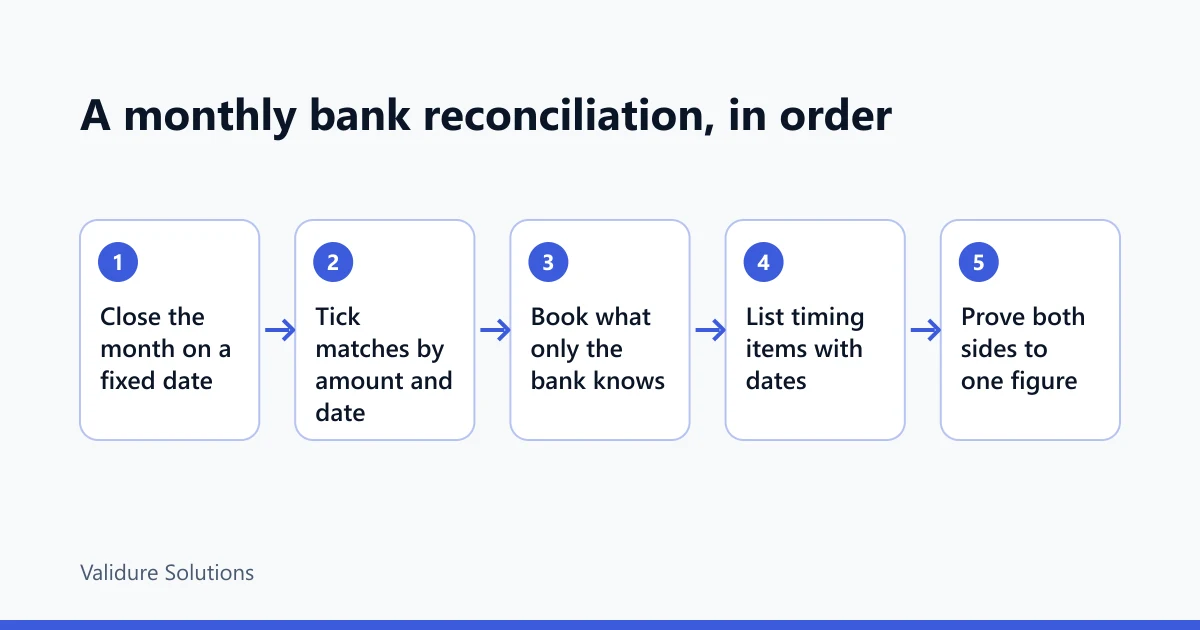
- Close the month on a fixed date. Download the statement for exactly the same period as the books, ending on the last day.
- Tick matches by amount and date. Start with exact matches, then same amount within a few days.
- Book what only the bank knows: charges, interest, direct receipts, standing instructions, loan EMIs. Each one is a real entry with a date.
- List timing items with their dates: cheques issued and not presented, deposits not yet credited, gateway settlements still due.
- Prove both sides to one figure, like the tables above. Keep the working, signed and dated, next to the statement.
Then, at the start of next month, look at last month's timing list before anything else. Every item on it should have cleared. Anything that hasn't is the first thing to chase.
For a business with one bank account and a few dozen transactions a month, this takes under an hour. With several accounts, a gateway or two and hundreds of UPI receipts, it can take a day, and that's when the way your records are kept starts to matter more than how careful you are.
Where the system helps, and where it doesn't
Most of the pain above comes from receipts that live somewhere other than the books: a sales register in one sheet, UPI screenshots on a phone, payments typed in at month end from memory. When receipts are recorded against the invoice they settle, in the same place as the bank ledger, step 2 shrinks to checking rather than hunting.
That's how Validure ERP is set up: receipts, banks and cash sit in double-entry accounting alongside the GST invoices they relate to, so a customer's payment is booked against their invoice when it arrives rather than reconstructed later. The full audit trail matters here too. When an entry in a reconciled month changes, you can see who changed it and when, which is the fastest way through the "opening balance doesn't match" problem.
You may not need any of that. With one account, no gateway and a few dozen entries a month, a spreadsheet and the routine above are enough. The case for a system grows with the number of accounts and payment channels, because that's where retyping turns into missed receipts.
Whatever you use, ask three things of it. Can you see, for any bank entry, which invoice or bill it settled? Can a reconciled month be locked? And when someone edits a past entry, is there a record of who did it?
Sources and checks
This is general information, not accounting or tax advice; your auditor or accountant should confirm how your business books bank charges, gateway fees and the GST on them. Payment system rules are from the Reserve Bank of India: the RBI notifications for the 2019 rules on turnaround time and compensation for failed transactions and the 2025 circular on continuous cheque clearing, and the RBI press releases for the NEFT and RTGS round-the-clock dates. The three-month cheque validity is from the RBI circular of 4 November 2011. Checked on 10 November 2026. The company, amounts, fee rate and GST rate in the examples are illustrations; use your own bank advice and gateway invoice.
Frequently asked questions
How often should a small business reconcile its bank account?
Every month at minimum, within the first week of the next month. With a busy gateway or many UPI receipts, weekly is easier than monthly, because the lists stay short.
Should I pass entries in my books for cheques that haven't cleared?
No. A cheque issued or deposited is already in the books. Its absence from the statement is timing. List it with its date and expect it to clear next month.
What do I do with a cheque that's been outstanding for months?
After three months from its date the bank won't honour it. Contact the payee, reverse the cheque in your books with a note, and reissue if the amount is still owed.
Why is my UPI money not showing as separate lines on the statement?
If you collect through a gateway, it pays you in settlements: one credit for a batch of payments, net of fees. Book each sale to a clearing account and match the settlement against the batch.
Can I write off a small unexplained difference?
Only after the checks above, and then with approval and a note. Most small differences are a swapped digit or a missed entry, and finding them protects next month's reconciliation.
Do I need software to reconcile?
Not with one account and low volume. A spreadsheet and a fixed monthly routine are enough. Software starts to pay when you have several accounts, gateways and hundreds of receipts a month.
