
FIFO or weighted average? How your stock method moves profit between years, with the numbers
By Validure team · · 14 min read
A worked example for a small Indian trader showing FIFO, periodic weighted average and moving weighted average side by side, what each does to profit and tax, why the difference reverses next year, how to write stock down to net realisable value, and the checks that catch a wrong closing stock figure.

It's the last week of March. An electrical goods distributor has 150 ceiling fans in the godown, and the accountant asks a question the owner has never thought about: are we valuing these on FIFO or weighted average? The owner says it doesn't matter, a fan is a fan. Then the accountant shows two closing stock figures 9,272 rupees apart, and with them two different profits.
Both figures are allowed. Neither is a mistake. But the choice decides how much profit lands in this year and how much in the next, and once you've picked one, you can't swap it back and forth to suit the year.
Below is one item worked through each method, why the difference always reverses, the write-down people miss when prices fall, and checks for a closing figure you can defend.
This is general information about Indian accounting and tax rules as checked on 17 November 2026, not advice for your business. Your auditor or CA has the final word on the method you adopt.
What the rules actually allow
AS 2, the ICAI standard most unlisted Indian businesses follow, says inventory is valued at the lower of cost and net realisable value (paragraph 5). Where items are interchangeable, cost is assigned using FIFO or the weighted average cost formula (paragraph 16). Goods made for one specific project are valued at their own cost (paragraph 14). Ind AS 2 has the same two formulas.
For income tax, the Income Computation and Disclosure Standard on inventories (ICDS II) allows the same two formulas, and says the weighted average can be worked out periodically or each time a new lot comes in. Since 1 April 2026, the Income-tax Act, 2025 has replaced the 1961 Act, and the inventory valuation rule that used to be section 145A is now section 277: lower of actual cost or net realisable value, worked out under ICDS.
LIFO, last in first out, is not allowed under any of them. GST doesn't care which formula you use: tax on a sale is charged on the invoice value, not your cost.
The example: one item, one year
Here's the example. Say a distributor stocks one model of ceiling fan and sells it at 1,400 a unit all year. The year runs April to March.
| Date | Movement | Units | Rate | Value |
|---|---|---|---|---|
| 1 April | Opening stock | 100 | 1,000 | 1,00,000 |
| 10 May | Purchase | 200 | 1,050 | 2,10,000 |
| June | Sale | 220 | ||
| 5 August | Purchase | 150 | 1,120 | 1,68,000 |
| October | Sale | 180 | ||
| 20 January | Purchase | 100 | 1,150 | 1,15,000 |
Units available: 100 + 200 + 150 + 100 = 550. Units sold: 220 + 180 = 400. Closing stock: 150 units. Total cost of everything available: 1,00,000 + 2,10,000 + 1,68,000 + 1,15,000 = 5,93,000. Sales: 400 x 1,400 = 5,60,000.
Prices rose all year, from 1,000 to 1,150. That's what makes the methods disagree.
Every method works the same way underneath. Cost of goods sold equals cost of goods available minus closing stock. So the only real question each method answers is: what are the 150 fans left in the godown worth?
FIFO
FIFO assumes the oldest fans went out first, so the ones left are the newest. That's the 100 bought on 20 January and 50 of the 150 bought on 5 August.
Closing stock = 100 x 1,150 + 50 x 1,120 = 1,15,000 + 56,000 = 1,71,000.
Cost of goods sold = 5,93,000 - 1,71,000 = 4,22,000. Gross profit = 5,60,000 - 4,22,000 = 1,38,000.
Periodic weighted average
The periodic version takes one average rate for the whole year: total cost divided by total units.
Rate = 5,93,000 / 550 = 1,078.18 a unit. Closing stock = 150 x 1,078.18 = 1,61,727.27 (using the unrounded rate). Cost of goods sold = 5,93,000 - 1,61,727.27 = 4,31,272.73. Gross profit = 1,28,727.27.
Moving weighted average
Most accounting software uses the moving version. The rate is recalculated every time a lot comes in, and each sale is costed at the rate on that day.
| Step | Units held | Value held | Rate after step |
|---|---|---|---|
| Opening | 100 | 1,00,000.00 | 1,000.00 |
| Buy 200 at 1,050 | 300 | 3,10,000.00 | 1,033.33 |
| Sell 220 (cost 2,27,333.33) | 80 | 82,666.67 | 1,033.33 |
| Buy 150 at 1,120 | 230 | 2,50,666.67 | 1,089.86 |
| Sell 180 (cost 1,96,173.91) | 50 | 54,492.75 | 1,089.86 |
| Buy 100 at 1,150 | 150 | 1,69,492.75 | 1,129.95 |
Cost of goods sold = 2,27,333.33 + 1,96,173.91 = 4,23,507.25. Check it the other way: 5,93,000 - 1,69,492.75 = 4,23,507.25. Gross profit = 1,36,492.75.
Side by side
| Method | Closing stock | Cost of goods sold | Gross profit |
|---|---|---|---|
| FIFO | 1,71,000.00 | 4,22,000.00 | 1,38,000.00 |
| Moving weighted average | 1,69,492.75 | 4,23,507.25 | 1,36,492.75 |
| Periodic weighted average | 1,61,727.27 | 4,31,272.73 | 1,28,727.27 |
With rising prices, FIFO shows the highest profit, because the cheap old fans got expensed. Periodic average shows the lowest. Moving average sits between, close to FIFO here because the last purchase came after the last sale.
The gap between FIFO and periodic average is 1,71,000 - 1,61,727.27 = 9,272.73 of profit. At an example tax rate of 30 per cent, that's about 2,782 of tax this year. Small for one item, noticeable across 400.
The difference always comes back next year
Here's the part most explanations skip. The method doesn't change your total profit. It only decides which year it shows up in.
Say next year the distributor sells the 150 leftover fans at 1,400 and buys no more of this model. Revenue is 2,10,000.
| Method | Year 1 profit | Year 2 profit | Two-year total |
|---|---|---|---|
| FIFO | 1,38,000.00 | 2,10,000 - 1,71,000 = 39,000.00 | 1,77,000.00 |
| Periodic weighted average | 1,28,727.27 | 2,10,000 - 1,61,727.27 = 48,272.73 | 1,77,000.00 |
Both land on 1,77,000, which is simply total sales of 7,70,000 minus total cost of 5,93,000. The closing stock of one year is the opening stock of the next, so whatever one method adds to this year's profit it takes out of next year's.
So the choice matters less than people think, and switching matters more. FIFO in the year you want a strong profit for the bank, average in the year you want less tax: that's moving profit at will, and the rules are written to stop it.
Changing method later is possible, but not casual
AS 2 requires you to disclose the cost formula you use as part of your accounting policies (paragraph 26). Under the accounting standards, a change of accounting policy is made only when a statute or standard requires it or when it gives a more appropriate presentation, and its effect has to be disclosed. ICDS II says the method once adopted shall not be changed without reasonable cause. "Reasonable cause" isn't defined; in practice it means a business reason you can put in writing, like a move to batch tracking.
The tax audit report asks about a change, so agree it with your auditor before the year starts.
When prices fall: lower of cost and net realisable value
Valuing at cost is only half the rule. If the fans can no longer be sold for what they cost, you value them at what they'll fetch.
Net realisable value is the expected selling price in the ordinary course of business, minus costs to complete and costs to sell. Continue the example. Say in March a newer model launches and this fan now sells for 1,180, with 60 a unit spent on delivery and dealer incentive to sell it. Net realisable value = 1,180 - 60 = 1,120 a unit.
| Method | Cost per unit | Net realisable value | Value at year end | Write-down |
|---|---|---|---|---|
| FIFO | 1,140.00 | 1,120.00 | 150 x 1,120 = 1,68,000 | 3,000 |
| Moving weighted average | 1,129.95 | 1,120.00 | 150 x 1,120 = 1,68,000 | 1,492.75 |
| Periodic weighted average | 1,078.18 | 1,120.00 | 1,61,727.27 (cost is lower) | none |
Under FIFO, cost per unit is 1,71,000 / 150 = 1,140, which is above 1,120, so the stock is written down by 3,000. Under periodic average the cost is already below net realisable value, so nothing changes.
AS 2 says write-downs are usually done item by item, or by groups of similar items, so you can't net a loss on old fans against a gain on new LED panels. And the estimate needs evidence: recent sale invoices, a price list, a dealer's quote.

What goes into cost in the first place
The formulas only work if the rate per unit is right. AS 2 paragraph 7 says the cost of purchase is the purchase price, plus duties and taxes other than those you recover from the tax authorities, plus freight inwards and other costs directly attributable to buying the goods.
For a GST-registered business that means:
| Cost item | Goes into stock cost? | Why |
|---|---|---|
| Purchase price on the invoice | Yes | It's the cost |
| GST you claim as input tax credit | No | You recover it, so it isn't your cost |
| GST you can't claim (blocked credit, composition dealer) | Yes | It's a real cost you carry |
| Freight and loading to bring goods to your godown | Yes | Directly attributable to acquisition |
| Freight to deliver to a customer | No | It's a selling cost |
| Godown rent and admin salaries | No | AS 2 excludes storage and general admin costs |
The tax version, section 277, is written to include taxes actually paid. Accountants handle that by adjusting purchases, sales and stock together, so the GST credit washes out and profit doesn't change. If your CA raises it in the tax audit, that's what they're talking about.
The common slip is freight booked straight to expenses, which makes the stock rate too low. Freight of 4,000 on the 10 May purchase of 200 fans is 20 a unit, and it belongs in the rate.
Which method to use
There's no universally better method. Here's how we'd decide.
| Your situation | Method we'd lean to | Why |
|---|---|---|
| Goods that expire or go out of fashion (food, pharma, garments, seasonal stock) | FIFO | It matches how stock physically moves, and old lots show up when you check what's left |
| You track batches or lots already | FIFO | You have the data, so use it |
| Interchangeable goods, frequent purchases at changing prices (hardware, electricals, spares) | Moving weighted average | One rate per item, easy to check, most software does it by default |
| Very few purchases a year, valued once at year end by hand | Periodic weighted average | Simple, one sum per item |
| Goods made or bought for one specific order | Specific identification | AS 2 requires it for items that aren't interchangeable |
If your software does one of the two well, use it and stick to it. A method you can recompute from the stock register beats a better one nobody can check. Different formulas for different kinds of stock are fine; different formulas for similar items because one gives a nicer number are not.
Checks before you sign off closing stock
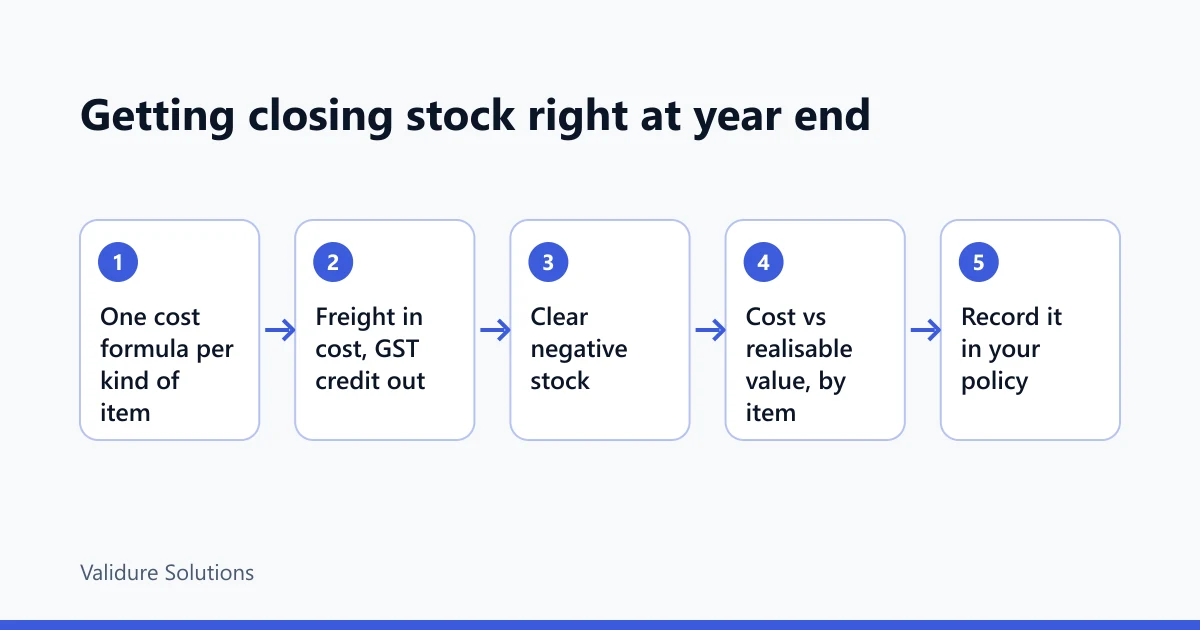
| Check | What to look for | What a hit means |
|---|---|---|
| Negative stock | Any item with a negative quantity on any date during the year, not just at year end | A sale was entered before its purchase. Moving average costs that sale at a stale rate and the closing value goes wrong |
| Value with zero quantity | Items showing nil units but a balance in value | Usually a godown or batch picked wrongly on a purchase or sale. Clear it before valuing |
| Rate jumps | Items whose closing rate is far above or below the last purchase rate | A wrong unit (box entered as piece), a purchase without a rate, or a free-quantity entry |
| Method by item | Costing method set on every item, compared with your written policy | New items created with a different default method |
| Freight and GST in cost | Freight inwards booked to expenses; claimed GST sitting inside item rates | Rate per unit is wrong in one direction or the other |
| Physical count vs book | Count a sample of high-value items and compare with the register | Shortages, damage or unrecorded issues that need an entry before valuation |
| Slow and obsolete stock | Items with no sale in six months or more | Candidates for a write-down to net realisable value |
| Manual closing figure | A closing stock typed into the books that differs from the stock summary | Someone overrode the register. Find out why before the auditor does |
The checklist only works if purchases are entered with the right rate in the first place. In Validure ERP, purchases and expenses go in with their input tax credit kept separate, so claimed GST doesn't creep into what the goods cost you. Every entry and correction also sits in a full audit trail, which is what you'll be asked for when a closing figure is questioned.
Write it down once
Put one paragraph in your accounting policy: the cost formula for each kind of stock, what goes into cost, how often net realisable value is reviewed, and who approves write-downs. Your auditor needs it for the disclosure anyway.
With a handful of items bought twice a year, a spreadsheet and that paragraph are enough; you don't need a system. Past a few dozen items bought every week, a stock register that applies one method the same way every time is the practical way to get a closing figure you can defend. If you're moving your books into one, Validure ERP takes existing data through Excel and CSV import.
Sources and checks
Checked on 17 November 2026. Accounting standards and tax provisions are revised from time to time; check the current text.
- ICAI, AS 2 Valuation of Inventories (paragraphs 5, 7, 13, 14, 16, 21 and 26): indasaccess.icai.org
- ICAI, Ind AS 2 Inventories, for companies under Ind AS: icai.org
- Income Computation and Disclosure Standard II, Valuation of Inventories, and the Income-tax Act, 2025 (section 277, formerly section 145A of the 1961 Act): incometaxindia.gov.in
- Goods and Services Tax, value of supply and input tax credit: cbic-gst.gov.in
Frequently asked questions
Is LIFO allowed in India?
No. AS 2, Ind AS 2 and ICDS II all allow only FIFO or weighted average for interchangeable items, plus specific identification for items that aren't interchangeable.
Does FIFO mean I pay more tax?
Only when prices are rising, and only in that year. The extra profit FIFO shows this year comes out of next year's profit, because this year's closing stock is next year's opening stock. Over the life of the stock the total is the same.
Can I use FIFO for one product line and weighted average for another?
Yes, if the lines are different in nature, for example a perishable range and a hardware range. Using different formulas for similar items to get a nicer number is what the rules are written to stop.
Can I change from weighted average to FIFO next year?
You can, with a real reason. ICDS II asks for reasonable cause, the accounting standards ask for a better presentation or a legal requirement, and the change and its effect have to be disclosed. The tax audit report asks about it too. Agree it with your auditor before the year starts.
Is GST part of the cost of my stock?
Not if you claim it as input tax credit, because you recover it. If the credit is blocked or you're a composition dealer and can't claim it, the GST is part of what the goods cost you.
