Should you customise your ERP or change how you work?
By Validure team · · 14 min read
The argument between bending the software to your process and bending your process to the software, with both sides at full strength. A payback formula with worked numbers, what India's audit trail and e-invoicing rules take off the table, and a check-list for every customisation request.

Three weeks into a new ERP rollout, the owner of a 30-person distribution business sits down with the implementation partner and a list. The billing team wants invoices that look exactly like the old pre-printed stationery. Sales wants the dealer scheme discounts worked out automatically, the way the old system's add-on did. The accountant wants to be able to correct a posted invoice "quietly, like before". And the owner wants his Monday report, which currently takes someone half a day in Excel. The partner says yes to all of it, quotes a figure, and the go-live date slides by two months.
That's an example, but most people who've lived through a rollout will recognise it. Every business that buys standard software hits the same fork: change the software to fit how we work, or change how we work to fit the software. People argue about this with real heat, and both camps have a point.
A note on where we stand before we start. We sell a standard ERP and we also build custom software, so we earn money on both sides of this question. Read our opinion, which is labelled as such further down, with that in mind.
First, separate three things people call "customisation"
Half the arguments go away once you split the word into what it actually covers.
| Kind of change | What it means | Who maintains it | Risk at the next upgrade |
|---|---|---|---|
| Configuration | Using the software's own settings: tax masters, invoice series, roles, approval rules, print templates it offers | The vendor's normal product | Low. Settings carry over |
| Extension or integration | A separate piece that talks to the software through an import, export or API: a report, a dealer portal, a sync | You, or whoever built it | Medium. Breaks only if the interface changes |
| Core modification | Changing how the software itself behaves, inside its code or database | You, forever | High. Every version has to be re-checked |
When an implementation partner says "we can customise that", ask which of the three they mean. A new print layout picked from the software's template options is configuration. A rewritten invoice-posting routine is a core modification, and it's a very different commitment.
The case for changing your process
This is the position most ERP vendors and consultants take, and the strongest version of it goes like this.
Standard software encodes a lot of other businesses' mistakes. The way it handles credit notes, stock transfers or approvals was usually shaped by thousands of customers and by the law, not by one designer's taste. When your process differs, the honest question is whether your way is better or just older. Plenty of "unique" processes turn out to be a workaround for a limitation in the previous system, or a habit from a supplier who stopped requiring it years ago.
Every core modification also has a running cost that the first quote rarely shows. Someone has to test it whenever the vendor ships a new version. Someone has to fix it when it breaks. And the one developer who understood it eventually leaves. A small business has less room to absorb that than a large one, because it usually depends on one outside partner.
There's a regulatory version of this argument too, and in India it's sharper than it used to be. Tax rules change, and when they do, the vendor updates the standard product. Anything you've built yourself is your problem. When the GST rate structure was rationalised from 22 September 2025, with most goods moving into the 5 and 18 per cent slabs, businesses whose rates lived in the software's tax masters changed a setting. Businesses with rates hard-coded in custom billing logic had a development job, under a deadline.
The case for customising
The other side is just as serious, and it's often made by people who've been burned by rigid software.
Your process is sometimes the reason customers buy from you. A distributor whose dealers get a scheme they understand, settled fast and correctly, may be winning on exactly that. Forcing it into a generic discount field can mean slower billing, more errors and unhappy dealers. "Adopt best practice" is easy advice from someone who doesn't run your counter.
Changing a process also has a cost, and it doesn't appear on any invoice. Retraining, a dip in speed for a few months, staff who quietly keep their old spreadsheet running alongside the new system: these are real, and they can sink a rollout as surely as a broken customisation.
And not all custom work is fragile. An extension that reads data through a published export and writes nothing back into the core can survive version after version. The horror stories mostly come from modifications to the core, not from reports and integrations built at arm's length.
What's established, what's contested
Established: configuration is cheap to keep and core modification is expensive to keep. That's true of almost any software, and nobody seriously disputes it.
Established for Indian companies: some requests aren't up to you at all (the next section covers them).
Contested: how often a business's process really is a competitive edge, as opposed to a habit. People who sell implementation services tend to say "rarely"; owners tend to say "often". There's no good data on this for small Indian businesses that we know of, so treat confident claims either way with suspicion.
Two things the law has already decided for you
Some of the most common requests aren't a matter of taste.
Silent edits to posted entries. Since the financial year starting 1 April 2023, the proviso to Rule 3(1) of the Companies (Accounts) Rules, 2014 requires every company that keeps its books in accounting software to use software that records an audit trail of each transaction, keeps an edit log of every change with its date, and doesn't let the audit trail be disabled. The auditor has to report on it under Rule 11(g) of the Companies (Audit and Auditors) Rules, 2014. So the accountant's request to correct invoices "quietly, like before" isn't a customisation you can buy. A correction has to leave a trace. In Validure ERP the full audit trail is part of the product and isn't something a customisation switches off. This rule applies to companies; partnerships and proprietorships should check with their accountant what applies to them, though the same discipline is good practice anyway.
The invoice layout, if you're on e-invoicing. A business whose aggregate turnover has crossed the e-invoicing threshold (above 5 crore rupees in a previous year, under the CBIC notification effective 1 August 2023) has to report invoices to the Invoice Registration Portal, get an IRN and print the QR code. Since 1 April 2025, GSTN's advisory says that businesses with an aggregate turnover of 10 crore rupees or more can't report an invoice more than 30 days after its date. So a custom invoice layout is fine, but it has to carry those details, and any custom step that delays reporting puts the 30 days at risk. Check your own threshold and dates with your GST practitioner; this is information, not tax advice.

Put a number on each request
Arguments about principle go round in circles. A payback sum usually settles them. For each request, estimate three things:
- build cost: the one-off quote
- upkeep per year: testing and fixing it across vendor updates, plus any support charge
- saving per year: hours saved, multiplied by what an hour of that person costs
Then:
Payback in years = build cost / (saving per year minus upkeep per year)
If the saving is smaller than the upkeep, it never pays back, however small the build cost looks.
Worked example: the four requests from the opening
These are example figures, not quotes. Take a billing clerk's cost at 40,000 rupees a month for about 200 working hours, so 200 rupees an hour.
Dealer scheme discounts. Today two clerks between them spend about 2 hours a day working schemes out by hand, 26 days a month.
- Hours saved a year: 2 x 26 x 12 = 624
- Saving a year: 624 x 200 = 1,24,800
- Build cost: 1,20,000. Upkeep: 30,000 a year
- Payback: 1,20,000 / (1,24,800 - 30,000) = 1,20,000 / 94,800 = 1.27 years, about 15 months
Over five years it costs 1,20,000 + (5 x 30,000) = 2,70,000 and saves 5 x 1,24,800 = 6,24,000. Net gain 3,54,000. Worth building, and worth building as an extension that calculates the discount and hands it to the standard invoice, rather than a change to how invoices post.
The owner's Monday report. It takes someone about 6 hours a month in Excel.
- Hours saved a year: 6 x 12 = 72
- Saving a year: 72 x 200 = 14,400
- Build cost: 40,000. Upkeep: 8,000 a year
- Payback: 40,000 / (14,400 - 8,000) = 40,000 / 6,400 = 6.25 years
That's longer than many businesses keep the same software. Before building it, try the standard reports plus an export to a saved spreadsheet. If that gets the 6 hours down to one, the question disappears.
Invoices that look like the old stationery. Build cost 35,000, upkeep 10,000 a year, saving zero. Nobody saves an hour because the logo sits on the left. That's habit. Change the process: use a layout the software already offers and stop buying pre-printed stock.
Silent corrections to posted invoices. Not priced, because for a company it isn't allowed. Change the process: corrections go through credit or debit notes, or an edit that shows in the log.
So of four requests, one is worth building, one probably isn't, and two shouldn't be built at all. That's a fairly typical split in our experience, though the exact mix depends on the business.
A check for every request on the list
Run each gap through these before anyone writes code.
| Check | What to look for | What a hit means |
|---|---|---|
| Can a setting do it? | Masters, roles, print templates, approval options, invoice series | Configure it. No custom work needed |
| Who asked, and why? | Is the reason "customers need it" or "we've always done it this way"? | Habit means change the process first, then decide |
| Does it touch posted entries? | Any change to how invoices, vouchers or stock entries post or edit | High risk; for companies, check it against the audit trail rule |
| Does it touch tax logic? | Rates, place of supply, IRN, returns | Keep it in the vendor's standard product, which gets updated when the law changes |
| Can it live outside the core? | Could it read through an export or API and write nothing back? | Build it as an extension. Much cheaper to keep |
| Does the payback work? | Build cost over (saving minus upkeep) | More than about 3 years, or upkeep above saving, means don't build |
| Who maintains it in year three? | A named person or firm, with the code and documents handed to you | No answer means don't build it yet |
The last row matters more than it looks. If the partner who built a customisation goes away and you don't hold the source code, you own a part of your business system that nobody can change. If you're contracting for custom work, settle who owns the code before it's written.
Our opinion
Labelled as opinion, and remember we earn on both sides.
For a small business, default to changing the process and configuring the software. Most requests on a typical list are habits, and habits are cheaper to change than code is to maintain. Customise only where a request clears three bars: it's tied to how you win or keep customers, the payback sum works with honest upkeep in it, and it can be built outside the core. When something clears all three, build it properly and own the code.
Where we're less sure: businesses with a genuinely unusual model, such as complex job work, unusual pricing or a regulated niche, may find that the "standard" product is simply the wrong product. For them the right move may not be to customise a general ERP at all but to choose a different one, or to build. And the opposite limit: if you have five people and one product line, you may not need an ERP for a while, and a good accounting package will do.
If you're on Validure ERP, the usual first move is configuration plus the Excel and CSV import and export for anything around the edges, and talking to us before anything touches how entries post.
How to run this with your team
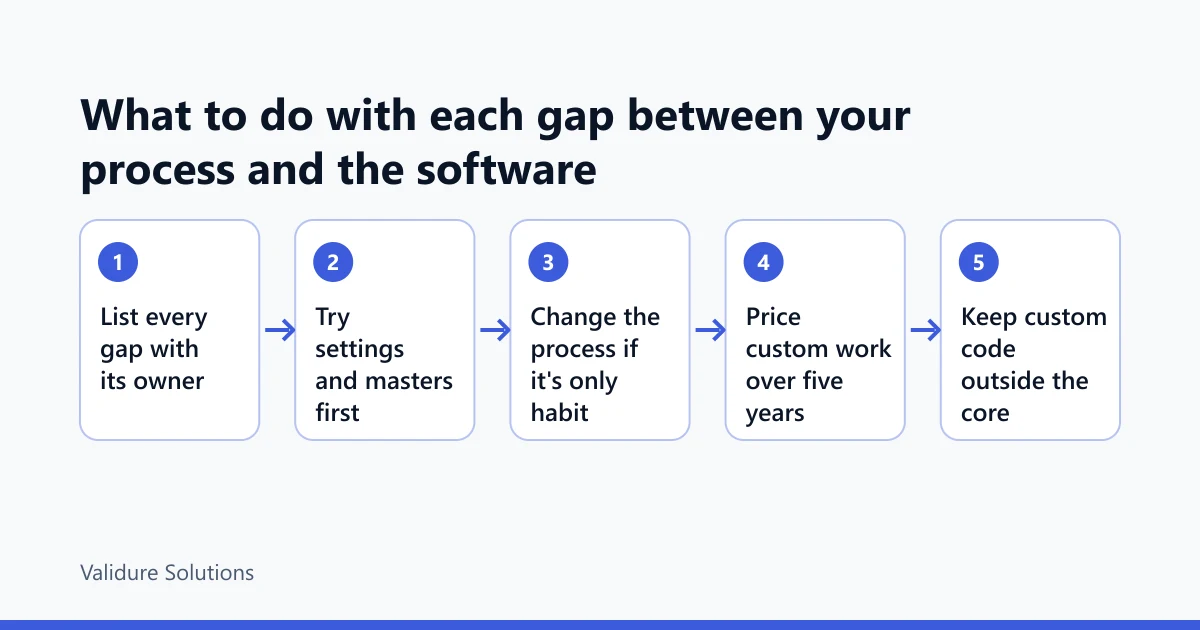
Collect every gap into one list, with the person who raised it and the reason. Sit with the implementation partner and mark each one configure, change process, extend or modify. Price the last two with the payback sum. Agree the list before the go-live date is set, not after, because the opening example's two-month slip came from saying yes to everything at once.
Then, three months after go-live, look at the "change process" items again. Some will have quietly turned into a spreadsheet running on the side. That's the signal that either the process change didn't land or the request was real after all, and it's the right moment to decide which.
Sources and checks
Rules checked on 19 November 2026. Confirm current positions on the official sites before you act.
- Ministry of Corporate Affairs, Companies (Accounts) Rules, 2014 and amendments, including the audit trail proviso to Rule 3(1): mca.gov.in
- Companies (Audit and Auditors) Rules, 2014, Rule 11(g): mca.gov.in
- GSTN advisory on the 30-day e-invoice reporting limit for aggregate turnover of 10 crore rupees and above: services.gst.gov.in
- e-invoice portal and the revised reporting time limit: einvoice6.gst.gov.in
- CBIC notifications on GST rates, including the rate changes effective 22 September 2025: cbic-gst.gov.in
Frequently asked questions
What's the difference between configuring and customising an ERP?
Configuring uses the software's own settings, such as tax masters, roles and print templates, and it carries over when the vendor updates the product. Customising changes or adds to the software's behaviour with code, and someone has to keep it working after every update.
Is ERP customisation always a bad idea?
No. It's worth it when the request is tied to how you win customers, the payback works once you include yearly upkeep, and it can be built as an extension outside the core. Most requests on a typical list don't meet all three.
Can we customise our accounting software so posted entries can be edited without a trace?
For a company in India, no. Since 1 April 2023 the Companies (Accounts) Rules require accounting software that keeps an edit log of every change and an audit trail that can't be disabled, and the auditor reports on it. Corrections should go through credit or debit notes or an edit that shows in the log.
How do I work out whether a customisation will pay for itself?
Divide the build cost by the yearly saving minus the yearly upkeep. If the answer is more than about three years, or the upkeep is bigger than the saving, it's usually not worth building.
Who should maintain custom work after the rollout?
A named person or firm, agreed in writing before the work starts, with the source code and documents handed over to you. If nobody can be named, wait until someone can.
What if the standard software doesn't fit our business at all?
Then customising it heavily is usually the wrong fix. Look at a different product built for your kind of business, or at custom software, and compare them over five years rather than on the first quote.