
Is the GST you paid on purchases part of your stock cost? Only when you can't get it back
By Validure team · · 14 min read
A worked guide to valuing stock when GST is involved. When the tax stays out of cost, when it goes in (composition, blocked and exempt credit, lost goods), what the 180-day rule does, and why income tax uses a different method that nets to zero.

Your accountant is closing the year and asks a simple question about the godown: is the closing stock figure with GST or without it? One person on the team says without, because GST is a pass-through. Another says with, because that's what the supplier's bill shows. A third points out that half the stock came from a supplier on the composition scheme whose bill had no GST line at all.
All three can be right, for different stock. The rule is short. Tax you can recover from the government stays out of stock cost. Tax you can't recover is part of what the goods cost you, so it goes in. The work is in deciding which bucket each rupee of GST falls into, and keeping that decision visible when goods are later sold, damaged or given away.
This post works through the numbers for the cases that come up in a small trading or manufacturing business. It's written for the person who keeps the books and for the owner who signs them. It's information, not tax advice; your accountant should confirm the treatment for your business.
The rule, in the accounting standard's own words
The accounting standard for stock in India is AS 2 (Valuation of Inventories), and Ind AS 2 for companies on Ind AS. Paragraph 7 of AS 2 says the cost of purchase is the purchase price "including duties and taxes (other than those subsequently recoverable by the enterprise from the taxing authorities)", plus freight inwards and other costs directly attributable to buying the goods. Trade discounts and rebates come off. Ind AS 2 uses almost the same words.
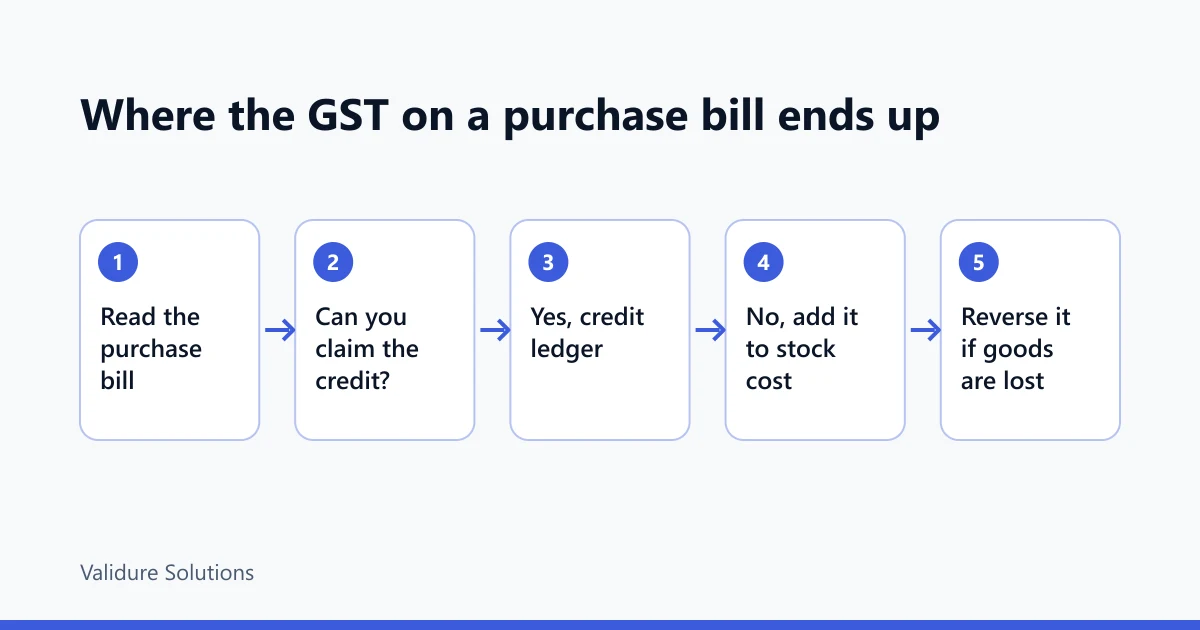
Under GST, "recoverable from the taxing authorities" means input tax credit. If you are a regular registered taxpayer and the credit on a purchase is available to you, the GST on that bill isn't a cost. It sits in an input credit ledger until you set it off against the GST you collect on sales.
If the credit isn't available, the GST is a cost like any other part of the price, and it belongs in stock value.
Example 1: a regular trader with full credit
Say a trader registered under the regular scheme buys 100 units of a product at 400 each, with GST at 18 per cent. The supplier's bill is:
| Line | Amount |
|---|---|
| 100 units x 400 | 40,000 |
| GST at 18% | 7,200 |
| Bill total | 47,200 |
A transporter charges 1,500 for freight inwards, plus 270 GST (18 per cent), and the trader can claim that credit too.
Cost of the stock is 40,000 + 1,500 = 41,500, which is 415 per unit. The 7,200 and the 270, together 7,470, go to the input credit ledger. If 30 units are unsold at year end, closing stock is 30 x 415 = 12,450.
Put the 47,200 into stock instead and you overstate it by 7,200, and then the same tax gets set off against your output GST as well. That's the double count you're trying to avoid.
Example 2: the same purchase, made by a composition dealer
Under section 10(4) of the CGST Act, a business paying tax under the composition scheme can't collect GST from its customers and isn't entitled to any input tax credit. So the GST on its purchase bills has nowhere to go except into cost.
Take the identical purchase, made by a composition dealer:
| Regular trader | Composition dealer | |
|---|---|---|
| Goods | 40,000 | 40,000 |
| GST on goods | to credit ledger | 7,200 into cost |
| Freight | 1,500 | 1,500 |
| GST on freight | to credit ledger | 270 into cost |
| Total stock cost | 41,500 | 48,970 |
| Cost per unit | 415.00 | 489.70 |
| Closing stock, 30 units | 12,450 | 14,691 |
The difference per unit is 74.70, which is the 72 of GST on each unit plus 2.70 of GST on freight per unit. For 30 units that's 2,241, and 14,691 minus 12,450 is the same 2,241.
Each figure is right for its own business. The mistake is a composition dealer copying a regular trader's stock sheet, or the other way round, which happens when the same bookkeeper handles both kinds of client.
The same logic covers anyone who buys from a composition supplier. Their bill of supply carries no GST, so there's nothing to claim. The full amount you paid is the cost.
Switching schemes moves tax in or out of stock
Changing scheme partway through a business's life is where stock values go quietly wrong.
When a regular taxpayer opts into composition, section 18(4) of the CGST Act requires them to pay back the credit already taken on stock held on the day before the switch. In the example above, 30 units in hand carry 30 x 72 = 2,160 of GST on goods (and whatever share of freight credit your adviser says applies). Once that's paid back, it isn't recoverable any more, so it becomes part of the cost of that stock.
Going the other way, section 18(1)(c) lets a composition dealer who becomes a regular taxpayer take credit on inputs held in stock on the day before the change, subject to the conditions and the form the rules prescribe. If you claim it, take it out of stock cost at the same time. If you don't claim it in time, it stays in cost.
Record either move on its date, with the stock count that supports it.
Where credit is blocked or only partly available
A regular taxpayer doesn't get credit on everything. The two cases that matter for stock and costs are blocked credits and exempt supplies.
Section 17(5) of the CGST Act lists credits that aren't available whatever you do with them. For stock, the relevant item is clause (h): goods lost, stolen, destroyed, written off or given away as gifts or free samples. Other items in the list, such as many motor vehicles and food and beverages, usually hit fixed assets or expenses rather than stock, but the treatment is the same. Blocked GST is a cost of whatever it was paid on.
Section 17(2) says that where goods or services are used partly for taxable supplies and partly for exempt supplies, credit is available only for the taxable part. The rules (rule 42 for inputs and input services) give the apportionment, broadly in the ratio of exempt turnover to total turnover. Inputs used only for exempt supplies get no credit at all.
So if you sell, say, packaged goods that attract GST alongside unpackaged goods that are exempt, the GST on stock bought only for the exempt line goes into the cost of that stock. GST on shared costs, like rent, is split, and the disallowed share goes to the expense it came in on.

Example 3: damaged stock and the credit you give back
Back to the regular trader. Say 20 of the units, carrying a cost of 415 each, are ruined by a roof leak and written off.
The stock loss is 20 x 415 = 8,300. Because the goods are destroyed, section 17(5)(h) blocks the credit already taken on them, so 20 x 72 = 1,440 has to be reversed in the GST return. That reversal isn't an asset any more. It's part of the loss.
| Amount | |
|---|---|
| Cost of units written off | 8,300 |
| Credit reversed on those units | 1,440 |
| Total loss in the books | 9,740 |
Whether the 2.70 per unit of freight credit also has to be reversed is a point some advisers take one way and some the other. Ask yours, and apply the answer the same way every time.
Two things catch people out here. First, insurance doesn't change the credit position: if the goods are destroyed, the credit goes, whether or not the claim is paid. Second, rule 56(2) of the CGST Rules expects your stock accounts to record goods lost, stolen, destroyed, written off or given away. If your stock register has no way to mark a write-off with a reason and a date, the reversal tends to be missed until an audit finds it, and then it comes with interest.
Goods taken out of stock as free samples or gifts follow the same pattern: the cost moves out of stock into the expense they're used for, and the credit on them is reversed and added to that expense.
The 180-day rule is a timing problem, not a cost
The second proviso to section 16(2) says that if you don't pay a supplier the value of the bill plus tax within 180 days of the invoice date, you have to reverse the credit you took on it, with interest. The third proviso lets you take it again once you do pay.
Because the credit comes back on payment, the reversed amount isn't a permanent cost and shouldn't be added to stock. Treat it as credit that's temporarily unavailable: track it against the unpaid bill, and reclaim it in the return for the period you pay. The interest is a finance cost, not stock. If you end up never paying the supplier, for example after a dispute is settled for less, that's when the lost part of the credit becomes a real cost, and your accountant will decide where it goes.
A decision table for every purchase bill
| Situation | Credit available? | Where the GST goes |
|---|---|---|
| Regular taxpayer, goods for taxable sales | Yes | Input credit ledger, not stock |
| Composition dealer, any purchase | No (section 10(4)) | Into stock or expense cost |
| Bought from a composition supplier | No GST charged | Whole bill is the cost |
| Goods used only for exempt supplies | No (section 17(2)) | Into stock cost |
| Shared inputs, taxable and exempt sales | Partly (rule 42) | Split: credit for the taxable share, cost for the rest |
| Goods later lost, destroyed or written off | Reversed (section 17(5)(h)) | Added to the loss |
| Unpaid after 180 days | Reversed, can be re-taken | Held as recoverable, not cost |
| Reverse charge on an eligible purchase | Yes, after paying the tax | Input credit ledger, not stock |
The reverse charge row surprises people: you pay the GST yourself, but if the purchase is eligible it's still recoverable credit.
Income tax sees stock differently, and it nets out
This is where the "with GST or without" argument usually comes from. For income tax, the computation has long used what's called the inclusive method. Section 145A of the Income-tax Act, 1961 required purchases, sales and stock to be adjusted to include taxes actually paid or incurred, and the income computation standard on inventories (ICDS II) includes taxes in cost whether or not they're recoverable. The Income-tax Act, 2025, which applies from 1 April 2026, carries a similar rule forward; commentators map it to section 277 of the new Act. Check the current text with your tax adviser before relying on the section number.
The point to understand is why it rarely changes taxable profit. If you add GST to opening stock, purchases, sales and closing stock alike, the additions cancel each other out. Your books can stay on the exclusive method, as AS 2 wants, and the tax audit report shows the method and any adjustment. Form 3CD has a clause for exactly this.
So the honest answer to the accountant at year end is: in the books, exclusive wherever the credit is recoverable; for the tax computation, the adviser makes the inclusive adjustment and shows it's neutral.
Checks to run before you sign off closing stock
| Check | What to look for | What a hit means |
|---|---|---|
| Composition period | Any stock bought while the business was on composition, or carried across a switch | GST should be inside that stock's cost; reconcile with the section 18 payment or claim |
| Bills of supply | Purchases from composition suppliers recorded with a GST line | A credit claimed that doesn't exist |
| Exempt lines | Items sold only as exempt that show credit taken on their purchase | Credit to reverse and add to cost |
| Write-offs and samples | Stock reduced for damage, theft, expiry or samples without a matching credit reversal | A reversal missing from the GST return, plus interest |
| Unpaid bills over 180 days | Supplier balances older than 180 days on credit you've claimed | A reversal due now, to be re-taken on payment |
| Per-unit cost sense check | Cost per unit in the stock sheet against the bill price before GST | Units carried at the GST-inclusive price by mistake |
The last check takes five minutes and catches the commonest error, a stock sheet built by copying bill totals. If the trader in Example 1 shows 472 per unit instead of 415, the stock sheet is carrying tax that's also sitting in the credit ledger.
Keep the tax and the cost apart when you enter the bill
Most of this goes wrong at data entry, not at year end. If a purchase is keyed in as one total, nobody can later tell which part was credit and which was cost. Enter the taxable value, the GST split into CGST and SGST or IGST, and whether the credit is eligible, at the time you book the bill.
Validure ERP records purchases and expenses with the input tax credit kept separately from the purchase value, and keeps a full audit trail, so a reversal months later shows who changed what and when. It also produces GSTR-3B summaries from the same entries, which is where a credit reversal has to show up. Any decent accounting package can do the split; what matters is that the bookkeeper uses it every time.
If you're a small composition dealer with one supplier and a few dozen lines of stock, you don't need a system for this. A stock sheet that carries cost including GST, plus a note of the date you joined the scheme, is enough.
Sources and checks
Verify against the official texts before relying on any figure or section here, because GST rules change by amendment and notification. The CGST Act and Rules (sections 10, 16, 17 and 18, rules 37, 42 and 56) are on the CBIC GST portal. Returns and credit reversal are filed on the GST portal. AS 2 and Ind AS 2 are published by the Institute of Chartered Accountants of India. The Income-tax Act, ICDS and the tax audit form are on the Income Tax Department site. Checked 22 November 2026. The numbers above are examples with round figures, not advice.
Frequently asked questions
Should closing stock be valued with GST or without it?
Without it, wherever the credit on the purchase is available to you. With it, where you couldn't claim credit, for example on the composition scheme or for goods used only in exempt supplies.
I'm on the composition scheme. Do I include GST in my stock?
Yes. Section 10(4) of the CGST Act denies composition taxpayers input tax credit, so the GST on purchase bills is part of what the goods cost you.
Our stock was damaged. Does the GST credit reversal add to the loss?
Yes. Section 17(5)(h) blocks credit on goods destroyed or written off, so the credit taken on them is reversed and becomes part of the loss, insured or not.
If I reverse credit after 180 days, does it become stock cost?
No. You can take it again once you pay the supplier, so treat it as temporarily unavailable credit, not cost. Only credit you finally lose becomes a cost.
Why does the tax audit report show stock including GST?
Income tax uses the inclusive method for the computation. When it's applied to opening stock, purchases, sales and closing stock alike, the effect on taxable profit is usually nil.
Does freight on purchases go into stock cost?
Yes, freight inwards is part of the cost of purchase under AS 2. The GST on the freight follows the same rule as the GST on the goods: out of cost if you can claim it, in if you can't.
