Can your employer hold your final settlement? The two-day rule, with the arithmetic
By Validure team · · 13 min read
What the Code on Wages says about paying a resigning employee, which deductions are allowed, and how a full-and-final settlement adds up. A worked example for both the employee and the small employer, with the points that are still unsettled.

Say a 30-person company has a designer who resigns, serves most of her notice and leaves on Friday 20 November 2026. The following Friday she still hasn't been paid. HR says full-and-final settlement "takes 45 days, as per policy". She has read somewhere that it should be two days. Who is right?
Short answer: the written law has a two-working-day rule for wages when someone resigns, and a company policy that promises longer is hard to defend against it. But "wages" is a narrower word than "everything you are owed", and several parts of a settlement follow other timelines or are still argued over. This post separates those parts, then works through a settlement with real numbers so both sides can check the sum.
It's information, not legal advice. Rights differ by state, by industry and by contract. For a specific dispute, ask the labour commissioner's office or a labour lawyer. I checked the provisions below in November 2026, and I've said where I couldn't confirm something.
What the two-day rule says
The Code on Wages, 2019 is one of the four labour codes that the government brought into effect on 21 November 2025. Section 17 deals with when wages must be paid. Sub-section (1) covers the normal cycle: for monthly-paid staff, wages are due before the expiry of the seventh day of the following month. Sub-section (2) is the one that matters at exit. Where an employee has been removed, dismissed or retrenched, has resigned, or has become unemployed because the establishment closed, the wages payable must be paid within two working days.
Two things are new compared with the older Payment of Wages Act, according to the legal commentary I read. The two-day period now includes resignation, not only employer-initiated termination. And it applies to the wages "payable", which several law firms read as running from the last working day, not from the day the resignation letter was submitted. That reading is sensible, but it comes from commentary, not from a court ruling that I could find.
Sub-section (3) lets the appropriate government set a different limit if it considers that reasonable. Sub-section (4) keeps any shorter limit that another law sets. The central rules under the Code on Wages were notified in May 2026, and state rules were still being finalised in many states at the time of writing. I could not confirm from the rules themselves whether any of them sets a different time limit for exit payments, so check your state's rules and the labour department's page before you rely on the two-day figure for a specific case.
Wages are not the whole settlement
This is where most arguments start. A full-and-final settlement is a bundle, and the bundle has parts with different clocks.
| Part of the settlement | Where the rule comes from | Timing |
|---|---|---|
| Salary up to the last working day | Code on Wages, section 17(2) | Two working days from the exit date, unless your state sets otherwise |
| Leave encashment | Company policy, contract, standing orders, state shops and establishments law | Depends on the document that grants it |
| Notice pay owed to you (if the employer ends your service without notice) | Contract, standing orders | Depends on the contract |
| Bonus due for the year | Code on Wages, bonus provisions | Per the bonus rules; check with your adviser |
| Gratuity | Code on Social Security, 2020 and the gratuity rules under it | Its own rule, separate from the two-day one |
| PF withdrawal | EPFO, through the member's own claim | Claim is made by the member online; not an employer payment |
Notice the PF row. Provident fund isn't paid out by the employer at all. The employee files a claim with EPFO, and the employer's job is to have filed the contributions and, where needed, approved the exit date. Holding a settlement "until PF is cleared" mixes two different processes.
Gratuity has its own eligibility test and formula, and I could not verify the payment deadline under the Code on Social Security from an official text, so I've left a number out. The old Payment of Gratuity Act and the new Code both treat gratuity as a separate entitlement. Check the current text on the labour ministry's site.
What an employer can deduct
Section 18 of the Code on Wages starts from a strong position: no deductions from wages except those the Code authorises. The list in sub-section (2) is specific. It includes fines, deductions for absence from duty, damage to or loss of goods entrusted to the employee where it's directly attributable to their neglect or default, recovery of advances and overpaid wages, income tax and other statutory levies, contributions to social security funds such as PF, and a few items that need the employee's written authorisation, such as trade union fees. Sub-section (3) says the total of these deductions in any wage period can't go above 50 per cent of that period's wages, and sub-section (4) lets an excess be recovered in the way the rules prescribe.
Look at what's not on the list in plain words: a general "notice shortfall" recovery, a "training cost" bond, or a blanket "pending handover" hold. Whether a notice-pay recovery fits inside the listed items is, as far as I could find, not settled in one authoritative place. Employers routinely recover it, and many contracts allow it. Employees have argued that the Code's list is exhaustive. Both positions are held in good faith. If you are the employee and the amount is large, or the employer if you are about to make such a deduction, get a view from a lawyer who knows your state.
A worked settlement
This is an example, with round numbers. Every figure is made up to show the method.
The designer earns 48,000 a month. Her notice period in the contract is 60 days. She worked 45 days of it and leaves on 20 November, so the shortfall is 15 days. She has 6 days of earned leave in her balance, and the policy allows encashment at exit. She has an unrecovered advance of 5,000. The company divides monthly pay by 30 for daily rates, and the policy says so in writing.
| Line | Working | Amount |
|---|---|---|
| Salary for 1 to 20 November | 48,000 x 20 / 30 | 32,000 |
| Leave encashment, 6 days | 48,000 / 30 x 6 | 9,600 |
| Total earned | 32,000 + 9,600 | 41,600 |
| Notice shortfall recovery, 15 days | 48,000 / 30 x 15 | (24,000) |
| Advance recovery | (5,000) | |
| Total recoveries | 24,000 + 5,000 | 29,000 |
| Net payable | 41,600 - 29,000 | 12,600 |
Income tax on the salary, PF and any tax on the encashment are left out for simplicity. A real statement would show them as their own lines.
Now check the sum against the 50 per cent cap in section 18(3). Recoveries are 29,000 against earnings of 41,600, which is 69.7 per cent. If you read the cap as applying to every one of these recoveries, this settlement is over the line. If you read notice recovery as outside section 18's list, the only listed deduction is the advance, 5,000, which is 12 per cent and well inside. The same facts give two answers depending on how that one line is read. That's the real state of the question, and it's why a plain "the employer can't deduct anything" or "the employer can deduct whatever the contract says" are both too simple.
Two practical points follow. First, the recovery must match a written term. If the contract says nothing about notice recovery, an employer who deducts it is on weaker ground. Second, the calculation basis matters. Some contracts use gross monthly pay for notice recovery, others use basic only. In this example the difference is large: if basic is half of pay, a 15-day recovery on basic would be 12,000, not 24,000, and the settlement becomes 24,600 instead of 12,600.
Can the employer hold the relieving letter or the original documents?
Companies do hold relieving letters until handover is finished or a bond amount is cleared. Employees do ask whether that's legal. I found no single rule that settles this across India. A relieving letter isn't wages, so the section 17 clock doesn't cover it. One Bombay High Court ruling reported in legal news went the employer's way where the resignation was a breach of a service bond. Other forum answers say an employee is entitled to the letter without conditions. These are not the same fact patterns, so don't treat either as a rule.
Original certificates are different in practice. Holding someone's original degree or identity documents is widely treated as unreasonable, and in some states it's a matter for the labour department. The safer course for an employer is to take copies at joining and keep the originals with the employee.

For the employer: how to pay on time without cutting corners
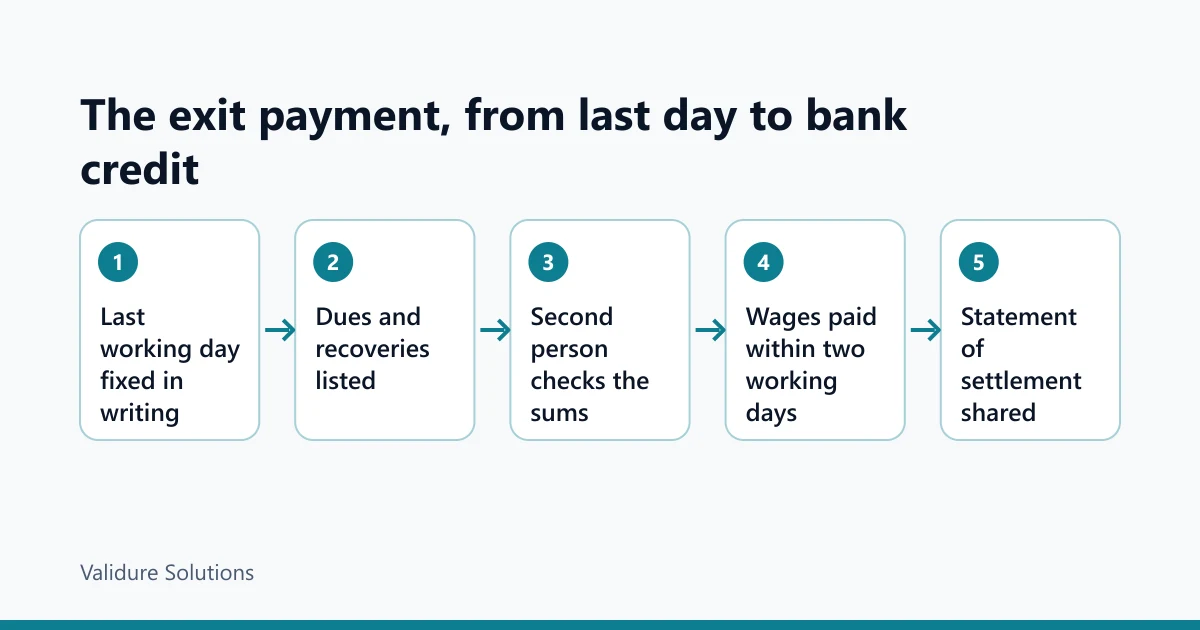
A two-day deadline sounds harsh until you notice that most of the work can be done before the last day. The idea is to treat the settlement as a prepared statement, not as a task that starts when the person leaves.
| Check | What to look for | What a hit means |
|---|---|---|
| Exit date in writing | A dated acceptance of the resignation with the last working day stated | Without it, the two days have no agreed start and the dispute begins on day one |
| Leave ledger replay | Opening balance plus accruals minus approved leave, replayed to the exit date | A balance someone typed over; fix it before the employee sees it |
| Advances and loans | A list of open amounts with the original sanction | A recovery you can't prove, or one the employee already repaid |
| Contract terms for recoveries | The notice clause, bond clause and the basis used | A deduction with no written basis |
| Pre-computed statement | A settlement sheet drafted a week before exit, updated on the day | Surprises on the last day |
| Second pair of eyes | A second person re-adds the sheet | A transposed digit that costs a dispute |
If you can send the draft settlement to the employee a few days before the last day, most disputes are resolved while the person is still at work and still reachable. Where a figure is disputed, pay the undisputed amount on time and say in writing what is under discussion. That keeps you on the right side of the deadline for the part nobody argues about.
Handling the leave balance well is half the battle. In Validure HR the leave ledger shows every accrual and every approved leave, so the encashment line can be replayed from the record instead of recalled. It doesn't compute a full-and-final statement for you; you still draw that up. If you have under ten people and few exits a year, a clean spreadsheet with the table above does the job.
For the employee: what to do next
If you've resigned or been let go, keep these:
- The resignation letter and the employer's acceptance, showing the last working day.
- Your offer letter and any contract, standing orders or handbook with the notice, leave and bond clauses.
- Your last three payslips and the leave statement.
- Any email about advances, loans or equipment you returned.
Then in order: ask HR for the settlement statement in writing, with the working for each line. If the two working days have passed, send a short written reminder that cites section 17(2) and names the amount you believe is undisputed. If that fails, the usual route is the labour commissioner's office for your state, and many states take complaints through the Shram Suvidha portal run by the labour ministry. A labour lawyer is worth the fee if the amount is big or a bond is involved.
Don't resign by message alone, don't sign a "no dues" form until the figures are on paper, and don't ignore a demand for equipment you do hold. Return it and get a receipt.
Who doesn't need to worry about this
If you're an employee whose company already pays final salary on the last working day with a written statement, nothing here changes your life. If you're an employer with a handful of staff, the same applies: the rule costs you nothing if your exit routine is already tidy. The pressure falls on companies that batch exits into a monthly cycle, or that treat settlement as a month-end finance task.
Sources and checks
Primary texts and official pages, which you should read yourself before relying on anything here:
- India Code, for the Code on Wages, 2019 (sections 17 and 18) and the Code on Social Security, 2020.
- Ministry of Labour and Employment, for the codes, notified central rules and the Shram Suvidha portal.
- Press Information Bureau, for the November 2025 announcement of the four codes taking effect.
- EPFO, for how PF claims work.
I read the text of sections 17 and 18 through a legal-text mirror and checked it against law-firm and news commentary. I could not confirm: the exact wording of the central or any state rules on exit payment timing, the gratuity payment deadline under the Code on Social Security, and whether a notice-pay recovery sits inside section 18's list. Where commentary differed, I said so.
Frequently asked questions
Is the two-day rule really in force?
The Code on Wages came into effect on 21 November 2025 and section 17(2) is part of it. State rules were still being finalised in many places, and sub-section (3) allows a government to set a different limit, so check your state.
Does the two days start when I give notice or when I leave?
Commentary reads it as the last working day, since wages are only payable up to then. The text says "within two working days" without naming the start, so write the last working day down.
Can the employer take back the notice period shortfall from my pay?
Many contracts allow it and employers do it. Whether it fits inside the deductions section 18 permits, and under the 50 per cent cap, is read differently. If the amount matters, ask a labour lawyer.
Is leave encashment mandatory when I resign?
Not by a single national rule that I could find. It depends on your contract, the company policy and your state's law for your type of establishment.
Can my employer refuse my relieving letter?
There's no single answer. A relieving letter isn't wages. Some courts have let employers withhold it over a breached bond, and others see no basis for conditions. Ask for it in writing and keep your correspondence.
Where do I complain if the settlement is late?
Start with a written request to HR, then the labour commissioner's office for your state. Many states take complaints through the Shram Suvidha portal.