Your company has fewer than 10 people and no POSH committee. Where does a harassment complaint go?
By Validure team · · 15 min read
How a sexual harassment complaint works when the workplace is too small for an Internal Committee. The Local Committee, the deadlines with worked dates, what the small employer still has to do, and where to file. Checked against the Act on 20 November 2026.

Say you work at an eight-person design studio in Kolkata. One of the two partners has been making remarks about your clothes for weeks, and last Friday he put his hand on your back in the pantry and left it there. You've read that companies must have a POSH committee. Yours doesn't. There's no HR person, and the only people you could complain to are the partner himself and his business partner, who is also his cousin.
You still have a route, and it doesn't run through your employer. Under the Sexual Harassment of Women at Workplace (Prevention, Prohibition and Redressal) Act, 2013 (the POSH Act), a workplace with fewer than ten workers isn't expected to have its own Internal Committee. Complaints from those workplaces, and complaints against the employer himself, go to a Local Committee set up for each district by a government officer. That committee has the same powers as an Internal Committee, works to the same deadlines, and its recommendations bind your employer.
This post covers where the complaint goes, the deadlines with real dates, what happens after you file, and what a small employer still has to do. It's for both the woman weighing her options and the small-firm owner who wants to get this right. It's information, not legal advice. I read the sections quoted here in a government copy of the Act on 20 November 2026. For a specific case, talk to the Local Committee, a women's rights organisation or a lawyer.
The short version: which committee hears the complaint
The Act sets up two kinds of committee. Section 4 makes every employer constitute an Internal Committee, with one at each office or administrative unit. Section 6 then has the District Officer set up a Local Committee "to receive complaints of sexual harassment from establishments where the Internal Committee has not been constituted due to having less than ten workers or if the complaint is against the employer himself."
So there are two triggers for the Local Committee, and the second one is easy to miss. Even a 200-person company sends a complaint to the Local Committee when the person complained about is the employer.
| Your situation | Where the complaint goes |
|---|---|
| Workplace has 10 or more workers and an Internal Committee | The Internal Committee |
| Workplace has fewer than 10 workers, no Internal Committee | The Local Committee for the district |
| The complaint is against the employer himself, any size | The Local Committee |
| Domestic worker in a home | The Local Committee (which forwards to police if there's a prima facie case) |
| Small firm that has set up an Internal Committee anyway | Arguably the Internal Committee, since section 9 says complaints go to it "if so constituted". If you don't trust it, ask the Local Committee whether it will take the case |
Two words in the Act matter here. "Employer" for a private workplace means "any person responsible for the management, supervision and control of the workplace", which covers the owner, the partners and the board. "Employee" is defined very widely: regular, temporary, ad hoc and daily wage staff, people hired through a contractor, trainees, apprentices, probationers and volunteers, paid or not.
The Act doesn't say exactly how to count the "ten workers". The safe reading for an employer is to count everyone at that office in any of those categories, interns and contract cleaners included, and set up an Internal Committee at ten.
Who the Local Committee is
Section 5 lets the state government notify a District Magistrate, Additional District Magistrate, Collector or Deputy Collector as the District Officer for each district. Under section 7 that officer nominates the Local Committee: a Chairperson from among eminent women in social work, a woman working locally in the district, two members from organisations working for women's rights (preferably one with legal knowledge), and the district's women and child development officer. None of them work for your employer.
For years many districts simply hadn't done this. On 3 December 2024 the Supreme Court, hearing a case on POSH implementation, directed every state and union territory to appoint District Officers by 31 December 2024 and to have Local Committees in place by 31 January 2025, according to reports of the order. Later reports of status filings say all states have appointed District Officers and most have constituted Local Committees, with a few states still unclear. So in most districts the committee should now exist. Whether it meets regularly is another question, and that's worth knowing before you rely on it.
How to file, and with whom
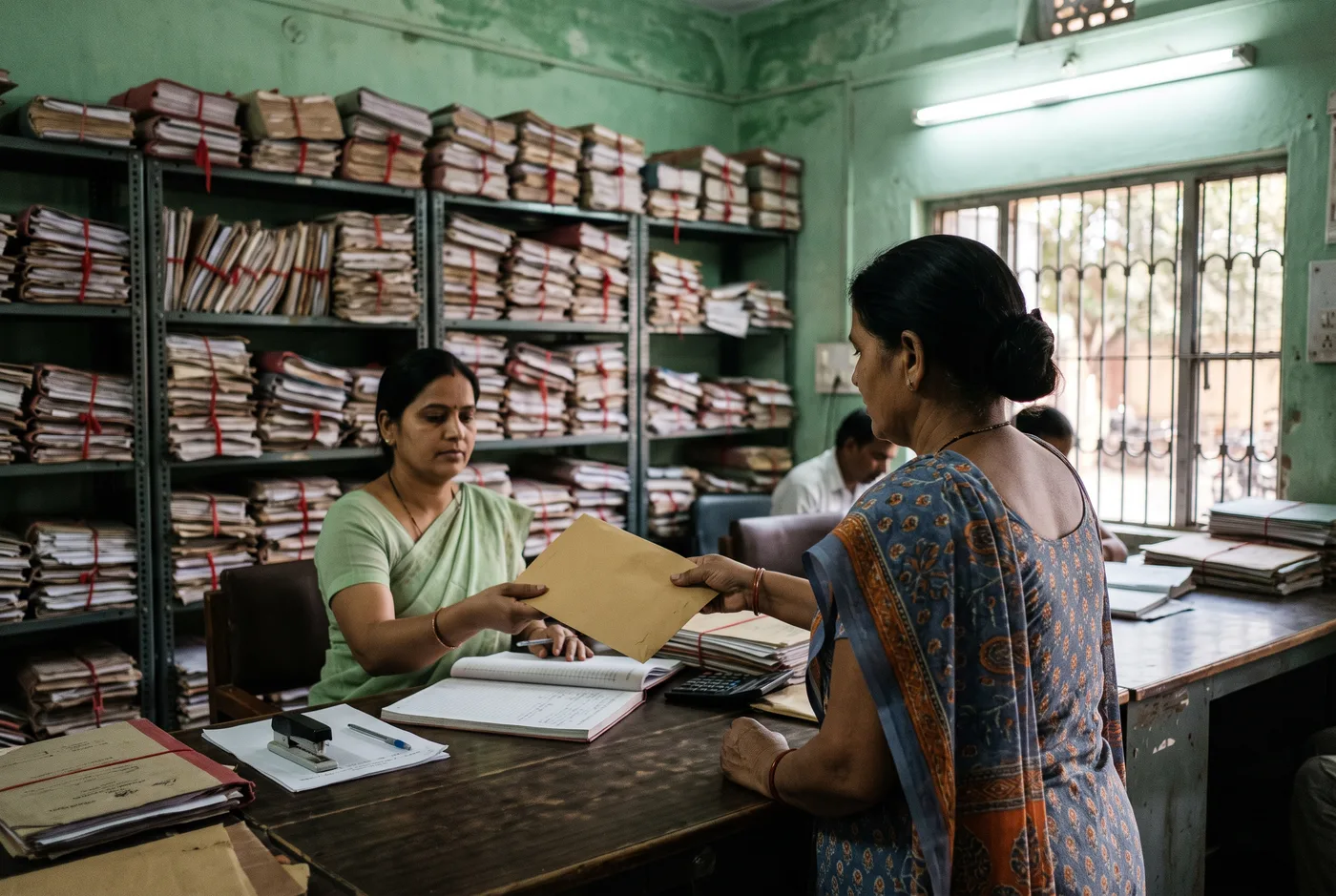
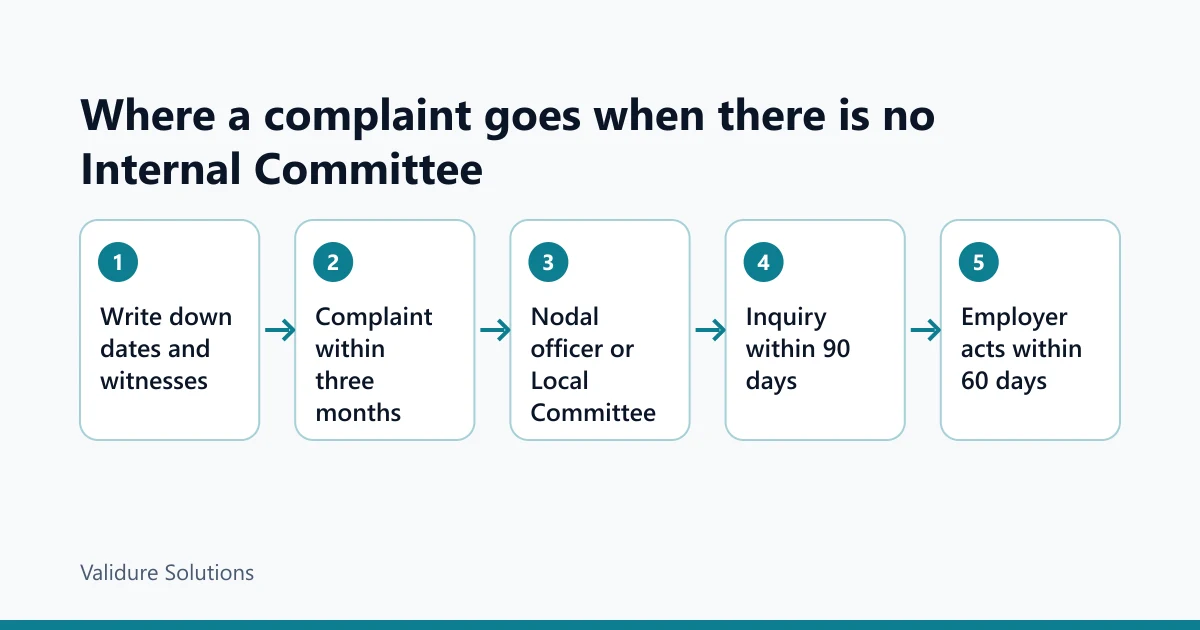
There are three ways in, and they all end at the same committee. Section 6(2) has the District Officer name a nodal officer in every block, taluka or tehsil, and every ward or municipality in towns, who must forward a complaint to the Local Committee within seven days. You can also hand it to the Local Committee directly; the district's women and child development office or the collectorate will have the address. Or you can use SHe-Box, the ministry's online portal at shebox.wcd.gov.in, relaunched in August 2024, which the ministry says routes complaints from any woman, public or private sector, to the right committee. The ministry also said it works fully only once states and employers upload their committee details, so if your district's committee isn't listed, file on paper as well.
The Rules ask for six copies of the complaint, with supporting documents and witnesses' names and addresses. If you can't write it, section 9 says a committee member has to give "all reasonable assistance". Put in who did what, where and when, who saw it, any messages or call logs, and anything that changed at work afterwards. Keep a copy, with the date you handed it in and to whom.
The deadlines, with real dates
The Act runs on a chain of deadlines. Here's what they mean on a calendar.
Section 9 gives you three months from the incident, or from the last incident if it was a series. The committee can extend that by up to three more months, for reasons it records in writing, if circumstances kept you from filing.
Example 1, a series of incidents. Remarks started in June 2026. The last incident, the hand on the back, was on 14 August 2026.
| Step | Rule | Date |
|---|---|---|
| Last incident | 14 August 2026 | |
| Normal deadline | 3 months from last incident | 14 November 2026 |
| Latest with an extension | Up to 3 more months, at the committee's discretion | 14 February 2027 |
Because the deadline runs from the last incident, the June remarks are inside the complaint too. That's why it's worth writing down every incident with its date, not only the worst one.
Example 2, what happens after filing. Say the complaint reaches the Local Committee on 3 December 2026 and no conciliation is asked for.
| Step | Rule | Date |
|---|---|---|
| Complaint received | 3 December 2026 | |
| Copy sent to the person complained about | Within 7 working days (Rules) | by about 14 December 2026 |
| Their reply | Within 10 working days of receiving it (Rules) | late December 2026 |
| Inquiry finished | 90 days, section 11(4) | 3 March 2027 |
| Report to the employer and District Officer | 10 days after the inquiry ends, section 13(1) | 13 March 2027 |
| Employer acts on the recommendations | 60 days, section 13(4) | 12 May 2027 |
| Last day to appeal the recommendations | 90 days, section 18(2) | 11 June 2027 |
Check the 90 days: 28 days left in December after the 3rd, plus 31 in January and 28 in February, is 87, so day 90 is 3 March. From 13 March, 18 days take you to the end of March, 30 more to the end of April, and 12 into May make 60. For the appeal, 18 plus 30 plus 31 is 79 at the end of May, and 11 more is 11 June. The working-day steps depend on holidays, so treat those two dates as approximate.
Committees do run late. The dates are still what you point to when you ask the District Officer why nothing has happened.
What the committee can do
During the inquiry, if you ask in writing, the committee can recommend a transfer for you or the other person, or up to three months' leave on top of your normal leave (section 12). The employer has to carry it out. In an eight-person office a transfer may not be possible; leave is.
The committee has the powers of a civil court to summon people, take evidence on oath and call for documents. Neither side can bring a lawyer into the hearing, under the Rules. If you want to settle, section 10 allows conciliation at your request before the inquiry starts, with one firm limit: "no monetary settlement shall be made as a basis of conciliation." A payment in exchange for dropping the complaint isn't a conciliation the Act recognises.
If the complaint is proved, section 13(3) says the committee recommends action for misconduct and can order a sum deducted from the respondent's salary and paid to you. Section 15 lists what it weighs: mental trauma and distress, lost career chances, medical costs, the respondent's income, and whether to pay in a lump sum or in instalments. If the respondent doesn't pay, the order can be sent to the District Officer to recover as arrears of land revenue.
Example 3, compensation in instalments. Say a committee recommends 60,000 rupees deducted from the respondent's salary at 10,000 a month, so six deductions. If he leaves after four, 20,000 is still due, and section 13(3) lets the committee direct him to pay it himself.
Where the person complained about is the owner, the committee's report goes to the District Officer, who is the one who acts on it. That's the point of sending owner complaints to the Local Committee: nobody is asked to judge their own case.
What happens if the complaint fails
Section 14 lets a committee recommend action against a complainant only if the complaint was malicious or knowingly false, or used forged documents, and only after a separate inquiry into the malicious intent. It also says "a mere inability to substantiate a complaint or provide adequate proof need not attract action against the complainant." Failing to prove something isn't lying about it, so a threatened counter-case has little footing.
The Act also sits alongside the criminal law, not in place of it. Sexual harassment is an offence under section 75 of the Bharatiya Nyaya Sanhita, which replaced section 354A of the old Penal Code from 1 July 2024. You can go to the police as well as, or instead of, the committee. Section 19 says the employer has to help you file a criminal complaint if you choose to.
What the small employer still has to do
Being under ten doesn't take a firm outside the Act. Section 19 lists duties for "every employer": a safe workplace, including safety from visitors and clients; the penal consequences of harassment displayed where people can see them; awareness sessions at regular intervals; facilities, witnesses and information for the Local Committee when it inquires; and treating harassment as misconduct.
Section 22 adds one that small firms almost always miss. Where an organisation doesn't publish an annual report, the employer has to intimate the number of cases filed and disposed of to the District Officer. If there were none, it costs nothing to say so in writing.
Section 26 sets a fine of up to 50,000 rupees for failing to set up an Internal Committee where one is required, failing to act on a committee's recommendations, or otherwise breaking the Act or its rules. A repeat conviction can bring twice the punishment and cancellation or non-renewal of the licence or registration the business needs. The wording on the doubled fine is a little tangled, but it's commonly read as up to 1,00,000 rupees for a second offence, and losing a trade licence hurts a small firm more than the fine.
Here's a check-list a small employer can run once a year. It takes an hour.
| Check | What to look for | What a hit means |
|---|---|---|
| Headcount, everyone counted | Interns, trainees, contract and daily wage staff at each office | At 10 or more in an office, you need an Internal Committee there |
| Notice on the wall | Penal consequences displayed, plus the Local Committee or nodal officer contact | Missing notice is a section 19 breach |
| Awareness session | Date of the last one and who attended | None this year means it's due |
| Written policy | Says what harassment is, where to complain, and that retaliation is misconduct | Without it staff assume the boss decides |
| Annual intimation | Number of cases sent to the District Officer | Not sent means a section 22 gap |
| Records access | Who can open complaint papers | Section 16 bars disclosing the complainant's identity; limit access to the people dealing with it |
Two of these are record-keeping jobs. If you run HR in Validure HR, the policy and session notes can sit in its document store next to offer letters, and role-based permissions keep complaint papers visible only to the people handling them. For a firm of eight, a locked cabinet and a calendar reminder work too. The law cares that it's done, not what tool you use.
Who this doesn't fit
The Act protects women; a man harassed at work has to rely on company policy, his contract or the criminal law. And in a workplace of ten or more with an Internal Committee you don't trust, the route is still that committee, then appeal under section 18. The Local Committee isn't a fallback for that unless the complaint is against the employer.
What to do next
If you're the one being harassed:
- Write down every incident with date, place and witnesses, today, while you remember.
- Save messages and call logs somewhere your employer can't reach, such as your own phone and email.
- Count back from the last incident. If you're near three months, file first and add detail later.
- Ask the district women and child development office or the collectorate for the Local Committee's address and your nodal officer, and register on SHe-Box as well.
- Keep a copy of the complaint with the date and the name of whoever received it.
If you're the employer and a complaint lands on you: don't investigate it yourself, don't try to settle it with money, and don't change the complainant's pay or duties without the committee's recommendation. Tell the Local Committee what facilities you can offer and answer what it asks. That's the whole job.
Sources and checks
Checked on 20 November 2026. Section numbers are from the Act as amended by Act 23 of 2016, which renamed the committees.
- The Act, on India Code: indiacode.nic.in
- The Act on the Legislative Department site: legislative.gov.in
- Ministry of Women and Child Development: wcd.gov.in
- SHe-Box complaint portal: shebox.wcd.gov.in
- Press Information Bureau release on the SHe-Box relaunch, August 2024: pib.gov.in
- Supreme Court of India, for the December 2024 order and later directions: sci.gov.in
The Rules details (six copies, working-day limits, no lawyers at hearings) come from public copies of the 2013 Rules, and the Supreme Court deadlines from press reports of the order; check both against the official text.
Frequently asked questions
Does a company with fewer than 10 employees need a POSH committee?
It doesn't need its own Internal Committee. Complaints from workplaces with fewer than ten workers go to the Local Committee set up by the District Officer. The employer still has duties under section 19, such as displaying the penal consequences, running awareness sessions and helping the Local Committee.
Where do I complain if the harasser is the owner?
The Local Committee for the district, whatever the size of the company. Section 6 sends complaints against the employer himself there, and the report goes to the District Officer, who acts on it.
How long do I have to file?
Three months from the incident, or from the last one in a series. The committee can extend that by up to three more months if it records reasons why you couldn't file sooner.
Can I file online?
Yes, through SHe-Box at shebox.wcd.gov.in. Because the portal depends on states uploading their committee details, it's sensible to also hand a paper copy to the nodal officer or Local Committee and keep proof of the date.
Can my employer sack me for complaining?
The Act treats sexual harassment as misconduct and lists "threat of detrimental treatment" and threats about your employment as forms of harassment in section 3. Retaliation can be part of your complaint. Write it down with dates and add it.
Can we settle it with a payment?
Not through the Act's conciliation. Section 10 says no monetary settlement can be the basis of conciliation. Compensation comes only through the committee's recommendation after an inquiry.