
Why did the tax on your salary jump in January? How employers work out TDS, with the maths
By Validure team · · 14 min read
Salary TDS is not a flat percentage. It is the year's estimated tax, minus what was already deducted, spread over the months left. Worked examples for a mid-year raise, missing investment proofs, a job change and the 12 lakh cliff, plus checks for employees and payroll teams.

Say you earn ₹1.5 lakh a month and your January payslip shows ₹14,000 more tax than December. Nothing about your job changed. You didn't get a raise. You open the payslip, then the portal, then message HR, and the answer comes back in one line: "your proofs were short". That's usually right, but it's only one of four common reasons, and the maths behind all of them is the same.
The short answer: your employer doesn't deduct a fixed percentage of each month's pay. It estimates your tax for the whole year, subtracts what it has already deducted, and spreads what's left over the months remaining. When the estimate changes late in the year, the catch-up lands on the last few payslips. January to March is where most estimates get corrected, so that's where the jumps show up.
This post works through the formula, four worked examples, and the checks that tell you whether a jump is right. It's written for employees and for the person who runs payroll in a small company. It's general information on how salary TDS works, not tax advice for your case. Rates and rules below were checked on 21 November 2026 for tax year 2026-27.
The rule your employer is following
From 1 April 2026, tax on salary is deducted under section 392 of the Income-tax Act, 2025, which replaced section 192 of the 1961 Act. The wording of the duty didn't change much. The employer deducts tax at the time of payment "at the average rate" of tax on your estimated salary income for the year.
In practice almost every payroll system turns that into one formula, run every month:
This month's TDS = (estimated tax for the whole year − TDS already deducted this year) ÷ months left, including this one
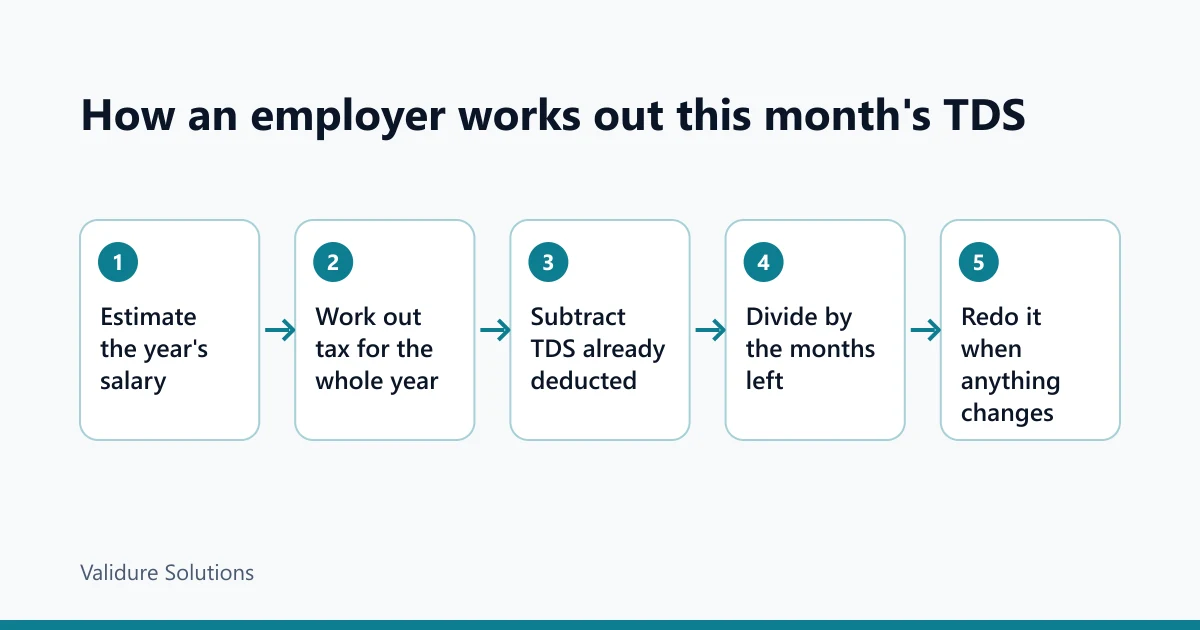
Two things follow from it. First, if the estimate stays the same all year, TDS is flat. Second, any change to the estimate is spread only over the months that remain. A change found in April is spread over twelve months and you barely notice. The same change found in January is squeezed into three.
The employer has a reason to catch up rather than leave it to you. Under the 1961 Act, an employer that deducted too little could be treated as being in default and charged interest. Expect the same treatment under the new Act and confirm the exact provision with a tax adviser if it matters to you. So payroll teams correct the shortfall before March closes.
The slabs the estimate uses for 2026-27
Budget 2026 left the new-regime slabs, the standard deduction and the rebate as they were set in 2025. The new regime is the default unless you tell your employer you want the old one.
| Taxable income (new regime) | Rate |
|---|---|
| Up to ₹4,00,000 | Nil |
| ₹4,00,001 to ₹8,00,000 | 5% |
| ₹8,00,001 to ₹12,00,000 | 10% |
| ₹12,00,001 to ₹16,00,000 | 15% |
| ₹16,00,001 to ₹20,00,000 | 20% |
| ₹20,00,001 to ₹24,00,000 | 25% |
| Above ₹24,00,000 | 30% |
On top of that: a standard deduction of ₹75,000 for salaried people, a rebate of up to ₹60,000 that makes tax nil when taxable income is ₹12 lakh or less, and 4% health and education cess on the tax. In the old regime the basic exemption is ₹2.5 lakh, the standard deduction is ₹50,000, the slabs are 5%, 20% and 30%, and you can claim deductions such as HRA, the ₹1.5 lakh investment deduction (what used to be section 80C), health insurance and the extra NPS deduction. The new Act renumbered those sections, so your payslip or declaration form may use new section numbers for the same things.
Surcharge starts above ₹50 lakh and isn't covered here.
Example 1: a raise in October, and tax appears from nowhere
Example. Priya, in the new regime, earns ₹1,00,000 a month from April. Her employer's estimate for the year is ₹12,00,000. After the ₹75,000 standard deduction her taxable income is ₹11,25,000. The slab tax on that is ₹52,500 (₹20,000 on the 5% band plus ₹32,500 on the 10% band), and the rebate wipes it out. TDS from April to September: nil.
In October she gets a raise to ₹1,30,000 a month. The new estimate is six months at ₹1,00,000 plus six at ₹1,30,000, which is ₹13,80,000.
| Step | Amount |
|---|---|
| Estimated salary for the year | ₹13,80,000 |
| Less standard deduction | ₹75,000 |
| Taxable income | ₹13,05,000 |
| Tax: 5% band (₹4L to ₹8L) | ₹20,000 |
| Tax: 10% band (₹8L to ₹12L) | ₹40,000 |
| Tax: 15% on ₹1,05,000 | ₹15,750 |
| Slab tax | ₹75,750 |
| Rebate | Nil (income above ₹12 lakh) |
| Cess at 4% | ₹3,030 |
| Tax for the year | ₹78,780 |
| Already deducted | Nil |
| TDS for each of the last 6 months | ₹13,130 |
Her raise was ₹30,000 a month. Her tax went from nothing to ₹13,130 a month, so her take-home rose by about ₹16,870, not ₹30,000. Nothing is wrong. She crossed the ₹12 lakh line, the rebate fell away, and a whole year's tax had to be collected in six months. Had the raise come in December, the same ₹78,780 would be due over four months at ₹19,695 each.
The ₹12 lakh cliff and marginal relief
Priya's case raises a fair question. If ₹12,00,000 of taxable income means zero tax, does ₹12,10,000 mean ₹61,500? No. Marginal relief caps the tax so it can't be more than the income above ₹12 lakh.
| Taxable income | Slab tax | Cap (income above ₹12L) | Tax before cess | With 4% cess |
|---|---|---|---|---|
| ₹12,00,000 | ₹60,000 | n/a, rebate applies | Nil | Nil |
| ₹12,10,000 | ₹61,500 | ₹10,000 | ₹10,000 | ₹10,400 |
| ₹12,50,000 | ₹67,500 | ₹50,000 | ₹50,000 | ₹52,000 |
| ₹12,80,000 | ₹72,000 | ₹80,000 | ₹72,000 | ₹74,880 |
The relief stops mattering at about ₹12,70,588 of taxable income, where the slab tax and the cap meet. For a salaried person that's roughly ₹13,45,588 of gross salary once you add back the ₹75,000 standard deduction. Check that your payroll software applies marginal relief. A system that skips it overstates TDS for anyone just above the line, and it's the kind of error people only find at filing time.
Example 2: the proofs came in short
This is the classic January jump. In April you declare what you plan to invest and what rent you'll pay. Payroll uses the declaration all year. In December or January, HR asks for proof, and whatever you can't prove is dropped from the estimate.
Example. Arjun earns ₹18,00,000 a year and chose the old regime. In April he declared:
| Declared item | Amount |
|---|---|
| Standard deduction | ₹50,000 |
| HRA exemption | ₹2,40,000 |
| Investments (the ₹1.5 lakh deduction) | ₹1,50,000 |
| Extra NPS contribution | ₹50,000 |
| Health insurance | ₹25,000 |
| Total | ₹5,15,000 |
Taxable income: ₹18,00,000 − ₹5,15,000 = ₹12,85,000. Old-regime tax: ₹12,500 (5% band) + ₹1,00,000 (20% band) + ₹85,500 (30% on ₹2,85,000) = ₹1,98,000. With cess, ₹2,05,920. That's ₹17,160 a month, and by the end of December ₹1,54,440 has been deducted.
In January his proofs show only ₹60,000 of investments and no NPS contribution. That removes ₹1,40,000 of deductions, and taxable income rises to ₹14,25,000.
| Step | Amount |
|---|---|
| Revised tax: ₹12,500 + ₹1,00,000 + 30% of ₹4,25,000 | ₹2,40,000 |
| Cess at 4% | ₹9,600 |
| Revised tax for the year | ₹2,49,600 |
| Already deducted (April to December) | ₹1,54,440 |
| Left to deduct | ₹95,160 |
| TDS for January, February and March | ₹31,720 each |
There's a quicker way to see it. ₹1,40,000 of lost deductions at a 30% slab, plus cess, is ₹43,680 more tax for the year. Divided by three months, that's ₹14,560 a month on top of the ₹17,160 he was already paying.
Two things are worth knowing here. Missing the employer's proof deadline doesn't lose you the deduction. If you made the investment, you can still claim it in your return and get the extra tax back as a refund. You just wait for it.
The second one is bigger. Run Arjun's salary through the new regime: ₹18,00,000 − ₹75,000 = ₹17,25,000 taxable, ₹1,45,000 slab tax, ₹1,50,800 with cess. That's ₹98,800 less than his revised old-regime tax, and ₹55,120 less than even his original April declaration. At current slabs the old regime only wins with large deductions, typically a big home loan interest claim together with HRA and full investments. Under the rules as they have stood for salaried people without business income, the regime you give your employer doesn't lock you in, and you choose again when you file. Check the current return form and the new Act before you rely on that, because the forms have changed this year.
Example 3: you changed jobs and nobody added it up
A job change usually causes the opposite problem: too little TDS during the year, then a bill when you file.
Example. Meera earns ₹1,20,000 a month. She works at company A from April to September and joins company B in October on the same pay, in the new regime throughout.
Company A estimated her salary for a full year, ₹14,40,000, and worked out ₹88,140 of tax (taxable ₹13,65,000, slab tax ₹84,750, cess ₹3,390). That's ₹7,345 a month, so she left with ₹44,070 deducted.
Company B only knows what it pays: six months at ₹1,20,000, ₹7,20,000. After the standard deduction that's ₹6,45,000 taxable, well under ₹12 lakh, so the rebate applies and B deducts nothing.
Her real income for the year is ₹14,40,000, the tax on it is ₹88,140, and only ₹44,070 was deducted. The other ₹44,070 is hers to pay. If the shortfall is large enough, interest for not paying advance tax can be added on top.
The fix is to give the new employer the previous employer's salary and TDS for the year. The law has a route for this, and payroll then adds both together. Most employees skip it because it means their January payslip is smaller. It's still cheaper than a lump sum plus interest in July.
Example 4: the bonus month
A bonus or arrears paid in March, and not projected earlier, is taxed in the month it's paid. Say someone already in the new regime's 20% band gets a ₹1,00,000 bonus in March. That's ₹20,000 of tax plus ₹800 cess, ₹20,800, all in one payslip. In the 30% band it's ₹31,200. Some employers project known bonuses from April and spread the tax. Many don't, because the amount isn't known until the month it's paid.
How to check a jump in ten minutes
Most people stare at the payslip. It's faster to rebuild the employer's estimate. Ask payroll for the tax computation sheet behind the month's TDS; most systems produce one. Then run these checks.
| Check | What to look for | What a hit means |
|---|---|---|
| Regime | Old or new, as payroll has it | Wrong regime means the whole estimate is wrong; ask HR to correct it and check the new regime anyway |
| Estimated annual salary | Does it include the raise, and only the raise you actually got? | A raise projected twice, or arrears counted as recurring, overstates tax |
| Deductions allowed | Compare with the proofs you submitted | A proof submitted but not taken means a correction, not a refund later |
| Previous employer's income | Is it there if you changed jobs? | If it's missing you'll owe tax at filing |
| Tax already deducted | Add up your payslips from April | A mismatch points to a missed month or a manual adjustment |
| Rebate and marginal relief | Applied if taxable income is near ₹12 lakh | Missing relief overstates TDS for incomes just above the line |
| Your tax credit statement | Your PAN's TDS on the e-filing portal | Deducted but not shown there means the employer hasn't deposited or filed it yet |
The last check matters more than the others. Deducted tax only becomes your credit once the employer deposits it and files the quarterly statement. You can see it on the income tax e-filing portal under your tax credit statement and the Annual Information Statement. If deductions on your payslip don't appear there after a quarter's filing date, raise it with HR in writing.
What payroll teams can do to stop the January complaints
Most of the noise comes from three things payroll controls.
Ask for proofs earlier. A deadline in mid-December leaves four months to spread a correction instead of three. Some employers ask for a provisional set in October and a final set in January.
Project known changes from the month they're approved. A raise approved in September with effect from October should go into the estimate in September's run, not October's.
Show the computation. A payslip that shows the annual estimate, the tax for the year, tax deducted so far and months left answers most questions before they're asked. Validure HR keeps salary structures, payslips and salary sheets together, so when someone asks why their deduction changed, payroll can put this month's sheet next to last month's and point at the line that moved. It doesn't decide your tax regime or your proofs for you; your payroll team and your adviser still do that.
If you run payroll for ten people on a spreadsheet and nobody's salary is near a slab edge, you don't need software for this. You need the formula, a column for tax already deducted, and a proof deadline you actually enforce.
Sources and checks
Checked on 21 November 2026. Rates are for tax year 2026-27 (1 April 2026 to 31 March 2027). The Income-tax Act, 2025 replaced the 1961 Act from 1 April 2026; forms and section numbers changed with it, so confirm form names on the portal before filing.
- Income-tax Act, 2025, section 392 (tax deduction on salary) on India Code
- Slabs, rebate and regime rules: Income Tax Department
- Tax credit statement, Annual Information Statement and return filing: income tax e-filing portal
- Budget announcements: Press Information Bureau
Secondary sources were used only to cross-check the slab table and the marginal relief cut-off. For your own case, talk to a chartered accountant.
Frequently asked questions
Why is my TDS higher in January, February and March?
Because your employer recalculates the whole year's tax and spreads any shortfall over the months left. The usual triggers are investment proofs that came in lower than declared, a raise or bonus, a missing previous-employer declaration, or a change of regime.
I missed the proof deadline. Have I lost the deduction?
No. If you actually made the investment or paid the rent, you can claim it in your income tax return and get the extra TDS back as a refund. The employer simply can't allow it without proof.
Can my employer deduct a fixed 10% every month instead?
The law asks for deduction at the average rate on your estimated income for the year, not a flat percentage. A flat rate can be wrong in either direction, and the employer is the one exposed if too little is deducted.
I chose the old regime at work. Can I switch to the new one when I file?
Under the rules as they have stood for salaried people without business income, yes: the choice given to the employer is for TDS, and you choose again in the return. Check the current return form before relying on it, because forms changed with the new Act.
Does the ₹12 lakh limit mean tax-free salary up to ₹12 lakh?
It means taxable income up to ₹12 lakh in the new regime is tax free after the rebate. With the ₹75,000 standard deduction, that's a gross salary of up to ₹12.75 lakh. Just above that, marginal relief limits the tax to the income over ₹12 lakh.
My payslip shows TDS but the portal doesn't. What now?
The employer may not have deposited the tax or filed the quarterly statement yet. Check again after the quarter's filing date. If it's still missing, ask HR in writing for the challan details, and keep your payslips.
