
Changed jobs and your old PF sits under a different member ID? How to move it, and why it matters for tax
By Validure team · · 13 min read
Why your EPF passbook shows two member IDs after a job change, how to check whether EPFO already moved the money, how to file the transfer online without your old employer, and what transferring instead of withdrawing does for tax and pension, with worked numbers.

You joined a new company in June. By October you finally log in to the EPFO member portal, open the passbook, and there are two lines in the drop-down: one member ID from the old job with about ninety thousand rupees in it, and one from the new job with four months of contributions. Same UAN, two accounts. Nobody at either company mentioned it. Is the old money stuck? Do you need the old HR team to sign something? And should you just withdraw it instead?
Short answer: the old balance doesn't move on its own in every case, you can usually move it yourself online in about ten minutes, and you should move it rather than withdraw it unless you really need the cash. The rest of this post is the how and the why, with numbers.
This is general information, not tax or legal advice. EPFO's process has changed several times since January 2025, and tax rules moved to the Income-tax Act, 2025 from 1 April 2026. For a specific case, ask your CA, the EPFO office that holds your account, or raise a grievance on EPFiGMS.
Why one UAN ends up with two member IDs
Your UAN (Universal Account Number) is meant to stay with you for your whole working life. The member ID is different: every employer that covers you under EPF opens a new member ID for you under its own establishment code. So after one job change, two member IDs under one UAN is normal. It isn't an error, and it isn't something either employer did wrong.
What it does mean is that your money sits in two places. The old account keeps earning interest for a while, but it no longer gets contributions, and until it's merged into the current one it causes real problems. Your service with the old employer isn't counted alongside the new one, which matters for tax on withdrawal and for pension eligibility (both covered below). A later withdrawal or advance has to be claimed separately for each ID, and overlapping service dates between IDs are a common reason claims get rejected. And small balances get forgotten. Five job changes later, you have five little accounts and no idea where two of them are.
First, check whether EPFO already moved it
Before you file anything, look. For Aadhaar-verified UANs, EPFO can transfer the old balance automatically once the new employer's contributions start, and in that case filing a second request just creates confusion.
Open the passbook for the old member ID. If you see a transfer-out entry and the balance is nil, it's done, and the same amount should show as a transfer-in on the new member ID's passbook. If the old balance is still sitting there two or three months after your new employer's first contribution, file the transfer yourself.
What changed in 2025
Two changes made this much easier, and a lot of advice online predates them.
On 18 January 2025, the Labour Ministry announced that members whose EPF accounts are e-KYC compliant (Aadhaar seeded and verified) can file transfer claims online with an Aadhaar OTP, without the employer having to approve the claim. Before that, the old or new employer had to attest every transfer, and the ministry said employers were taking 12 to 13 days on average to do it. A later reply in the Lok Sabha said only about 10 per cent of transfer claims still need employer attestation.
On 25 April 2025, EPFO said it had removed the need for the destination office (the EPFO office that holds your new account) to approve transfer claims. Once the office that holds your old account approves it, the old account is merged into the new one automatically. The revamped Form 13 also splits your old balance into taxable and non-taxable parts, which matters if your interest has a taxable portion (more on that below).
So for most people now, it's you, an OTP and the source office. Your old employer usually doesn't need to do anything.
Fix your details before you file
Transfer claims mostly fail on data, not on rules. Check these first on the member portal, under Manage and View.
| Check | What to look for | What a hit means |
|---|---|---|
| KYC | Aadhaar shows as verified; bank account and PAN seeded and approved | Without verified Aadhaar the OTP route won't work and you'll need employer attestation |
| Name, date of birth, gender | Same spelling in EPFO, Aadhaar and PAN | A mismatch can block the claim; correct it first (members with UANs issued after 1 October 2017 can usually do this online themselves) |
| Date of exit on the old member ID | An exit date is recorded for the old job | No exit date can mean the transfer is held, or service looks like it overlaps |
| Service dates | Old job's exit date is before the new job's joining date | Overlapping dates are a common rejection reason |
| Second UAN | You were given a new UAN at the new job instead of using the old one | The transfer screen only lists member IDs under the UAN you're logged in with |
The exit date trips up a lot of people. If your old employer never marked it, the portal lets members mark their own date of exit in many cases, once contributions from that employer have stopped for two months. Use the last day you actually worked there, from your relieving letter or final payslip.
The second-UAN problem is the awkward one. If the new employer generated a fresh UAN instead of using yours, the old member ID isn't visible from the new UAN at all. You need EPFO to link the old member ID to your current UAN and deactivate the duplicate. Ask your current employer's HR to take it up, or raise it on EPFiGMS with both UANs and a copy of your Aadhaar. Only then can you file the transfer.
Filing the transfer, step by step
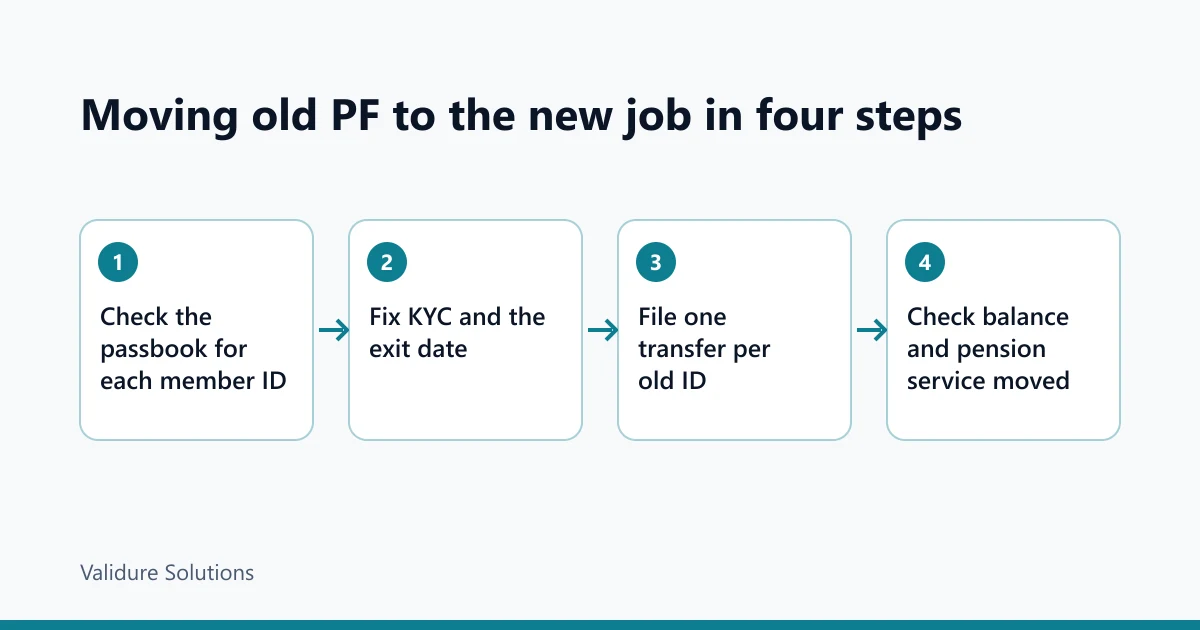
On the EPFO member portal (unifiedportal-mem.epfindia.gov.in):
- Log in with your UAN, password and captcha.
- Go to Online Services, then One Member, One EPF Account (Transfer Request).
- Check the personal details and the current member ID it shows. The money goes to that account.
- Choose the previous member ID you want to move. If you have more than one old ID, you file one request per old ID.
- If the system asks for an attesting employer, pick the current or previous one. If it doesn't ask, it's on the OTP-only route.
- Get the OTP on your Aadhaar-linked mobile, enter it, submit, and note the tracking ID.
Then wait. Business press reports put typical processing at a couple of weeks, but it varies by office. Track it under Track Claim Status. When it's done, the old member ID's passbook shows a transfer-out and the new one shows the transferred amount as an opening balance.
If your old employer ran its own PF trust instead of depositing with EPFO (an exempted establishment), the transfer goes through the trust, and you may need to deal with it directly. The portal's Annexure K download shows what was sent across, including service history and both member IDs.
The money: transfer versus withdraw, with numbers
Here's why "just withdraw it" usually costs more than it looks.
Say, as an example, a QA engineer worked at Company A from 1 June 2021 to 31 March 2024, which is 34 months. Her PF wages were 15,000 a month throughout. Then she took two months off and joined Company B on 1 June 2024.
Her monthly contributions at Company A, using the usual split on 15,000:
| Contribution | Rate | Monthly | Over 34 months |
|---|---|---|---|
| Employee share to EPF | 12% | 1,800 | 61,200 |
| Employer share to EPF | 3.67% | 550 | 18,700 |
| Employer share to EPS (pension) | 8.33% | 1,250 | 42,500 |
The EPF balance from contributions is 61,200 + 18,700 = 79,900, plus whatever interest was credited. That's the money you see in the passbook. The 42,500 sent to EPS doesn't show as a balance you can spend; it buys pension service, which is counted in months.
Tax: the five-year clock
Under the Income-tax Act, 1961, a PF withdrawal is tax free if you've completed five years of continuous service, and service with a former employer counts if the PF from that job was transferred into the current account (Rule 8 of Part A of the Fourth Schedule). If the five years aren't met, the employer's share and the interest become taxable in the year you withdraw, and EPFO deducts TDS above a threshold. The Income-tax Act, 2025, in force from 1 April 2026, carries the same idea in its schedule on recognised provident funds; ask your CA to confirm the exact section that applies to your withdrawal year.
Now count her service as of the end of November 2026:
| If she transferred A to B | If she withdrew A | |
|---|---|---|
| Months at Company A that count | 34 | 0 |
| Months at Company B (June 2024 to November 2026) | 30 | 30 |
| Total counted service | 64 months, 5 years 4 months | 30 months |
| Five years reached? | Yes | No, not until end of May 2029 at Company B |
If she transferred, a withdrawal today would generally be tax free. If she had withdrawn Company A's balance back in 2024, the A money would have been taxed then, and her five-year clock at B would only finish at the end of May 2029, assuming she stays. Change jobs again before then without transferring, and it restarts.
Pension: the ten-year clock
EPS works in months of service, and you need at least 10 years (120 months) of eligible service for a monthly pension from age 58. Her pension service, if both stints are kept together, is 34 + 30 = 64 months. If she'd withdrawn the EPS part when she left Company A, those 34 months would be gone, and she'd be at 30.
That's 34 months of pension service lost, almost three years of working life. For anyone who changes jobs every two or three years, withdrawing at each exit can mean never reaching the ten years at all.
One caution: the PF transfer and the pension service are separate records and can go wrong separately. After the transfer, check that the service history moved, not only the money. The Annexure K download and the service history on the portal are where to look.
Interest that's taxable either way
Since 1 April 2021, interest on your own contributions above 2.5 lakh a year (5 lakh where the employer doesn't contribute) is taxable each year, whether or not you withdraw. Most people on modest salaries never cross it. If you do, that's why the revamped Form 13 splits the transferred balance into taxable and non-taxable parts: the new account needs to know which is which, or TDS will be wrong later.
When withdrawing does make sense
Transfer isn't always the right call. If you've genuinely stopped working, are moving abroad, or need the money for something that can't wait, the scheme allows withdrawal, and tax may not apply if you've already done five years of continuous service. The five-year rule also has exceptions for leaving because of ill-health, the employer closing down, or reasons beyond your control. Read the withdrawal rules carefully, because EPFO revised its partial withdrawal categories in 2025 and some limits and waiting periods changed. Check the current rules on the EPFO site before you decide.
What usually doesn't make sense is withdrawing a small balance just because it's there. The tax hit is real and the pension months are gone for good.
If you're the employer
Most of this lands on the employee, but HR can stop half the problems at joining. Ask every joiner for their existing UAN before the first payroll runs, and use it; generating a fresh UAN for someone who already has one creates the second-UAN mess above. When someone leaves, mark the date of exit promptly with the real last working day, and put the same date on the final payslip and the relieving letter so the records agree.
A payroll system that holds each employee's UAN on their record and shows the PF deduction on every payslip makes most of this routine. Validure HR keeps salary structures, payslips and employee records in one place, which helps here; the EPFO filings themselves still happen on the EPFO employer portal.
What to do next
Keep these in one folder: your UAN, every member ID you've had, the relieving letter and last payslip from each employer, and the tracking ID of every transfer request.
If the transfer is stuck for more than a month, raise a grievance on EPFiGMS (epfigms.gov.in) with the tracking ID. If it's rejected, the rejection reason is shown under Track Claim Status; fix that exact thing and refile rather than trying a different route.
Sources and checks
Checked on 21 November 2026. EPFO screens and rules change often; check the live portal before acting.
- EPFO, member portal and official notices: epfindia.gov.in and unifiedportal-mem.epfindia.gov.in
- Press Information Bureau, EPFO releases of January 2025 (transfer claims with Aadhaar OTP, profile changes) and 25 April 2025 (revamped Form 13, destination office approval removed): pib.gov.in
- EPFO grievance portal: epfigms.gov.in
- Income Tax Department, the Income-tax Act, 1961 (Fourth Schedule, Part A) and the Income-tax Act, 2025: incometaxindia.gov.in
- Ministry of Labour and Employment: labour.gov.in
Contribution rates in the example (12% employee, 3.67% EPF and 8.33% EPS employer, on 15,000 wages) are the standard split under the EPF scheme. Your employer may contribute on higher wages; your payslip shows what they actually pay.
Frequently asked questions
Does my old PF account stop earning interest after I leave?
Not straight away. Interest keeps being credited for a period, but an account with no contributions can eventually be treated as inoperative, and holding money in several old accounts makes it easy to lose track. Transferring it is simpler.
Do I need my old employer's signature to transfer PF?
Usually not anymore. Since January 2025, members with Aadhaar-verified accounts can file transfer claims with an Aadhaar OTP, and the Labour Ministry has said only about 10 per cent of claims still need employer attestation. If the portal asks for an attesting employer, pick whichever one is quicker to respond.
I have two UANs. Can I transfer from one to the other?
Not directly through the transfer screen, which only lists member IDs under the UAN you're logged in with. Ask EPFO, through your current employer or EPFiGMS, to link the old member ID to your active UAN and deactivate the duplicate, then file the transfer.
Does transferring PF count as a withdrawal for tax?
No. A transfer from one recognised fund to another isn't taxed, and the former employer's service then counts toward the five years that make a later withdrawal tax free.
What happens to my pension (EPS) when I transfer?
Your pension service history moves with the transfer, so months from both jobs add up toward the ten years needed for a monthly pension. Check the service history on the portal after the transfer, because it's a separate record from the balance.
How long does a PF transfer take?
There's no single figure. Reports suggest a couple of weeks is common since the 2025 changes, but it depends on the EPFO office. If nothing has moved in a month, raise a grievance with your tracking ID.
