Can your employer make you work overtime without paying for it? The labour code rules, with the maths
By Validure team · · 16 min read
Who the overtime rules in the labour codes actually cover, how the double rate is worked out on a daily or weekly basis, and the points that are still unsettled. Worked examples for the employee and the small employer, checked as of 12 November 2026.

Say a packer at a 40-person warehouse in Pune has stayed two hours late on three evenings this week because a big order has to go out. Nobody asked her in so many words. The supervisor said "we all have to stay till the trucks are loaded", and on payday the slip shows the same amount as last month. A colleague says the new labour codes make overtime double pay. The supervisor says overtime is only for factory workers, and anyway everyone gets a comp-off later. Who's right?
Mostly the colleague, with conditions. If she counts as a "worker" under the Occupational Safety, Health and Working Conditions Code, 2020 (the OSH Code), and her workplace is covered, then overtime needs her consent and has to be paid at twice the rate of wages. If she is a manager, or a supervisor earning above a set amount, the overtime section doesn't cover her at all, and her contract and her state's shop rules decide.
This post goes through who is covered, how the double rate is worked out with real numbers, and the points that are still argued about. It's written for two readers: the employee who wants to know what they're owed, and the small employer who wants to pay it correctly. It's information, not legal advice. Hours rules vary by state and by industry, so for a specific case, ask your state labour department or a labour lawyer. I checked the sections quoted here on 12 November 2026.
What the Code actually says
Three provisions do most of the work.
Section 25(1) of the OSH Code says no worker shall be required or allowed to work more than eight hours in a day, with intervals and spread-over to be notified by the government. Section 27 then says overtime is paid "at the rate of twice the rate of wages" where a worker works beyond the hours prescribed for a day or a week, and that the overtime is to be calculated on a daily or weekly basis, "whichever is more favourable to such worker". The same section adds two provisos: the employer can require overtime only with the worker's consent, and the government may prescribe a cap on total overtime hours.
The Code on Wages, 2019 says the same thing from the pay side. Section 14 sets the overtime rate at not less than twice the normal rate of wages for work beyond a normal working day. Section 13 lets the government fix the normal working day and a weekly rest day, and says work on a rest day is paid at not less than the overtime rate.
So the headline is settled law, in force since 21 November 2025: double rate, consent needed, and the worker gets the better of the daily or weekly count.
What isn't in the Code itself is the detail. The weekly limit, the spread-over, and the cap on overtime hours per quarter come from rules. The central rules under the OSH Code were notified in May 2026, and commentary reports that they set a 48-hour week and a cap of 144 overtime hours a quarter. I couldn't read the gazette text itself, and some commentators say that cap applies only to certain sectors. More to the point, central rules mostly govern establishments where the central government is the appropriate government. Most private offices, shops and warehouses fall under their state's rules, and the states haven't all landed on the same numbers. Check your state's rules before you rely on any cap.
Who is a "worker", and who isn't
This is where most arguments start, so it's worth being exact.
The OSH Code defines a worker in section 2(1)(zzl) as anyone employed to do manual, unskilled, skilled, technical, operational, clerical or supervisory work for hire or reward. Then it carves out four groups. Two are the armed forces, police and prison staff. The two that matter in ordinary jobs are:
- someone employed mainly in a managerial or administrative capacity
- someone employed in a supervisory capacity drawing wages above 18,000 rupees a month, or a higher amount the central government notifies
Separately, the workplace has to be an "establishment". Section 2(1)(v) covers a place where any industry, trade, business, manufacturing or occupation is carried on with ten or more workers, plus factories, mines, ports and a few named sectors.
Here's how that plays out for a few people in the same company. These are examples, not rulings on anyone's real job.
| Person (example) | What they do | Monthly pay | Covered by section 27? |
|---|---|---|---|
| Packer | Packs and loads orders | 24,000 | Yes, operational work |
| Accounts clerk | Enters bills, reconciles the bank | 28,000 | Yes, clerical work |
| Shift supervisor | Allocates work, signs off the shift | 16,500 | Yes, supervisory but under 18,000 |
| Shift supervisor | Same job | 32,000 | No, supervisory above 18,000 |
| Warehouse manager | Hires, approves leave, runs the budget | 60,000 | No, mainly managerial |
Two things people get wrong. First, the title doesn't decide it. A "team lead" who spends the day packing boxes alongside everyone else is doing operational work, whatever the business card says. Indian labour cases have long looked at the main duties of the job rather than the label, and that's the sensible way to read this definition too. Second, the 18,000 line only applies to supervisors. A clerk earning 50,000 is still a worker.
Working out the rate: the hourly figure first
Overtime is twice the "rate of wages". So you need an hourly rate, and that's where two honest people can get different answers.
The OSH Code defines wages in section 2(1)(zzj) the same way as the Code on Wages: basic pay, dearness allowance and retaining allowance, with a list of exclusions such as house rent allowance, conveyance and overtime allowance. If the excluded items come to more than half of total pay, the excess is added back. That's the 50 per cent rule.
Take the packer as an example. Her monthly pay is:
| Component | Amount |
|---|---|
| Basic plus dearness allowance | 11,000 |
| House rent allowance | 7,000 |
| Conveyance allowance | 6,000 |
| Total | 24,000 |
The excluded items are 7,000 + 6,000 = 13,000. Half of 24,000 is 12,000. The exclusions are 1,000 over the half, so 1,000 is added back: 11,000 + 1,000 = 12,000 counts as wages.
Next, a daily and hourly rate. The Code doesn't fix a divisor for a monthly-paid worker. Many employers use 26 working days, some use 30, and the contract or state rules may say which. Using 26 as an example, the daily rate is 12,000 / 26 = 461.54, the hourly rate is 461.54 / 8 = 57.69, and the overtime rate is twice that, 115.38 an hour.
Now the catch. Some employers and contracts work overtime out on gross pay, not on the defined wage. On gross, the same packer's overtime rate is 24,000 / 26 / 8 x 2 = 230.77 an hour, exactly double the other figure here because her gross is double her defined wage. The Code on Wages also has a second proviso that brings HRA, conveyance and overtime allowance back in "for the purpose of payment of wages", and people read that proviso in different ways. I couldn't find an authoritative answer on which base the double rate must use. What's clear is that an employer can always pay on the more generous base, because better terms are allowed. If you are the employer, pick one base, write it in the policy and the appointment letter, and apply it to everyone the same way.

Daily or weekly, whichever is better for the worker
Section 27's "whichever is more favourable" line matters more than it looks. Here are three example weeks for the packer, on a six-day week with Sunday as the rest day and eight normal hours a day.
Week 1: long early days, short Friday and Saturday
| Mon | Tue | Wed | Thu | Fri | Sat | Total |
|---|---|---|---|---|---|---|
| 10 | 10 | 8 | 8 | 6 | 6 | 48 |
Counted daily, Monday and Tuesday are 2 hours over each, so 4 hours. Counted weekly, 48 hours is nothing over 48, so 0. The daily count is more favourable: 4 hours.
An employer who only looks at weekly totals pays nothing here. That's wrong. The worker gets the daily count.
Week 2: nine hours every day
| Mon | Tue | Wed | Thu | Fri | Sat | Total |
|---|---|---|---|---|---|---|
| 9 | 9 | 9 | 9 | 9 | 9 | 54 |
Counted daily, it's 1 hour over on each of six days, so 6 hours. Counted weekly, 54 minus 48 is also 6. Same either way.
A caution: some states allow a nine-hour day as normal. If yours does, the daily count here would be zero and only the weekly count of 6 would apply. Same answer this week, different answer in others.
Week 3: a normal week plus a Sunday
| Mon | Tue | Wed | Thu | Fri | Sat | Sun | Total |
|---|---|---|---|---|---|---|---|
| 8 | 8 | 8 | 8 | 8 | 8 | 8 | 56 |
Counted daily, no single day goes over 8, so 0. Counted weekly, 56 minus 48 is 8 hours, and that's the more favourable figure.
This is the week where the daily-only habit fails. The Code on Wages also says work on the rest day is paid at no less than the overtime rate, which points the same way. In practice many employers give a substituted day off as well; read your state rules on whether that replaces the pay or comes on top of it.
Add a fourth, ordinary week with no overtime, and the month comes to 4 + 6 + 8 = 18 overtime hours.
| Base used (example) | Overtime rate per hour | 18 hours |
|---|---|---|
| Defined wage, 26-day divisor | 115.38 | 2,076.92 |
| Gross pay, 26-day divisor | 230.77 | 4,153.85 |
| Defined wage, 30-day divisor | 100.00 | 1,800.00 |
The gap between the cheapest and the most generous reading is 2,353.85 for one month and one person. Across 30 people and twelve months, it's a number that will come up in a dispute. That's why the base and the divisor belong in writing.
"But we give comp-off instead"
This is the most common answer employees hear, and it's on weak ground for anyone the section covers. Section 27 talks about paying wages at twice the rate. It doesn't say time off can stand in for that pay. Some state shop and establishment rules deal with substituted holidays, and those are about the weekly rest day, not about converting overtime hours into leave. If you're an employer using comp-off in place of overtime pay for covered workers, I'd stop, or at least get a written view from someone who knows your state's rules. Comp-off on top of overtime pay is fine; it's a better term.
For staff outside the definition (managers, and supervisors above the line), comp-off policies are a matter of contract and company policy, and that's where they make sense.
Consent, and what it means in a small company
The first proviso to section 27 says overtime can be required only with the worker's consent. Commentary generally reads that as written consent, kept on record. The Code text I read says "consent" without spelling out the form, so treat the written form as good practice that also protects the employer.
Consent has to mean something. A sign-up sheet for the Saturday shift, where people can say no without consequence, is consent. "Everyone stays till the trucks are loaded" isn't. The same applies during a notice period: an employee serving notice is still a worker, and the consent rule doesn't switch off because they're leaving.
The strongest case on the employer's side deserves a fair hearing too. Seasonal businesses do have weeks where the work can't wait, and a small team has no slack. The law doesn't stop overtime in those weeks. It asks the employer to ask, pay double, keep the record and stay under the cap. A business that plans its peaks and asks early usually finds enough volunteers.
The open questions, labelled
Here's what I'd call settled, contested and opinion, as of 12 November 2026.
Settled, from the text: double rate, consent, the more favourable of daily or weekly, the worker definition with its managerial and supervisory exclusions, and the ten-worker threshold for an establishment.
Contested or unclear: first, whether the double rate is calculated on the defined wage or on gross pay, as worked through above. Second, whether section 14 of the Code on Wages, which talks about "employees" rather than "workers", gives anyone outside the OSH definition a route to overtime pay. It's tied to the minimum rate of wages, and I found no clear answer. Third, the exact quarterly cap for your workplace, because it depends on which government's rules apply to you and whether your state has notified its own.
Opinion, ours: the cheapest way to avoid all three arguments is to pay on the more generous reading, keep daily records, and write the method down. A few thousand rupees a month is much less than one claim before the authority.
Checks for the employer before each payroll run
| Check | What to look for | What a hit means |
|---|---|---|
| Daily hours over the normal day | Any covered worker with a day above 8 hours (or your state's figure) | Overtime owed on the daily count |
| Weekly hours over 48 | Any covered worker above the weekly limit, including rest-day work | Overtime owed on the weekly count; pay the higher of the two |
| Consent on record | A written yes for each overtime shift or period | Overtime without consent is a breach even if paid |
| Who is excluded | Supervisors above 18,000 and managers, judged by duties | Wrongly excluded staff are owed back pay |
| Quarter-to-date hours | Running total against the cap in your state's rules | Over the cap is a breach even with consent |
| Base and divisor | The same written method used for everyone | Inconsistent methods are the first thing a claim will find |
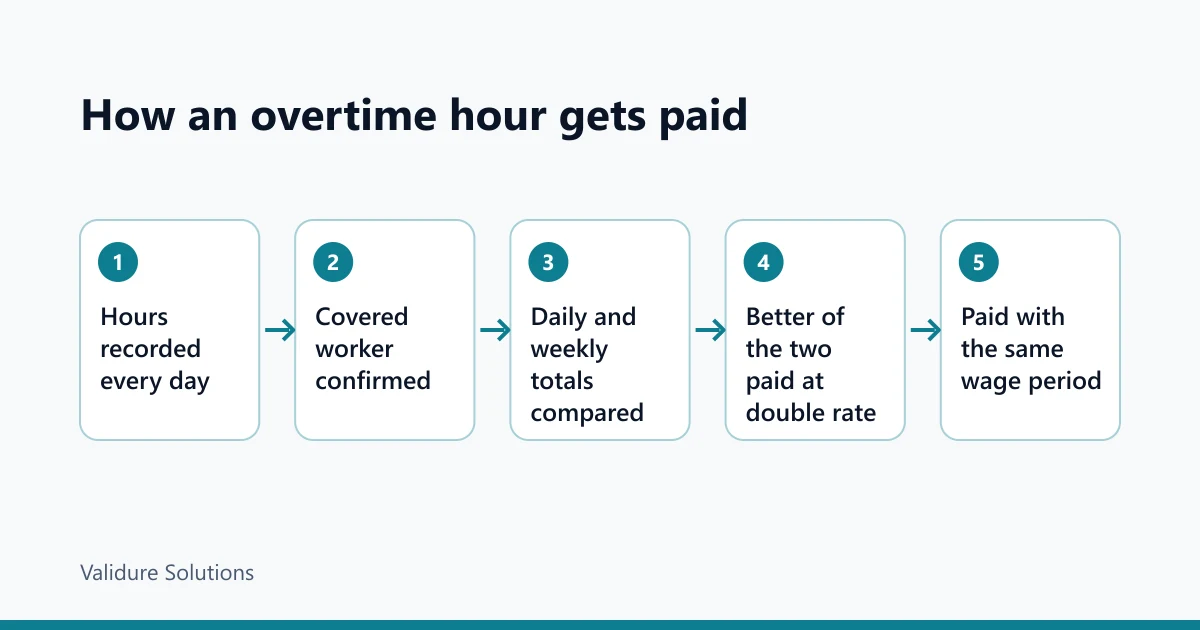
All of these come back to one thing: time recorded every day, per person, in one place. If that lives in three different spreadsheets, overtime will always be argued after the fact. Validure HR keeps attendance from self-service punch or biometric devices next to payroll with salary structures, so the hours that drive overtime and the pay that results come from the same record. It also handles night-shift payroll cycles, which is where shift hours and dates most often get split wrongly. You don't need a system for this if you have fewer than ten people and a supervisor who keeps an honest daily register; a paper register signed each day is fine.
For the employee: what to do next
Keep your own record. A notebook or phone note with the date, start time, end time and who asked you to stay is worth more than memory six months later. Keep your payslips and your appointment letter, because the letter usually says your pay structure and sometimes how overtime is worked out.
Raise it in writing first, with HR or the owner, and give the dates and hours. Many underpayments are a missing method, not bad faith.
If that doesn't work, a claim for unpaid wages under the Code on Wages goes to the authority appointed under section 45, and section 45(6) gives three years from the date the claim arises, with room for a late claim on sufficient cause. Your state labour department or labour commissioner's office can tell you which authority covers your area. The Ministry of Labour and Employment's Samadhan portal is also a route for some grievances.
Sources and checks
I read sections 2(1)(v), 2(1)(zzj), 2(1)(zzl), 25 and 27 of the OSH Code, 2020, and sections 13, 14 and 45 of the Code on Wages, 2019, through official gazette copies and bare-act mirrors, on 12 November 2026. I could not read the gazette text of the OSH (Central) Rules, 2026, so the 48-hour week and the 144-hour quarterly cap are reported from commentary, and commentators disagree on how widely that cap applies. I also could not confirm which base the double rate must use, or the state rules for any particular state.
- Ministry of Labour and Employment for the codes and rules
- India Code for the text of the OSH Code, 2020 and the Code on Wages, 2019
- e-Gazette of India for notifications and rules
- Samadhan portal for grievances
- Your state labour department's website for the state rules on hours, spread-over and overtime caps
Frequently asked questions
Is overtime always paid at double the normal rate now?
For a worker covered by the OSH Code, yes: section 27 sets twice the rate of wages, and section 14 of the Code on Wages says not less than twice. Managers and supervisors above 18,000 a month are outside that section, so their contract decides.
Can my employer make overtime compulsory?
Not for a covered worker. Section 27 says overtime is subject to the worker's consent. Your employer can ask and pay double, but can't require it without your agreement.
Does the 8-hour day apply to IT and office staff?
It applies to workers in any establishment with ten or more workers, which can include offices. Many state shop rules set their own hours too, so check your state. Senior staff in managerial roles are outside the definition.
Is overtime calculated on basic or on gross salary?
The codes point to the defined wage (basic plus dearness allowance, with the 50 per cent add-back), but a second proviso and common practice make this contested. An employer can always pay on gross, which is more generous.
Can a company give comp-off instead of overtime pay?
For covered workers, the Code talks about wages at double rate, not time off, so replacing pay with comp-off is on weak ground. Comp-off in addition to pay is fine.
How long do I have to claim unpaid overtime?
Section 45(6) of the Code on Wages gives three years from when the claim arises, and the authority can accept a late claim for sufficient cause. Ask your state labour department which authority handles your area.