
Billing only foreign clients? When a freelancer needs GST registration, and what an LUT actually does
By Validure team · · 14 min read
A worked guide for Indian freelancers and small service firms paid from abroad. When the 20 lakh threshold bites, why exports count towards it, what the LUT changes on your invoice, the one-year payment rule, the refund maths, and the intermediary change from March 2026.

Say you're a designer in Pune. Your one client is a small agency in Ohio that pays you $1,800 a month through a bank transfer. A friend who freelances for a UK company tells you she "had to get GST and file an LUT", and now you're wondering whether you've been breaking the law for two years.
Probably not. But the answer depends on one number, and most people add it up wrong.
This post goes in the order you'd hit it: registration, what counts as an export, what the Letter of Undertaking (LUT) does, late payers, and whether voluntary registration pays. It's for one-person freelancers and small service firms that bill mostly abroad. It's general information as of 17 November 2026, not advice for your case; check your own position with a chartered accountant or GST practitioner.
The short answer
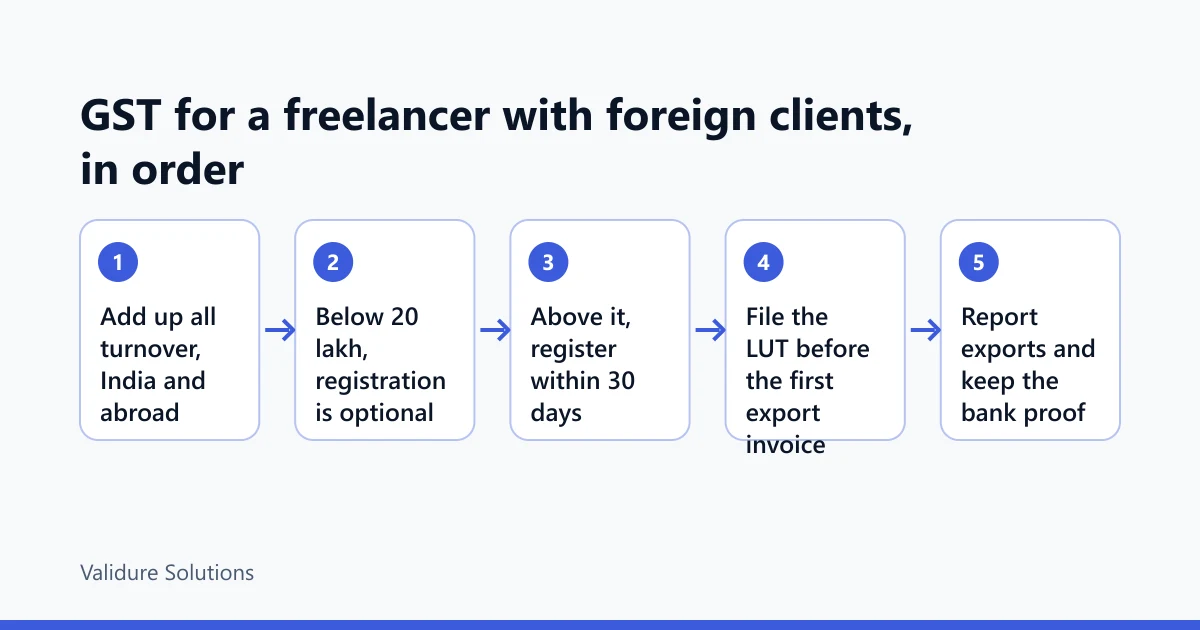
If everything you bill in a financial year, India and abroad together, stays under 20 lakh rupees, you don't have to register for GST, even though your clients are foreign. (The limit is 10 lakh in a few special category states, including Manipur, Mizoram, Nagaland and Tripura.) Once that total crosses 20 lakh, you must register, even if every rupee comes from abroad and no GST is ever charged on those invoices.
Two things trip people up.
First, exports count. GST's "aggregate turnover" is built on your PAN and includes taxable supplies, exempt supplies and exports. A lot of freelancers assume that because export invoices carry no GST, they don't count towards the limit. They do.
Second, the limit is on turnover, not profit. Twenty lakh of billing triggers it even if your costs eat half.
Why can a service exporter under 20 lakh stay unregistered at all? Exports of services are treated as inter-state supplies under the IGST Act, and inter-state suppliers normally have to register whatever their size. For services, a 2017 IGST notification (Notification 10/2017-Integrated Tax) exempts inter-state service suppliers below the threshold from that compulsory registration. Goods sellers don't get the same break, which is why advice written for exporters of goods can mislead you.
Doing the sum properly
Here's the example from the opening, using 88 rupees to the dollar as an example rate. Use the rate on your actual bank credits.
| Example: Asha, freelance designer | Amount (Rs) |
|---|---|
| US client, $1,800 a month x 12 x 88 | 19,00,800 |
| Total, foreign only | 19,00,800 |
| Adds one Indian client in February | 1,50,000 |
| New total for the year | 20,50,800 |
At 19,00,800 Asha doesn't need to register. The moment that Indian project takes her past 20 lakh, she does. The law gives 30 days from the date you become liable to apply. The Indian client's invoice is taxable once she's registered, and her foreign invoices then need either the LUT or tax paid on them, which we'll get to.
When a foreign payment isn't an "export" for GST
Being paid from abroad doesn't automatically make your work an export. Section 2(6) of the IGST Act sets five conditions, and all five have to hold:
| Condition | What it means in practice |
|---|---|
| Supplier located in India | You work from India |
| Recipient located outside India | Your client is abroad, not their Indian office |
| Place of supply outside India | Usually yes for remote services, with exceptions below |
| Paid in convertible foreign exchange, or in rupees where RBI permits | The money comes in through proper banking channels |
| Not two establishments of the same person | You're not a branch billing your own foreign head office |
The fifth condition catches branches. CBIC's Circular 161/17/2021-GST says an Indian branch of a foreign company billing that company abroad isn't exporting, while an Indian-incorporated subsidiary billing its foreign parent can be. Solo freelancers rarely meet this one.
The third condition is where the real exceptions live. The default rule for services is that the place of supply is where the recipient is, which is what makes most remote work an export. But the IGST Act has special rules for some services: work done on goods that are physically made available to you in India, services connected to property in India, and events held in India, among others. If your foreign client ships you equipment to test or repair, or pays you to run an event in Bengaluru, read section 13 of the IGST Act before calling it an export.
The intermediary change from 30 March 2026
For years, the nastiest trap was the "intermediary". If you arranged or facilitated a supply between two other parties (say, a sourcing agent who finds Indian textile mills for a German retailer and earns a commission), section 13(8)(b) of the IGST Act put the place of supply at your location in India. So the commission was taxed in India at 18 per cent, even though the money came from abroad.
The GST Council recommended removing that clause at its 56th meeting on 3 September 2025. The Finance Act, 2026 omitted section 13(8)(b), and CBIC's consolidated text of the IGST Act dates the omission to 30 March 2026, the day the Act received assent. Intermediary services now fall under the default rule: place of supply is where the recipient is. So the sourcing agent's commission from the German retailer can now qualify as an export, provided the other four conditions hold.
Two cautions. Most practitioners read the change as forward-looking, so invoices from before 30 March 2026 are judged under the old rule. And when I checked, I couldn't find a CBIC circular on how transition cases (work started before, invoiced after) should be handled. If you're an agent with a long-running contract, get your adviser's view on the cut-over.
What the LUT does, and what happens without one
Once you're registered, every export invoice has two possible routes. Both are "zero-rated" supplies under section 16 of the IGST Act, but they treat your cash very differently.
| With an LUT | Without an LUT (pay IGST) | |
|---|---|---|
| Tax on the export invoice | None | IGST, usually 18 per cent for professional and IT services |
| Who pays it | Nobody | You, since a foreign client rarely will |
| How you get it back | Nothing to get back | Refund claim on the GST portal |
| What else you can refund | Unused input tax credit | Not applicable; you used it against the IGST |
| Cash tied up | Nil | The tax, until the refund lands |
Example: an invoice for $3,000 at 88 rupees comes to 2,64,000. IGST at 18 per cent is 47,520. Without an LUT, you pay that 47,520 into the government account and then wait for a refund. One more caution: the IGST Act was amended so the government can restrict the pay-and-refund route to notified cases, so don't assume it's always available to you. The LUT route is the normal one.
The LUT itself is a short online form, GST RFD-11, filed on the GST portal under Services, User Services, Furnish Letter of Undertaking. It's free, it's valid for one financial year, and you file a fresh one each year, ideally before the first export invoice of April. You can't use one if you've been prosecuted for a GST offence involving more than 2.5 crore rupees of tax; those exporters have to give a bond with a bank guarantee instead. That won't touch most freelancers.
The invoice changes too. Under the export proviso to Rule 46 of the CGST Rules, an export invoice carries an endorsement along the lines of "supply meant for export of services under bond or letter of undertaking without payment of integrated tax", plus the client's name, address and country. Show the rupee value alongside the foreign currency amount, and keep the exchange rate you used. Validure ERP can raise GST tax invoices with IGST and print the details you put on them, so the endorsement goes on every export invoice once rather than being typed by hand each month.
In your returns, exports go in GSTR-1 Table 6A and in GSTR-3B under outward zero-rated supplies, Table 3.1(b). Leaving them out is common, and it makes your turnover look smaller than it is, which matters when you later claim a refund against it.
The client who pays late
The LUT is a promise, and Rule 96A of the CGST Rules says what happens if the money doesn't arrive. If you haven't been paid in convertible foreign exchange (or in rupees where RBI permits), you owe the IGST with interest. The deadline was changed by Notification 12/2024-Central Tax from 10 July 2024. It's now 15 days after whichever is later: one year from the invoice date, or the period allowed under FEMA including any RBI extension. The Commissioner can allow longer. Older articles still quote a flat one year; that wording is out of date.
Example: you invoice a client 1,10,000 rupees ($1,250 at 88) on 10 January 2026 under your LUT. They go quiet. Unless an extended FEMA period runs later, one year ends on 10 January 2027, and you'd need to pay IGST of 19,800 (18 per cent of 1,10,000) plus interest by 25 January 2027. Interest under section 50(1) of the CGST Act is 18 per cent a year. If you don't pay, the LUT facility is withdrawn until you do. If the client eventually pays, you can claim back the IGST, but practitioners agree the interest stays paid.
So keep a list of unpaid export invoices by date. Anything near eleven months old needs a decision: chase it, ask your bank about an extension, or budget for the tax.
Should you register voluntarily to get refunds?
Below 20 lakh you can still register under section 25(3) of the CGST Act. The usual reason is input tax credit: the GST you pay on your coworking desk, your accountant and your Indian software subscriptions. Because exports are zero-rated, that credit can come back to you as a refund. Unregistered, it's simply a cost.
The refund under an LUT follows Rule 89(4) of the CGST Rules:
Refund = Turnover of zero-rated supplies x Net ITC / Adjusted total turnover
"Net ITC" there means credit on inputs and input services. Credit on capital goods, like a laptop, isn't part of that formula, which surprises people.
Example: Ravi, a developer, bills a US client $2,000 a month. At 88 rupees that's 1,76,000 a month and 21,12,000 a year, so he has to register anyway.
| Example: Ravi's credits for the year | Spend (Rs) | GST at 18% (Rs) |
|---|---|---|
| Coworking desk, 8,000 a month | 96,000 | 17,280 |
| Accountant's fees, 2,000 a month | 24,000 | 4,320 |
| Software bought from Indian sellers | 12,000 | 2,160 |
| Net ITC (inputs and input services) | 23,760 | |
| Laptop (capital goods, outside the formula) | 90,000 | 16,200 |
All his turnover is zero-rated, so the formula gives 21,12,000 x 23,760 / 21,12,000 = 23,760 a year that he can claim back, on RFD-01, within two years of the relevant date. For exported services the relevant date is generally tied to when the foreign payment arrives (or the invoice date if you were paid in advance); confirm the current wording of section 54 with your accountant, because the rules around it have been amended more than once.
Now look at the accountant's line. Ravi pays 24,000 a year for filing, and gets back 23,760. For him, as a forced registrant, the refund is a bonus. For someone like Asha, below the threshold, the same maths says voluntary registration costs roughly what it returns, plus the monthly or quarterly returns and the risk of late fees if she forgets one. Our view: below the threshold, register voluntarily only if you spend a lot with GST-charging Indian suppliers, or a client insists on a GSTIN. Otherwise the paperwork isn't worth it.

If you do claim refunds, the work is in the evidence, not the form. Validure ERP keeps purchases, expenses and input tax credit in one place, with GSTR-1 and GSTR-3B summaries, so the refund working starts from a clean list rather than a folder of PDFs. If you have ten invoices a year, a spreadsheet does the same job.
Proof of payment: keep it from day one
For every export invoice, keep the bank's inward remittance advice or certificate, or the SWIFT message and statement line. If a payment platform pays you, download its payout statement monthly and match payouts to invoices. Condition four and any refund claim depend on this, and rebuilding it two years later is miserable.
A checklist before the next financial year starts
| Check | What to look for | What a hit means |
|---|---|---|
| Total turnover, India plus abroad, at actual bank rates | Anything above about 17 lakh with months still to go | You may cross 20 lakh mid-year; plan the registration |
| Any Indian clients | Domestic invoices you didn't count | They add to the total and are taxable once registered |
| How you're paid | Foreign currency through a bank or platform, with records | Gaps here can fail condition four |
| Who your client really is | A foreign entity, not its Indian branch | A branch-to-head-office setup isn't an export |
| What the service is | Work on goods in India, events or property in India | A special place of supply rule may apply |
| Commission or agency income | Arranging deals between others | After 30 March 2026 it can be an export; earlier invoices aren't |
| LUT for the new year | RFD-11 filed for April onwards | Without it, export invoices need IGST paid |
| Unpaid export invoices | Anything near one year old | IGST and interest may fall due under Rule 96A |
Who this isn't for: exporters of goods, and income tax questions on foreign earnings. Those follow different rules.
Sources and checks
I checked these on 17 November 2026; confirm them against the official text before relying on them. The export definition (section 2(6)), place of supply rules (section 13) and zero-rating (section 16) are in the IGST Act, and the registration threshold and voluntary registration (sections 22 and 25) and refunds (section 54) are in the CGST Act, both on India Code and the CBIC GST site. Rule 46, Rule 89(4) and Rule 96A are in the CGST Rules on the same CBIC site; the Rule 96A wording is from the gazette text of Notification 12/2024-Central Tax dated 10 July 2024. The registration exemption for inter-state service suppliers is Notification 10/2017-Integrated Tax, and the branch and subsidiary position is Circular 161/17/2021-GST, both on CBIC. The omission of section 13(8)(b) by the Finance Act, 2026 is shown in CBIC's consolidated IGST Act text; the 56th GST Council meeting recommendation is on the GST Council site. The LUT filing path and return tables are on the GST portal and its user manual. Payment-in-rupees permissions under FEMA are on the Reserve Bank of India site. The claim that the intermediary change is forward-looking, and that interest isn't refunded under Rule 96A, come from practitioner commentary rather than a CBIC circular. All names, exchange rates and amounts in the examples are illustrations.
Frequently asked questions
Do I need GST registration if all my clients are outside India?
Not if your total turnover for the year, including exports, stays under 20 lakh rupees (10 lakh in a few special category states). Above that you must register, even though your export invoices carry no GST.
Does export income count towards the 20 lakh limit?
Yes. Aggregate turnover includes exports, exempt supplies and taxable supplies across your PAN. That's the most common mistake freelancers make.
Can I file an LUT without registering for GST?
No. The LUT is filed from a GST registration on the portal. If you're below the threshold and unregistered, you don't need one, because you aren't charging GST at all.
How long is an LUT valid?
One financial year. File a fresh RFD-11 for each year, before your first export invoice of that year if you can.
What if my foreign client pays a year late?
Under Rule 96A, if you haven't been paid by 15 days after the later of one year from the invoice or the FEMA period, you owe the IGST with 18 per cent interest. You can claim the tax back once the payment arrives, but not the interest.
I earn commission for connecting a foreign buyer with Indian suppliers. Is that an export now?
It can be, for invoices from 30 March 2026, when the special intermediary rule was removed from the IGST Act. The other export conditions still have to hold, and earlier invoices follow the old rule, so check transition cases with your adviser.
