
Does the 50 per cent wage rule cut your take-home pay, and who really pays for it?
By Validure team · · 15 min read
A year into the labour codes, the honest answer is "sometimes". Worked examples of when take-home falls, why special allowance already counts as wages, who carries the cost under a CTC model, and both sides of the argument.

Say you got a raise in April. Your CTC went up by 8 per cent, HR sent a new salary breakup, and the money that landed in your account in May was barely higher than in March. The breakup has a bigger basic, a smaller special allowance and a larger PF line. Someone in the office says it's the new labour codes. Someone else says the ministry promised take-home wouldn't fall.
Both of them are partly right. The 50 per cent wage rule can lower take-home pay, but only through a few specific routes, and in most of them the money doesn't vanish. It moves into your provident fund and your gratuity. Whether that's a good trade depends on who you are, and on who was paying for it in the first place.
This post works through the numbers, then puts the two sides of the argument at full strength. The codes have been in force since 21 November 2025, so this is a one-year look. It's information, not legal or tax advice: your state, your industry and how your employer contributes to PF all change the answer, so check your own case with your payroll team, a consultant or the labour commissioner's office.
What the rule actually says
The Code on Wages, 2019 defines wages in section 2(y) as all remuneration, by way of salaries, allowances or otherwise. It names basic pay, dearness allowance and retaining allowance as included. Then it lists what's left out. Paraphrasing the list: bonus not payable under the terms of employment, the value of housing and amenities, the employer's PF and pension contributions, conveyance allowance and travel concessions, sums paid to cover special expenses of the job, house rent allowance, payments under an award or settlement, overtime allowance, commission, gratuity, and retrenchment compensation or other retirement benefits.
The first proviso is the famous one. If the payments in the first nine of those exclusions add up to more than half of all remuneration, the amount above half is added back to wages. The Code on Social Security, 2020 uses a wage definition built the same way, and that's the one that matters for PF, ESI and gratuity.
Two things follow that most salary breakups ignore.
First, the rule is a cap on exclusions, not a rule that basic must be 50 per cent. Nothing in the text says "basic". It says that excluded items can't be more than half.
Second, special allowance isn't on the exclusion list. A general special allowance paid to everyone is wages from the start, under the opening words of the definition, whether or not you're near the 50 per cent line. Most law-firm and consultancy commentary reads it that way. The exception is an allowance that really pays for job expenses, which can fall under the special-expenses clause, and even then it counts towards the half.
This isn't new thinking for PF either. In February 2019, in Regional Provident Fund Commissioner (II), West Bengal v. Vivekananda Vidyamandir, the Supreme Court held that allowances paid universally, necessarily and ordinarily to all employees are basic wages for PF under the old EPF Act. Many companies kept splitting pay the old way anyway. The codes put the same idea into the statute.
Example 1: a 22,000 salary where nothing is above half
Say a 30-person firm pays an accounts assistant 22,000 a month, all of it fixed. The company pays its own PF share on top of that, not out of it.
| Component | Monthly | Excluded under 2(y)? |
|---|---|---|
| Basic | 9,000 | No |
| House rent allowance | 4,500 | Yes |
| Conveyance allowance | 1,600 | Yes |
| Special allowance | 6,900 | No |
| Total | 22,000 |
The exclusions are 4,500 + 1,600 = 6,100, which is about 27.7 per cent of 22,000. That's under half, so nothing is added back. Wages are basic plus special allowance: 9,000 + 6,900 = 15,900.
If the firm used to deduct PF on basic alone, the change looks like this:
| PF on basic only | PF on wages | |
|---|---|---|
| PF base | 9,000 | 15,900 |
| Employee PF at 12% | 1,080 | 1,908 |
| Take-home before tax and PT | 20,920 | 20,092 |
| Employer PF at 12% | 1,080 | 1,908 |
Take-home falls by 828 a month. The employer pays 828 more a month too, which is 9,936 a year for this one person. The PF account gets 1,656 a month more in total from both sides.
Notice that the 50 per cent rule did nothing here. The fall came from special allowance being counted as wages, which the Supreme Court had already said about universally paid allowances in 2019. The ministry's reassurance, which we'll get to, doesn't help this person either, because 15,900 is below the PF wage ceiling.
Example 2: a structure where the add-back bites
Now say a different company pays 50,000 a month made up of basic 20,000, HRA 25,000, conveyance 3,000 and special allowance 2,000. To keep the sum simple, the employer's PF is paid on top and left out of the total. Your consultant may treat the employer share differently when testing the half, so ask.
The exclusions are HRA and conveyance: 25,000 + 3,000 = 28,000. Half of 50,000 is 25,000. The excess, 3,000, is added back.
Wages = basic 20,000 + special allowance 2,000 + add-back 3,000 = 25,000.
That's the case the rule was written for: a structure that kept most of the money in an excluded allowance. The pay doesn't change. What changes is the base for PF, gratuity and the other benefits worked out from wages.
Example 3: the CTC model, where you pay both halves
This is the case behind most of the angry posts, and it's the one that answers "who pays".
Say an engineer has a CTC of 1,00,000 a month, and the employer's PF contribution is counted inside that CTC. Before, the company paid PF on actual basic. Afterwards, it raised basic to 50,000 to "comply" and kept the habit of PF on actual basic.
| Before | After | |
|---|---|---|
| Basic | 30,000 | 50,000 |
| HRA | 15,000 | 15,000 |
| Employer PF (inside CTC) | 3,600 | 6,000 |
| Special allowance (balance) | 51,400 | 29,000 |
| CTC | 1,00,000 | 1,00,000 |
| Employee PF | 3,600 | 6,000 |
| Take-home before tax and PT | 92,800 | 88,000 |
Take-home falls by 4,800 a month. Total PF contributions go from 7,200 to 12,000, also up by 4,800. Every rupee of the extra employer share came out of the special allowance, which was the engineer's money. So under a CTC model the employee pays both halves. The employer's cost stays at 1,00,000.
Two details worth knowing. The pension part of the employer's share is capped: 8.33 per cent of wages up to the PF ceiling, which is about 2,083 a month at the new 25,000 ceiling reported from 17 September 2026. The rest of the employer share goes to the provident fund account. And the restructuring itself was less necessary than it looked: in the "before" column, special allowance of 51,400 was already wages under the definition.
Contrast what happens if the same company contributes only on the ceiling. PF on 25,000 is 3,000 from each side. Take-home rises to 30,000 + 15,000 + 52,000 - 3,000 = 94,000, which is 1,200 more than before, because the special allowance absorbs the 600 the employer no longer contributes. The choice of PF base, not the wage rule, decides most of the change.

What the ministry said, and where it stops
In December 2025 the Ministry of Labour and Employment said on its official social media account that the codes don't reduce take-home pay if the PF deduction is on the statutory wage ceiling, and that contributions above the ceiling are voluntary. At the time the ceiling was 15,000.
That's accurate for people whose wages were already above the ceiling and whose employer contributes only on the ceiling. It doesn't cover three groups:
| Check | What to look for | What a hit means |
|---|---|---|
| Wages under the ceiling | Basic plus special and other non-excluded allowances below 25,000 | PF rises up to the ceiling whatever the employer prefers |
| PF on actual wages | Offer letter or payroll says PF on "actual basic" or "full wages" | The voluntary part grows with the new wage base unless both sides change it |
| Employer costs inside CTC | Employer PF or gratuity shown as lines inside CTC | Any rise in employer cost is taken from your cash pay |
| Ceiling moved | Your PF base was 15,000 and your wages are above it | The new 25,000 ceiling alone raises the deduction by up to 1,200 a month |
The last row is a separate change from the wage rule, but it landed in the same year and people blame the codes for both. If your wages are 25,000 or more, the mandatory employee PF went from 1,800 to 3,000 a month.
The case that this is a pay cut
Here's the strongest version of the argument against the rule, as unions, employees and some employers make it.
Cash in hand is what pays rent and EMIs. For someone on 20,000 to 30,000 a month, losing 800 to 1,300 of monthly cash is a real cut in what they can spend, whatever the PF passbook says. A saving you didn't choose and can't easily reach isn't the same as pay.
Under a CTC model, the employer's cost doesn't move, so the "employer contribution" is just your money relabelled. Calling it a benefit is generous.
Part of what goes in isn't liquid at all. The pension share goes to EPS, which pays a monthly pension later under its own formula. Withdrawal rules for EPF have also changed over the years and can change again.
Gratuity is real money, but you only get it if you leave in a way that qualifies, and it's often shown inside CTC too. A larger gratuity accrual in your CTC means a smaller cash line now for a payment you might never receive.
And employers who pay above CTC carry a higher cost with no change in output. In Example 1, it's 828 a month per person. Some of that comes back as smaller raises, which means employees pay for it later even when the employer paid it first.
The case that this is overdue
And here's the strongest version of the argument for it.
Keeping basic at 30 or 40 per cent and filling the rest with a special allowance was a way to cut statutory costs, mostly at the employee's expense. It lowered PF, gratuity, bonus base and leave encashment. The Supreme Court said in 2019 that universally paid allowances are basic wages for PF. The codes say the same thing more clearly, with a numeric limit.
The money stays the employee's. EPF interest for 2025-26 was notified at 8.25 per cent, and that rate has been the same for three years. For many workers, PF and gratuity are the only retirement savings they will ever have. Forced saving is paternalistic, but people who argue for it point out that voluntary saving rates for low-wage workers are low.
Gratuity is the clearest gain. In Example 1, a year's gratuity accrual on basic alone is 9,000 × 15 ÷ 26 = 5,192.31. On wages of 15,900 it's 15,900 × 15 ÷ 26 = 9,173.08. Over five years, that's a difference of about 19,900 for one person, paid by the employer whether or not it was shown in CTC.
And the take-home fall is optional above the ceiling. If an employer contributes on actual wages and you'd rather have the cash, the PF part above the ceiling is described as voluntary. That's a conversation to have, not a law to blame.
Who actually pays: our reading
This section is our opinion, labelled as such. We build payroll software, so we have an interest in rules being clear and payrolls being right, but not in either side of this argument.
The employee pays when employer contributions sit inside a fixed CTC. That's the bulk of white-collar India. The employer pays when pay is fixed as a gross figure and the company contributes on top, which is common in small firms, shops and factories. And nobody pays anything new when wages were already above the ceiling and the company contributes only on the ceiling, apart from the separate ceiling rise.
So "the codes cut take-home pay" is too strong, and "the codes don't cut take-home pay" is too weak. The honest line is that they moved some cash into savings, and the CTC model decides whose cash it was.
Where the evidence is thin: we haven't found official data on how many employers restructured, or by how much take-home moved on average. The percentages quoted in news stories come from consultants' examples, not from payroll data, so we've left them out.
What to check on your own payslip
If you're an employee, take last March's payslip and this month's side by side and work through the diagram below.
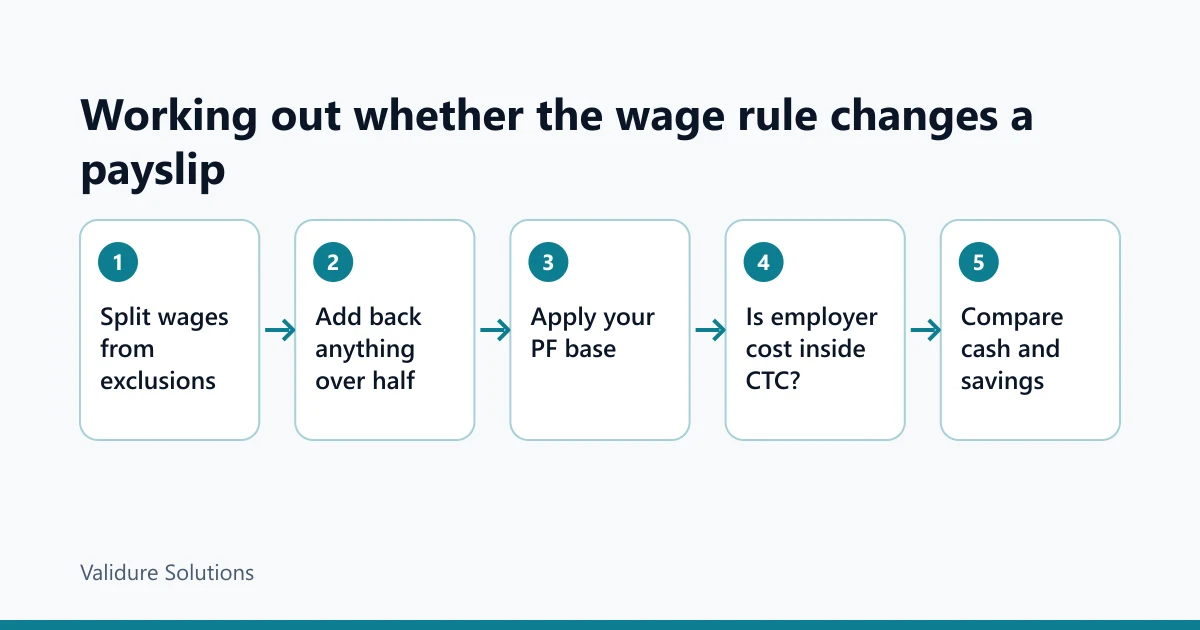
Add up the excluded items (HRA, conveyance and the others listed above) and compare them with half of your total pay. Then find which PF base your employer uses. Then look at whether employer PF and gratuity are inside your CTC. Those three facts explain nearly every change. If the numbers don't add up, ask HR for the working in writing before you escalate. Keep your offer letter and payslips, and look up your PF contributions on the EPFO member portal.
If you're the employer, the quick fix of raising basic to exactly half and leaving the rest alone doesn't make the structure right, because special allowance is probably wages already. Decide your PF base in writing, tell people before the first changed payslip, and don't cut an above-ceiling contribution someone was promised without their agreement.
In a payroll system, this is mostly about keeping the components labelled honestly and the PF base as a setting rather than a formula someone typed once. Validure HR runs payroll from salary structures and produces payslips and salary sheets, so the PF and gratuity base shows on its own line and a change can be reviewed on the salary sheet before payslips go out. Test any rule on a sample month before relying on it. For a business with a handful of staff on simple fixed pay, a spreadsheet with the 2(y) split done once is enough.
Sources and checks
Checked on 18 November 2026. Rates, ceilings and rules change, so verify against the official sources before relying on any figure here.
- Code on Wages, 2019, section 2(y), and Code on Social Security, 2020, definition of wages: India Code and the Ministry of Labour and Employment
- Labour codes in force from 21 November 2025: Press Information Bureau
- PF contribution, the wage ceiling and the interest rate: EPFO. The 25,000 ceiling from 17 September 2026 is reported by consultancy and news summaries of the notification; check the notification itself. The 8.25 per cent rate for 2025-26 is reported from an EPFO circular dated 1 July 2026.
- Regional Provident Fund Commissioner (II), West Bengal v. Vivekananda Vidyamandir, 28 February 2019: Supreme Court of India
- The ministry's December 2025 statement on take-home pay was posted on its official social media account and reported by several newspapers. I couldn't find it as a press release.
The treatment of special allowance comes from law-firm and consultancy commentary, which largely agrees; one payroll vendor's guide lists it as an exclusion, which doesn't match the text of the Code. Whether the employer's PF share counts in the total when testing the half is not settled in anything official I found, so the examples leave it out. The sums in the examples are illustrations with round numbers.
Frequently asked questions
Does the 50 per cent rule mean my basic must be half my CTC?
No. The text caps the listed exclusions at half of total remuneration. Basic can be lower if other non-excluded pay, such as a general special allowance, makes up the rest of wages.
Is special allowance part of wages under the labour codes?
Usually yes. It isn't on the exclusion list, so a special allowance paid to everyone is wages from the start. An allowance that genuinely covers job expenses can be treated differently.
Will my take-home fall if my PF is on the ceiling?
Not because of the wage rule, if your wages were already above the ceiling. But the ceiling itself rose to 25,000, which raises the mandatory deduction for anyone whose wages are above 15,000.
Can I ask my employer to stop PF above the ceiling?
The part above the ceiling is described as voluntary. If it was promised in your offer letter, any change needs both sides to agree, and some employers won't change it mid-year. Ask HR in writing.
Does a bigger wage base raise my gratuity?
Yes. Gratuity is worked out as 15 days' wages for each completed year, using wages divided by 26 for a day, so a larger wage base means a larger gratuity when you qualify for it.
My take-home fell and HR says it's the law. How do I check?
Put your old and new payslips side by side, add up HRA, conveyance and other excluded items, find your PF base, and check whether employer PF sits inside your CTC. If it still doesn't add up, ask HR for the working, then the labour commissioner's office.
