
Why GSTR-1 and GSTR-3B totals differ, and how to reconcile them every month
By Validure team · · 17 min read
A worked month shows how timing, credit notes, advances, reverse charge and wrong tax heads pull GSTR-1 and GSTR-3B apart. Includes a step-by-step way to compare your sales register by tax head, how the portal treats the two returns now, and a monthly routine tied to the due dates.

Say a distributor in Pune files monthly. On the 18th the accountant opens the GSTR-3B screen to pay September's tax and sees a liability of 9,12,600. The sales register says 8,37,000. The gap is 75,600, nobody has done anything obviously wrong, and the payment is due in two days.
That gap is almost never one mistake. It is four or five small, ordinary ones that each have a name. This post lists them, works one month through with numbers that net to the difference, shows how to produce the comparison from a sales register, and then covers how the GST portal treats the two returns today and what to do when you've already filed something wrong. The figures in the examples are made up for clarity. The rules are from official-source summaries I checked, with the places I couldn't confirm marked as such.
What each return actually reports
GSTR-1 is the statement of outward supplies. Invoice by invoice for B2B, summarised for B2C, plus credit and debit notes, advances received, and amendments to earlier periods. It is a list of documents.
GSTR-3B is the summary return on which you declare liability, claim input tax credit and pay. Its Table 3.1 gives outward supplies (including a row for inward supplies on which you pay tax under reverse charge), and Table 4 gives the credit you claim. It is a statement of money.
So they overlap on one thing, the tax on your outward supplies, and differ on everything else. GSTR-1 has no reverse charge on purchases. GSTR-3B has no invoice detail. Comparing the two totals without knowing that is the first reason people think something is broken.
Where the drift comes from
| Cause | What happens | What you see |
|---|---|---|
| Timing | Invoice dated the 31st is entered in the next month | Books higher than the return this month, lower next month |
| Amendments | An earlier invoice is corrected in this month's GSTR-1 | The return carries a delta your register may not show for this month |
| Credit and debit notes | Raised in books, left out of or added late to GSTR-1 | Return higher or lower by the note's tax |
| Advances | Tax is payable on an advance receipt before any invoice exists | Return has a line the sales register can't have |
| Reverse charge | Tax you pay on certain purchases appears in GSTR-3B only | 3B liability above GSTR-1 total, by that amount |
| Wrong tax head | An inter-state sale entered as intra-state, or the reverse | Total tax right, but CGST, SGST and IGST all off |
| Input tax credit | Credit claimed that doesn't match the purchase register or GSTR-2B | Cash paid differs although liability matches |
Two of these deserve a line more. On advances: for services, tax is generally payable when you receive the advance, and it is then adjusted when the invoice is raised. GSTR-1 has a separate table for advances received and adjusted. For goods, advance receipts have been outside the scheme for years, but confirm your own position. A sales register built only from invoices will always miss this, which is why advances are worth their own query.
On reverse charge: you pay tax on certain supplies you buy (a legal fee from an advocate is the usual example), and you declare it in GSTR-3B Table 3.1(d). Because it is a purchase, GSTR-1 never sees it. You then claim the credit in Table 4. The cash effect is often nil, but the 3B liability total is higher than the GSTR-1 total by that amount. Missing it in 3B is also a classic error, because the register you reconcile from is the sales register.
The tax-head slip is the quiet one. Total tax is unchanged, so a total-only comparison passes. The credit then lands in the wrong ledger for your customer, and your own cash ledgers get used in the wrong order. Only a comparison by head catches it.
A worked month, netted to the difference
An example, a distributor with three kinds of supply. Everything is at 18 per cent for simplicity. Amounts in rupees.
First, what the books say for September 2026, from the sales register, with credit notes shown as negatives:
| Taxable value | CGST | SGST | IGST | |
|---|---|---|---|---|
| Tax invoices dated in September | 48,50,000 | 2,70,000 | 2,70,000 | 3,33,000 |
| Credit notes raised in September | (2,00,000) | (18,000) | (18,000) | 0 |
| Net per books | 46,50,000 | 2,52,000 | 2,52,000 | 3,33,000 |
Net tax per books is 2,52,000 + 2,52,000 + 3,33,000 = 8,37,000.
Now the four things that happened that the register doesn't show, or shows differently:
| Item | Taxable value | CGST | SGST | IGST |
|---|---|---|---|---|
| A. Inter-state invoice dated 30 September, entered after GSTR-1 was prepared, reported next month | (1,20,000) | 0 | 0 | (21,600) |
| B. Advance received for a service, no invoice yet | 5,00,000 | 45,000 | 45,000 | 0 |
| C. Credit note of 40,000 left out of GSTR-1 (the books have it) | 40,000 | 3,600 | 3,600 | 0 |
| D. Inter-state invoice of 1,00,000 entered as intra-state | 0 | 9,000 | 9,000 | (18,000) |
| Total adjustments | 4,20,000 | 57,600 | 57,600 | (39,600) |
Add them to the books and you get what was reported:
| Taxable value | CGST | SGST | IGST | Total tax | |
|---|---|---|---|---|---|
| Net per books | 46,50,000 | 2,52,000 | 2,52,000 | 3,33,000 | 8,37,000 |
| Adjustments A to D | 4,20,000 | 57,600 | 57,600 | (39,600) | 75,600 |
| As reported in GSTR-1 | 50,70,000 | 3,09,600 | 3,09,600 | 2,93,400 | 9,12,600 |
| Reverse charge, GSTR-3B Table 3.1(d) only | 1,00,000 | 9,000 | 9,000 | 0 | 18,000 |
| Liability shown in GSTR-3B | 51,70,000 | 3,18,600 | 3,18,600 | 2,93,400 | 9,30,600 |
Check it by head. CGST: 2,52,000 + 57,600 = 3,09,600. IGST: 3,33,000 − 39,600 = 2,93,400. The 75,600 from the opening paragraph is 90,000 for the advance, plus 7,200 for the missed credit note, minus 21,600 for the late invoice, and the wrong-head item moves 18,000 out of IGST and into CGST and SGST without changing the total. The 18,000 of reverse charge is the whole of the difference between GSTR-1 and GSTR-3B in this month.
Read that table once more for what it teaches. Items A and C are mistakes you can fix: the invoice and the credit note belong in September. Item D is a mistake that has to be corrected through an amendment, because the customer's credit is affected. Item B is not a mistake at all, and neither is the reverse charge line. Half the "mismatch" is correct, and the job is to be able to say which half.
What the portal does now
This section changes faster than the rest, so treat it as a snapshot and check the official advisories. The sources I found were mostly tax-news summaries of GSTN advisories, not the advisories themselves.
First, GSTR-3B is increasingly built from GSTR-1. Reports on the GSTN advisory of 7 June 2025 say that the liability auto-populated from GSTR-1, GSTR-1A or IFF became non-editable from the July 2025 tax period. If that holds for your account, the outward figure in GSTR-3B equals what you filed in GSTR-1, and a mismatch between those two for outward supplies is mostly gone. What remains is the gap between your books and the returns, which is exactly the table above. So the reconciliation that matters has moved: you compare your books with the draft GSTR-1 before you file it, because after you file, the portal carries the number forward.
Second, Table 3.2 of GSTR-3B (inter-state supplies to unregistered persons, composition taxpayers and UIN holders) had its own, shifting timeline. An advisory of April 2025 announced a lock, which was deferred, and later advisories set dates in July and November 2025. Sources disagree on what applied when. Check the portal before relying on any date.
Third, GSTR-1A. It's an optional form to amend or add to your GSTR-1 for the same period, available after you've filed GSTR-1 and before you file GSTR-3B. It has no due date of its own. The window closes when you file GSTR-3B for that period. This is the route for correcting an auto-populated figure you can no longer edit in 3B, for example a wrong tax head or a missed credit note.
Fourth, input tax credit. Table 4 is populated from GSTR-2B, and reports describe the Invoice Management System (accept, reject, pending) as feeding it since the October 2025 period. Industry articles describe a further lock on manual changes to Table 4, expected from around July 2026, but the latest source I found said that no official advisory confirmed it. Don't assume either way. Open the 3B screen and see whether the ITC cells accept edits.
Fifth, QRMP. If you're a quarterly filer, GSTR-1 is quarterly (due on the 13th of the month after the quarter), you may use the invoice furnishing facility on the 13th in the first two months, and GSTR-3B is quarterly, due on the 22nd or 24th depending on your state. You pay tax monthly in between. The reconciliation is then quarterly for the returns and monthly for the books, and the monthly payment (by challan, in that scheme) is one more figure to tie in.
The reconciliation, from a sales register
Start with an export of your sales register into Excel: one row per document, with the document number, type (invoice, credit note or debit note), date, status, supplying state, customer state, taxable value, CGST, SGST, IGST and the return period it was reported in. Then work in two steps.
Step one is the headline comparison. Total the register for the month, posted documents only, with credit notes subtracted. Total the same four figures (taxable value, CGST, SGST, IGST) from the GSTR-1 summary you downloaded from the portal. Put them side by side as books, filed and difference. Any row with a difference needs an explanation.
If you have a developer, this is the query for the books side of that comparison.
SELECT SUM(CASE WHEN doc_type = 'CN' THEN -1 ELSE 1 END * (cgst + sgst + igst)) AS books_tax
FROM   sales_register
WHERE  status = 'posted'
  AND  doc_date >= '2026-09-01' AND doc_date < '2026-10-01';
Add one SUM per head if you want them separately, and compare the result with the same figure in the GSTR-1 summary.
Step two is explaining each non-zero difference. Three checks map to the causes above, and an Excel filter or a helper column does each one.
| Check | What to look for | What a hit means |
|---|---|---|
| Timing | Documents whose date falls in one month but whose return period column says another | Not an error. The amount sits in the other month and should reverse next time |
| Wrong head | Rows where the supplying and customer state match but IGST is above zero, or where they differ and CGST or SGST is above zero | Tax is under the wrong head. Correct it by amendment |
| Advances | Money received from customers in the month with no invoice adjusted against it yet | Tax is payable on the advance even though no invoice exists |
The wrong-head check uses the customer's state as a stand-in for place of supply. That is right for most goods sales to a registered customer and wrong for some services, where the place of supply follows other rules. Treat the hits as a review list, not a verdict.
When those three checks plus your reverse-charge list explain every rupee of the difference, you're done. If a residual is left, it's usually a rounding difference at line level or a document with the wrong status, and both are worth finding because they repeat.

Writing down the differences
A reconciliation nobody can read later is only half done. Keep one short note per month, in the same place, in the same shape:
Put the period, the preparer and the reviewer at the top, then this table.
| Line | Item | Amount (₹) | What to do |
|---|---|---|---|
| Books net tax | 8,37,000 | ||
| GSTR-1 net tax | 9,12,600 | ||
| Difference | 75,600 | ||
| A | Inv S-2291 dated 30 Sep, reported in Oct GSTR-1 | (21,600) | Timing, no action |
| B | Advance from a customer, receipt 22 Sep | 90,000 | Adjust against the invoice in Oct |
| C | CN 114 omitted from GSTR-1 | 7,200 | Add via amendment or next GSTR-1 |
| D | Inv S-2260 IGST shown as CGST+SGST | 0 | Correct via amendment (heads move by 18,000) |
| GSTR-3B liability | 9,30,600 | GSTR-1 9,12,600 plus RCM 18,000 |
That page answers most of an officer's first questions before they're asked. It also tells next month's preparer what to expect: item A should show up as a plus, and item B should disappear when the invoice is raised.
Set a threshold, for example anything above a few hundred rupees, and write one line each. Below it, group them under rounding. The threshold is yours to pick. Having none is the problem.
If you've already filed wrong
I'm not a tax adviser, and what follows is the general shape. Whether a particular fix is open to you depends on the facts, the timing and sometimes on court decisions, so take it to your adviser before you act.
GSTR-3B can't be revised once filed. Corrections go into a later return. Section 39(9) of the CGST Act lets you rectify an omission or incorrect particulars in the return for the month in which you discover it, with interest where tax was short paid. Sources I found say this is available up to 30 November following the end of the financial year, or the date of the annual return if that's earlier, and that in practice the October return filed by 20 November is the last one you can count on. Treat these as a reading to verify, not as advice.
For GSTR-1, the options in rough order:
- Before you file GSTR-3B for the period: use GSTR-1A to fix the same period. Cleanest, since 3B then picks it up.
- After GSTR-3B is filed: amend through the amendment tables of a later GSTR-1, and carry any tax effect in the later 3B.
- Missed credit note: a credit note affecting GST has a time limit under section 34(2), commonly summarised as 30 November following the end of the financial year or the annual return date, whichever is earlier. After that, only a commercial credit note without GST effect is possible. Check the section text on the CBIC site.
- Underpaid tax found late: it is still payable. The return route may be closed, and a payment by a separate challan with interest may be what's left. That's an adviser conversation.
The rule of thumb that holds up: fix it in the same period if the window is still open, because that creates the least paperwork, and if you can't, fix it in the next return and write the note above. Don't net a short payment in one head against excess in another without understanding how credit and cash ledger rules treat that.
Where a system helps, and where it doesn't
The honest root cause of most drift is that the two returns are built from different data. If GSTR-1 comes from the sales register and GSTR-3B comes from a spreadsheet someone assembled, they will disagree. If both summaries come from the same posted invoices, credit notes and receipts, the differences shrink to the timing and amendment items, and those are the easy ones to explain.
That is the narrow thing we built Validure ERP to do. It produces CGST, SGST and IGST summaries for GSTR-1 and GSTR-3B from the same invoices, with purchases and input tax credit alongside, and an audit trail so a changed document leaves a record. You still compare its numbers with what the portal shows. It's a way to stop the books and the returns starting from different data, not a replacement for the check.
Under a few dozen invoices a month, one state, no advances and no reverse charge, you probably don't need any of it. A tidy sheet and the routine below will do.
A monthly routine tied to the due dates
For a monthly filer, GSTR-1 is generally due on the 11th and GSTR-3B on the 20th of the following month. Both have been extended in particular periods, so check the portal each month. QRMP filers use the 13th, and the 22nd or 24th for the quarter.
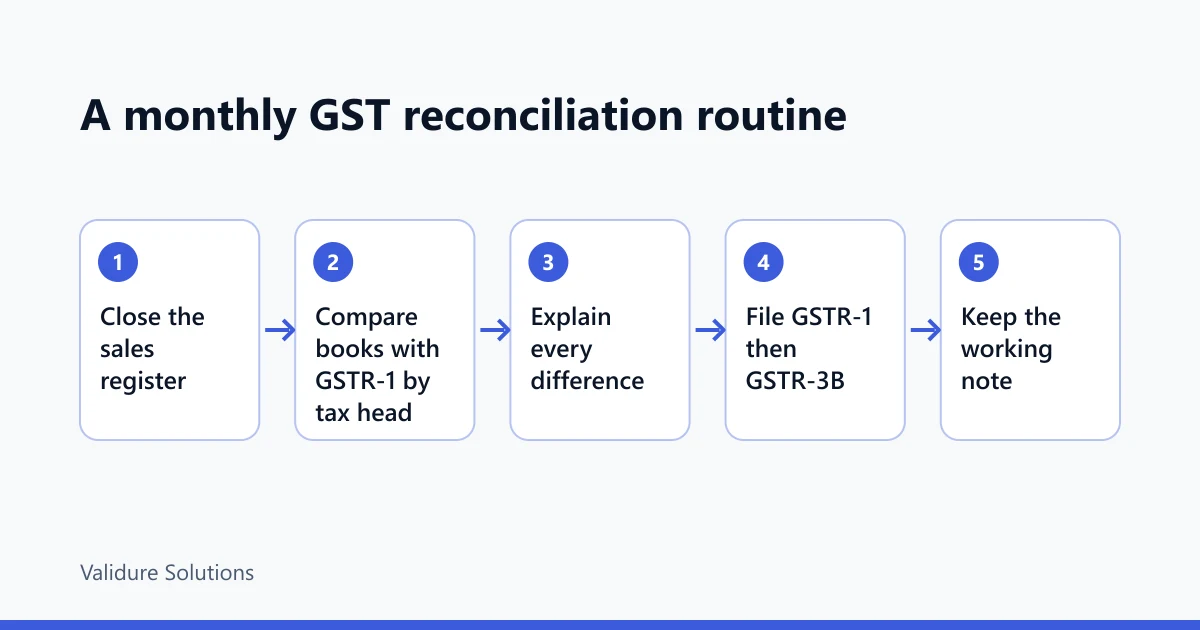
- Days 1 to 3: close the sales register for the month. Post or cancel every draft. Block back-dated edits.
- Day 4: run the by-head comparison, the timing query, the wrong-head query and the advances query. Fix what's wrong in the books first.
- Days 5 to 8: prepare GSTR-1. Compare the draft totals with the books by head, and list the differences.
- By day 10: have a second person review the difference note, then file GSTR-1 a day or two before the 11th. Late filing is the one that costs a fee.
- Days 12 to 15: with GSTR-1 filed, look at the auto-populated GSTR-3B. If something in it is wrong and the form won't let you edit it, GSTR-1A is open until you file 3B.
- Days 15 to 18: reconcile purchases and ITC with GSTR-2B, add the reverse-charge lines, and settle what will be paid from cash and what from credit.
- By day 20, minus a buffer: file and pay GSTR-3B. Save the portal summary and the difference note together.
If you're on QRMP, do the same steps on the quarterly dates and run the by-head comparison each month anyway, since the books don't wait for the quarter.
Sources and checks
Verify every date and rule against the official sources before acting: the GST portal for advisories, forms and due dates, the CBIC GST site for notifications and circulars, and the CBIC tax information repository for the text of the CGST Act, including sections 34 and 39. Most of what I could search for was commentary by tax firms and software vendors, which differs on effective dates, so the dates for the auto-population and locking changes in particular need checking on the portal. The worked month uses round numbers and is an illustration, not advice.
Frequently asked questions
Do GSTR-1 and GSTR-3B have to match exactly?
Not line for line. Liability reported in GSTR-3B should equal your GSTR-1 for outward supplies, plus reverse charge, and any gap should be one you can name: timing, amendment, advance, credit note or tax head. An unexplained gap invites questions.
Why is my GSTR-3B liability higher than my GSTR-1 total?
The commonest reason is reverse charge, which appears in GSTR-3B Table 3.1(d) and never in GSTR-1. Advances you haven't yet invoiced and amendments to earlier periods are the next suspects.
Can I edit the figures that auto-populate in GSTR-3B?
Reports on GSTN advisories say that liability auto-populated from GSTR-1, GSTR-1A and IFF has been non-editable since the July 2025 period, and Table 3.2 had its own timeline. Open your own 3B and see which cells accept edits, and use GSTR-1A before filing 3B to correct them.
What's the difference between GSTR-1A and amending in the next GSTR-1?
GSTR-1A amends the same period, and only between filing GSTR-1 and filing GSTR-3B for that period. After that, amendments go in a later GSTR-1 and show up in a later period's liability.
I filed GSTR-3B with a mistake. Can I revise it?
No. GSTR-3B can't be revised after filing. Corrections are made in a later return, with interest if tax was short paid, within the limits of section 39(9). The details depend on your facts, so speak to your adviser.
How often should I reconcile?
Every month, before you file GSTR-1, because that is the last point at which the auto-populated GSTR-3B can still be changed from your side. If you file quarterly under QRMP, reconcile the books monthly anyway and the returns quarterly.
