GSTR-9 for 2025-26: why Table 8A won't match your GSTR-3B, and what to fix before you file
By Validure team · · 15 min read
A worked guide to the GST annual return due on 31 December 2026. Who has to file, where Table 8A comes from, why its number never matches the credit you claimed, how to split the difference, and the dates that close doors before the due date does.

Your accountant opens the GSTR-9 screen for 2025-26 and two numbers stare back. Table 6A says you claimed 41.8 lakh of input tax credit through the year. Table 8A says your suppliers' filings support 41.65 lakh. The gap is small, so it looks fine. Then someone asks which invoices make up the gap, and nobody can say.
That gap is where most of the work in an annual return sits. The tax you paid on sales is usually easy, because it came out of your own GSTR-1 and GSTR-3B. Input tax credit is harder, because one table is built from what you claimed and another from what your suppliers reported, on different time bases, and the portal won't let you edit the second one.
This post walks through the 2025-26 return with one worked example: who has to file, where each credit number comes from, how to split a difference into its real causes, and the two dates that matter more than 31 December. It's for the owner or accountant who'll press the file button, and for anyone who wants to know what their consultant is actually checking.
This is general information, not tax advice. Your consultant or chartered accountant should look at your own figures.
Who has to file, and by when
GSTR-9 is the annual return under section 44 of the CGST Act. Rule 80 of the CGST Rules sets the due date as 31 December following the end of the financial year, so the return for 2025-26 is due by 31 December 2026.
Not everyone files it. Notification 15/2025-Central Tax, dated 17 September 2025, exempts registered persons whose aggregate turnover in a financial year is up to 2 crore rupees, from 2024-25 onwards. Earlier years had the same relief, but it was notified one year at a time. Aggregate turnover is counted on your PAN across India, so two registrations in two states with 1.2 crore each means both file.
Above 5 crore, Rule 80 adds GSTR-9C, a reconciliation statement between your audited books and the return. It has been self-certified since 1 August 2021, so it no longer needs a chartered accountant's certificate, though most businesses still have one prepare it. CBIC's Circular 246/03/2025-GST says the annual return isn't complete until both forms are in where 9C applies, and the late fee runs until it is.
Composition taxpayers file GSTR-9A, not GSTR-9, and aren't covered here.
| Aggregate turnover for 2025-26 (all GSTINs on the PAN) | GSTR-9 | GSTR-9C |
|---|---|---|
| Up to 2 crore | Optional | Not needed |
| Above 2 crore, up to 5 crore | Required | Not needed |
| Above 5 crore | Required | Required, self-certified |
The portal only opens GSTR-9 for a year once every GSTR-1 and GSTR-3B for that year has been filed. GSTN said so in its FAQ for 2024-25, and if a single month is pending the form won't appear. Check that first.
The date that really matters is 30 November
Section 16(4) of the CGST Act says you can't take credit for an invoice of a financial year after 30 November following that year, or after you file the annual return for that year, whichever comes first. For 2025-26 invoices, that's 30 November 2026.
Two things follow. First, credit you missed during the year can only be picked up through a GSTR-3B filed by 30 November. GSTR-9 is not a place to claim new credit; it only reports what you already claimed. Second, filing GSTR-9 early, before 30 November, shuts the credit window on that date. There's rarely a reason to file before December.
For a monthly filer, the October 2026 GSTR-3B, due on 20 November, is normally the last regular return in that window. If yours is already filed, the window for missed 2025-26 credit has effectively closed for you. If it's still pending, filing it by 30 November with the missed credit is still within section 16(4), though you'll pay the late fee for the return. Quarterly filers under QRMP should ask their consultant how this works for them, because their next GSTR-3B falls after the cut-off.
One more date. Since 1 October 2023, section 44(2) bars filing an annual return more than three years after its due date. The 2022-23 return was due on 31 December 2023, so 31 December 2026 is the last day it can be filed at all. If a 2022-23 return is still pending for any GSTIN in your group, that's the more urgent job.
Where Table 6A and Table 8A come from
Most of the confusion goes away once you know what feeds each table.
Table 6A is the credit you claimed in Table 4A of your GSTR-3Bs from April 2025 to March 2026. It's auto-filled and locked. It counts by the return period you claimed in, not by the date on the invoice. So it includes 2024-25 invoices you claimed late, in April to November 2025.
That's why there's a Table 6A1. It takes out the previous year's credit claimed this year, and 6A2 (6A minus 6A1) is the 2025-26 credit you split across Tables 6B to 6H by type: inputs, capital goods and services from regular suppliers, reverse charge, imports and so on.
Table 8A is built from GSTR-2B, the statement of credit your suppliers' filings support. GSTN's FAQ for 2024-25 says 8A takes invoices belonging to that year from GSTR-2B, including ones that only showed up in GSTR-2B between April and October of the next year, and leaves out last year's invoices that showed up late. Reading the same rule forward, 8A for 2025-26 covers 2025-26 invoices appearing in GSTR-2B up to October 2026. Treat that as our reading of the 2024-25 FAQ until GSTN publishes one for 2025-26.
GSTN also said the Invoice Management System has no direct effect on GSTR-9: invoices you accepted, or left alone so they were deemed accepted, went into GSTR-2B and so into 8A. An invoice you rejected in IMS never reached GSTR-2B, so it won't be in 8A.
Two more things trip people up. Table 8A doesn't include reverse charge credit or imports, because neither comes through a supplier's GSTR-1. And you can download the invoice-wise list behind 8A as an Excel file from the GSTR-9 dashboard. That file is your starting point for every reconciliation below.
A worked example: one trader, one year
Say a distributor in Pune has one GSTIN and an aggregate turnover of 3.4 crore for 2025-26. It files GSTR-9 but not 9C. These figures are an example, chosen to show the common causes.
| Table | What it holds | Amount |
|---|---|---|
| 6A | Credit claimed in GSTR-3B, April 2025 to March 2026 | 41,80,000 |
| 6A1 | Of that, 2024-25 credit claimed during 2025-26 | 1,20,000 |
| 6A2 | 2025-26 credit claimed during the year (6A minus 6A1) | 40,60,000 |
| 6C and 6D | Reverse charge credit, inside 6A2 | 60,000 |
| 6B | Credit from regular suppliers, inside 6A2 | 40,00,000 |
| 8A | 2025-26 invoices in GSTR-2B, up to October 2026 | 41,65,000 |
Check the arithmetic: 41,80,000 minus 1,20,000 is 40,60,000, and 40,60,000 minus the 60,000 of reverse charge leaves 40,00,000 in 6B.
Now the reconciliation, invoice by invoice, from the 8A Excel against the purchase register. It turns up three things.
| What the matching found | Amount | In 8A? | In 6B? |
|---|---|---|---|
| Invoices claimed in the year and present in GSTR-2B | 39,60,000 | Yes | Yes |
| Invoices a supplier filed late, never claimed in 2025-26, then claimed in the October 2026 GSTR-3B | 95,000 | Yes | No |
| Credit on staff food and a car's servicing, blocked under section 17(5), correctly never claimed | 1,10,000 | Yes | No |
| An invoice claimed during the year whose supplier never filed it | 40,000 | No | Yes |
The rows add up both ways. 39,60,000 plus 95,000 plus 1,10,000 is 41,65,000, which is 8A. 39,60,000 plus 40,000 is 40,00,000, which is 6B.
How the difference lands in Table 8
Table 8 is where the portal compares the two sides. 8B is the credit from 6B, so 40,00,000. 8C is credit for 2025-26 invoices claimed for the first time in the next year's returns, within the time limit: the 95,000 claimed in October 2026. And 8D is 8A minus (8B plus 8C): 41,65,000 minus 40,95,000, which is 70,000.
A positive 8D of 70,000 looks harmless: you appear to have claimed less than your suppliers support. But 70,000 is a net figure. It's 1,10,000 of blocked credit you rightly didn't take, minus 40,000 you took without a supplier filing behind it. The first goes into 8F as credit available but ineligible, and that's the end of it. The second is a real problem hidden inside a reassuring total.
That's the case for reconciling by invoice rather than by annual total. A net difference can hide two errors that cancel out, and a tax officer looking at your 2B data will see the 40,000 on its own.
The 95,000 claimed in October 2026 also goes into Table 13, which reports this year's credit availed in the next financial year. GSTN's FAQ draws one fine line here: credit that was claimed, reversed and then reclaimed in the next year goes in Table 13 only, not 8C, or it creates a false difference in 8D.
What to do with the 40,000
Credit claimed on an invoice your supplier never reported is the one item that costs money.
Start by asking the supplier to report it. If they file the invoice in a GSTR-1 or GSTR-1A and it appears in your GSTR-2B, the support is there. For it to count in 8A for 2025-26 it had to appear by October 2026, so for this year it's probably late. The credit may still be defensible with the invoice and proof of payment, but expect questions. If the supplier won't or can't, reverse the credit and pay it through Form DRC-03, with interest, and keep the DRC-03 with your GSTR-9 papers. Ask your consultant which table of the return should show it.
Interest on credit wrongly availed and used is charged under section 50(3) at the notified rate of 18 per cent. As an example, if the 40,000 was used against output tax for 300 days before you pay it back, interest is 40,000 × 18% × 300 / 365, which is 5,917.81. Your consultant will work out the actual days from your ledger.

The checks to run before you file
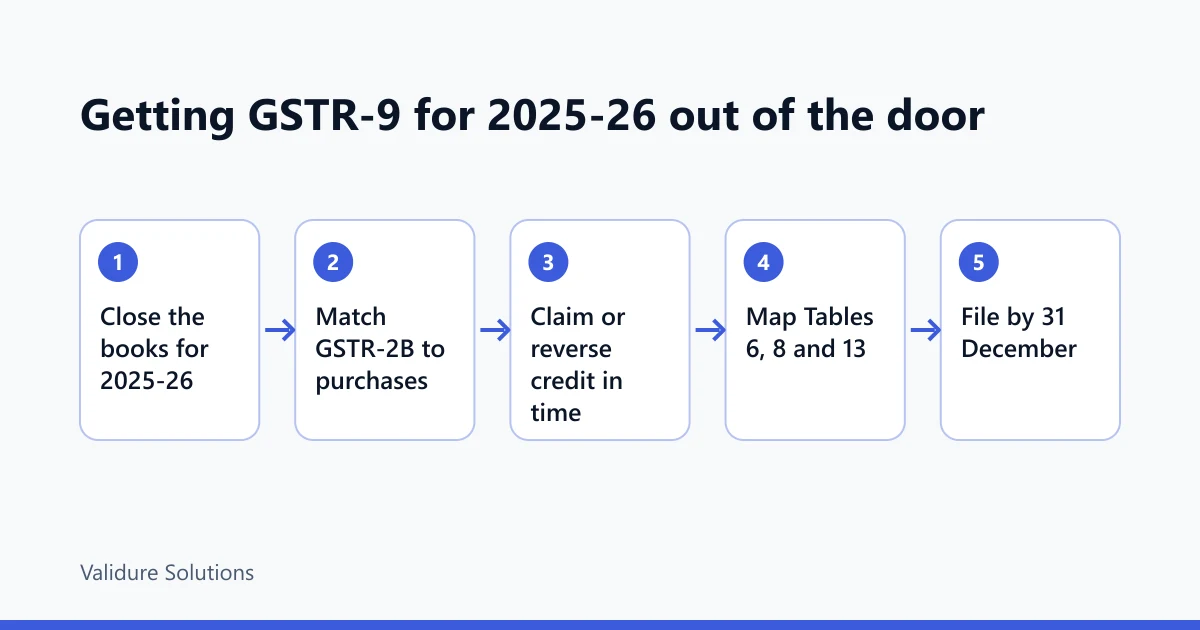
Do these in this order. The first three need the 8A Excel download and your purchase register for the year, both sorted by supplier GSTIN and invoice number.
| Check | What to look for | What a hit means |
|---|---|---|
| Every month filed | GSTR-1 and GSTR-3B for April 2025 to March 2026 all show as filed | If one is missing, the form won't open; file it first |
| In 8A, not in your books | Rows in the 8A Excel with no matching purchase entry | Either a missed invoice (claim only if a 3B is still possible by 30 November), blocked credit (8F), or a bill you never received, which you should ask the supplier about |
| In your books, not in 8A | Purchase entries with credit claimed and no row in the 8A Excel | The supplier didn't file, or filed under the wrong GSTIN or invoice number; chase it or reverse and pay |
| Last year's credit | Credit claimed from April to November 2025 on 2024-25 invoices | Belongs in 6A1, not in 6B |
| Reverse charge | Credit on reverse charge services such as a goods transport agency or legal fees | Belongs in 6C or 6D; it's never in 8A, so don't chase it there |
| Sales side | Table 4 and 5 against your sales register and books, including credit notes | An unreported sale, or a credit note in the wrong year |
| Tax paid | Table 9 against your cash and credit ledgers | Tax payable that doesn't match what you paid |
If you have a developer and your purchase register sits in a database, the second and third checks are one full outer join on GSTIN, invoice number and tax amount against the 8A Excel loaded as a table. In a spreadsheet, a lookup from each side to the other does the same job. Either way, look at every unmatched row, not just the total.
Rounding and typing differences are common. An invoice entered as 1234 in your books and 01234 by the supplier will show as two mismatches. Normalise invoice numbers (strip leading zeros, spaces and slashes) before matching, and then look at the near-misses by hand.
There's no second go
Once filed, a GSTR-9 can't be revised on the portal. A wrong split between tables stays on record, and so does a difference you couldn't explain. That's another reason not to rush it before December.
Late filing costs a fee under section 47(2), reduced from 2022-23 onwards by Notification 07/2023-Central Tax. For turnover up to 5 crore, the notified fee is 25 rupees a day under CGST plus the same under SGST, capped at 0.02 per cent of turnover in the state under each. Between 5 and 20 crore it's 50 rupees a day under each, with the same cap. Above 20 crore the original 100 rupees a day under each applies, capped at 0.25 per cent under each.
For our Pune distributor, filing on 31 January 2027, 31 days late, would cost 31 × 50, which is 1,550, well under the cap of 0.04 per cent of 3.4 crore, which is 13,600. The fee isn't the real cost. The real cost is a return filed in a hurry, with nobody having looked at the invoices behind 8D.
Keeping next year's return short
The annual return is hard mostly because the year's work wasn't done monthly. If every GSTR-2B is matched against the purchase register before each GSTR-3B, the annual reconciliation is just adding up twelve months that already agree.
That's the part Validure ERP handles: purchases and expenses are recorded with their input tax credit, the GSTR-1 and GSTR-3B summaries come from the same entries, and every change sits in an audit trail with a name and a time. When the year-end question is "which invoices make up this 40,000", you can answer it from the records rather than from memory. It doesn't file returns for you or replace your consultant.
You may not need software for this. With fifty purchase invoices a month from a dozen regular suppliers, a monthly spreadsheet match against GSTR-2B does the same job. The case for a system grows with the number of suppliers, branches and GSTINs, because that's where a missed invoice turns into lost credit.
Sources and checks
Rules here were checked on 23 November 2026. Verify against the official sources before relying on any figure: the GST portal and the GSTN tutorial and FAQ site for the form, Table 8A and IMS behaviour (the consolidated GSTR-9 and 9C FAQ for 2024-25 is the latest we found); CBIC's GST site for Notification 15/2025-Central Tax, Notification 07/2023-Central Tax and Circular 246/03/2025-GST; and the CBIC tax information portal for sections 16, 44, 47 and 50 of the CGST Act and Rule 80. The worked example uses made-up figures to show the method. It isn't advice for your business.
Frequently asked questions
My turnover for 2025-26 was 1.8 crore. Do I need to file GSTR-9?
No. Notification 15/2025-Central Tax exempts aggregate turnover up to 2 crore from 2024-25 onwards. You can still file if you want to. Remember the 2 crore is counted across all GSTINs on your PAN.
Can I claim credit I missed during the year in GSTR-9?
No. GSTR-9 only reports credit claimed in GSTR-3B. Missed 2025-26 credit had to go into a GSTR-3B filed by 30 November 2026, or before the annual return if you filed that earlier.
Why is Table 8A higher than what I claimed?
Usually because of credit you rightly didn't take, such as blocked credit under section 17(5), or invoices you missed. It can also hide the opposite problem, credit you claimed with no supplier filing. Match invoice by invoice to find out which.
Does a difference in Table 8D mean I owe tax?
Not on its own. A positive difference is credit available but not taken; you report it as not availed or ineligible. A negative difference, or a hidden one like the 40,000 in the example, is what needs payment.
Can I correct GSTR-9 after filing?
No. The portal has no revise option. Any tax you find later can still be paid through DRC-03, but the return itself stays as filed.
Is there anything due on 31 December 2026 besides the 2025-26 return?
Yes. It's the last day to file a 2022-23 annual return at all, because of the three-year bar in section 44(2). After that, the portal won't take it.