Which bills make you pay the GST yourself? Reverse charge for a small business, with the maths
By Validure team · · 14 min read
A worked guide to GST reverse charge in India. Which purchases still trigger it (commercial rent, transport, legal fees and a short list of others), why it is paid in cash, when it falls due, how the credit comes back, and the checks that catch a missed one.

Your accountant is going through October's bills and stops at three of them. The godown rent of 60,000 has no GST because the landlord isn't registered. The transporter's freight bill of 40,000 has no GST on it either, just a line saying tax is payable by the recipient. And the lawyer who sent a notice for you has billed 25,000, also with no tax. The accountant's question is short: who pays the GST on these three, and did anyone pay it last month?
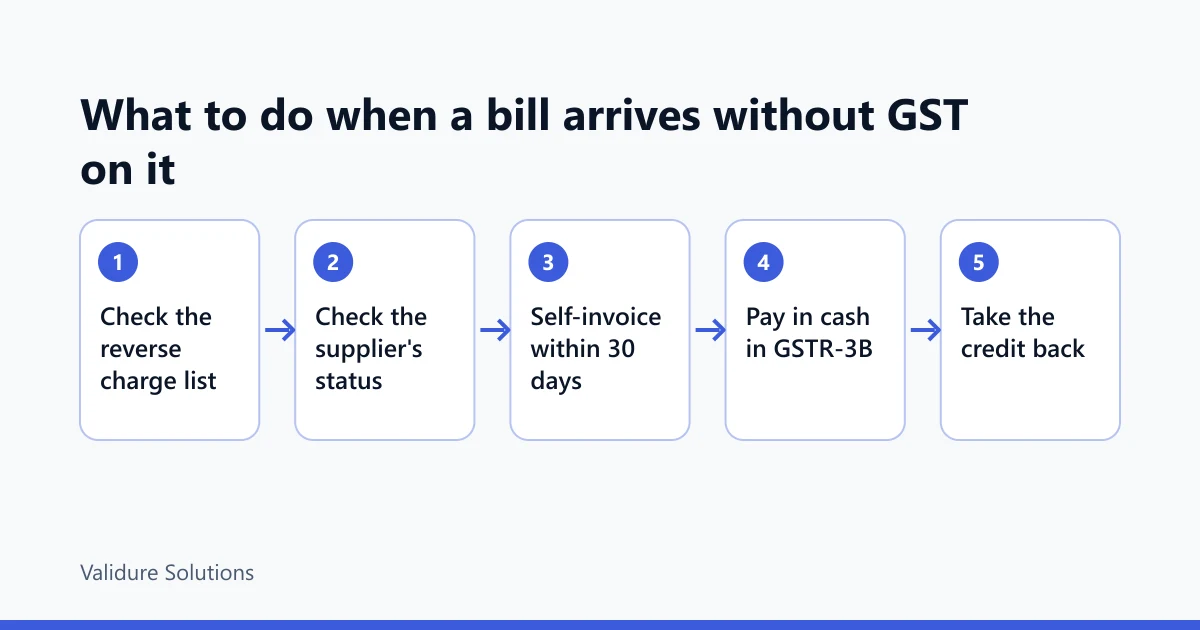
The answer for all three is probably you. This is reverse charge, and it's the part of GST that small businesses miss most quietly, because nothing on the bill tells you how much to pay. The supplier hasn't charged it. You have to work it out, pay it in cash, report it, and then take it back as credit.
Below: which bills still trigger it, what it costs in cash (usually little), what a miss costs (more), and the checks that catch one. It's information, not tax advice, and the lists change by notification, so check your own case with your CA.
Reverse charge in one paragraph
Normally the seller charges GST and pays it to the government. For a notified list of supplies the law flips that: the buyer pays the tax directly, at the same rate. The power is in section 9(3) of the CGST Act, and the list for services sits in Notification 13/2017-Central Tax (Rate), amended many times since.
The second route, section 9(4), once meant every purchase from an unregistered seller attracted reverse charge. That version was suspended and replaced; since 1 April 2019 it covers only real estate promoters (Notification 07/2019-Central Tax (Rate)). Plenty of articles still say you owe reverse charge on any purchase from an unregistered dealer. For a trader or a services firm, that's out of date.
The bills that still trigger it
Most small businesses meet only these entries, as they stood when we checked on 23 November 2026.
| Bill you receive | Who pays the GST | Rate | Watch for |
|---|---|---|---|
| Rent for a shop, office or godown from a landlord who isn't GST registered | You, if you are registered and not on the composition scheme | 18% | In force from 10 October 2024; composition taxpayers excluded from 16 January 2025 |
| Road freight from a goods transport agency (GTA) that hasn't opted to charge GST itself | You, if you are a company, firm, factory, registered person and certain others | 5% | If the GTA has opted for forward charge, it charges you 5% or 18% on the bill and you pay nothing under reverse charge |
| Fees of an advocate or a firm of advocates | You, as a business entity | 18% | Small business entities may be exempt; check the threshold with your CA |
| Sitting fees or commission paid to a company's directors | The company | 18% | Applies to the director's services as director, not to salary under an employment contract |
| Security services from a supplier that isn't a body corporate | You, if registered (some exclusions apply) | 18% | Check whether your security agency is a company or a proprietor |
| Services bought from a supplier outside India | You | Rate of the service | Usually software subscriptions and consultants abroad, paid as IGST |
The rent entry is the one that catches most people now, because it's recent. The GST Council recommended it in September 2024 and Notification 09/2024-Central Tax (Rate) put it into the list from 10 October 2024. Then Notification 07/2025-Central Tax (Rate), dated 16 January 2025, took composition taxpayers out of it, and regularised what they had done in between "as is where is". So a composition dealer renting from an unregistered landlord pays nothing on rent from 16 January 2025. A regular-scheme business does.
The GTA entry changed in September 2025. From 22 September 2025, under Notification 15/2025-Central Tax (Rate), a GTA either stays on the default, where the recipient pays 5% under reverse charge, or opts to charge forward. The forward options are 5% without input credit for the GTA, or 18% with credit, the 18% replacing the old 12%. A GTA has to make that choice by declaration, so the freight bill itself should tell you which one applies. If it says nothing and shows no tax, assume reverse charge and ask the transporter in writing.
What it actually costs you in cash
Here's the part that reassures most owners. For a regular-scheme business that sells taxable goods or services, reverse charge is mostly a timing and paperwork cost, not a real one. You pay the tax in cash, and you take the same amount back as input tax credit in the same return, provided the usual conditions are met.
Take the three bills from the opening, as an example for a registered business in one state. All three are intrastate, so each tax splits half into CGST and half into SGST.
| Bill | Value | Rate | Tax under reverse charge | CGST | SGST |
|---|---|---|---|---|---|
| Godown rent | 60,000 | 18% | 10,800 | 5,400 | 5,400 |
| GTA freight | 40,000 | 5% | 2,000 | 1,000 | 1,000 |
| Advocate's fee | 25,000 | 18% | 4,500 | 2,250 | 2,250 |
| Total | 1,25,000 | 17,300 | 8,650 | 8,650 |
Now say this business, in the same month, has 1,20,000 of output tax on its own sales and 95,000 of credit from normal purchases.
Without the reverse charge bills, it pays 1,20,000 minus 95,000, which is 25,000 in cash.
With them, it first pays the 17,300 in cash. Then its credit grows to 95,000 plus 17,300, which is 1,12,300. Its cash for output tax drops to 1,20,000 minus 1,12,300, which is 7,700. Total cash out: 17,300 plus 7,700, which is 25,000.
Same 25,000. The reverse charge went out of one pocket and came back into the other in the same return.
That shrug is fair for this business. Not for three others.
Three businesses for whom it is a real cost
First, the composition dealer. A composition taxpayer can't claim input tax credit at all, so any reverse charge it owes is a pure cost. The rent exclusion helps, but a composition dealer that hires a GTA on reverse charge, or pays an advocate, still pays that tax and never sees it back.
Second, the business with exempt sales. A clinic, a school or a dealer in exempt goods pays reverse charge in cash and can't use the credit, or can use only part of it under the common credit rules. For them the 18% on rent is simply 18% more rent.
Third, the business whose credit already piles up. An exporter supplying under a letter of undertaking, or a business whose input rate is higher than its output rate, has little output tax to set the credit against. It pays 17,300 in cash every month and the credit sits in the ledger. It can usually be refunded, but refunds take time and paperwork, so the cash is gone for months.
If you're one of these three, reverse charge belongs in your pricing and your lease talks, not only in your returns.
Why it has to be paid in cash
People try to pay reverse charge out of their existing credit balance. The portal won't let you, and the reason is in two definitions.
Section 49(4) of the CGST Act lets the electronic credit ledger pay "output tax". Section 2(82) defines output tax as the tax on supplies you make, and it expressly excludes tax payable on reverse charge. So reverse charge isn't output tax, and the credit ledger can't pay it. Rule 85(4) of the CGST Rules says the same thing directly, and CBIC repeated it in Circular 172/04/2022-GST.
So a business with 3 lakh of credit in the ledger still needs 17,300 in actual cash for our example month.

The self-invoice, and the 30-day clock
When the supplier is unregistered, there's no proper tax invoice for you to hold. The law makes you write one to yourself. Section 31(3)(f) of the CGST Act requires a registered recipient paying reverse charge on a supply from an unregistered supplier to issue an invoice for it. That's the self-invoice. You also issue a payment voucher when you pay the supplier.
Rule 47A, inserted by Notification 20/2024-Central Tax and in force from 1 November 2024, now says it must be issued within 30 days of receiving the goods or services.
The self-invoice matters for one more reason. Under section 13(3), as amended from 2024, the time of supply for services from an unregistered supplier is the date you issue the self-invoice. And CBIC's Circular 211/5/2024-GST ties the deadline for claiming that credit to the financial year of the self-invoice. A missing self-invoice leaves the tax due and the credit with no clean anchor.
When the tax falls due
Reverse charge isn't always due in the month of the bill. The time of supply rules decide it, and they differ for goods and services.
For services from a registered supplier (a GTA on reverse charge, an advocate's firm that is registered), section 13(3) says the time of supply is the earlier of the date you pay and the date immediately after 60 days from the supplier's invoice.
A worked case, as an example. A GTA issues a freight invoice on 5 October 2026. You pay it on 20 December 2026. Sixty days from 5 October runs to 4 December, so the date immediately after is 5 December. The earlier of 5 December and 20 December is 5 December. The reverse charge belongs in December's GSTR-3B, not October's, and not because of when you paid.
For goods under reverse charge (the notified goods list, which most traders don't meet), section 12(3) takes the earliest of three dates: when you receive the goods, when you pay, and the date immediately after 30 days from the supplier's invoice.
Paying early costs a few weeks of cash. Paying late costs interest.
What a missed reverse charge costs
When reverse charge is found late, usually by an auditor or in a departmental scrutiny, three things follow. You pay the tax, in cash. You pay interest on it under section 50, at 18% a year for tax not paid on time. And you take the credit back, if you are still within the time limit in section 16(4).
The interest has a simple formula:
Interest = tax x 18% x days late / 365
Say one month's rent reverse charge of 10,800 was missed and paid 180 days late:
10,800 x 18% = 1,944 a year. 1,944 x 180 / 365 = 958.68.
A full year of missed rent reverse charge is 10,800 x 12 = 1,29,600 of tax in cash at once, plus interest on each month. The tax may come back as credit. The interest never does, and for months past the credit time limit the tax doesn't either. On time, reverse charge is cash-neutral; late, it's a cash hit.
Where it goes in the return
Two tables in GSTR-3B carry it. The tax you owe goes in Table 3.1(d), inward supplies liable to reverse charge, with the taxable value. The credit you take back goes in Table 4(A): imported services in 4(A)(2) and everything else under reverse charge in 4(A)(3).
GSTR-1 doesn't carry your reverse charge purchases, so 3B can show more tax than your sales explain. If the gap equals your reverse charge, it's not a mismatch.
A monthly check that catches the misses
Run this before filing each GSTR-3B. In a spreadsheet it's a filter on the purchase register. In accounting software it's usually a report on expense heads.
| Check | What to look for | What a hit means |
|---|---|---|
| Rent paid to unregistered landlords | Rent expense entries where the landlord's GSTIN is blank | Reverse charge at 18% due, plus a self-invoice, unless you are on composition |
| Freight with no tax on the bill | Transport expense where the bill shows no GST and the supplier is a GTA | Reverse charge at 5% due, unless the GTA has declared forward charge; get it in writing |
| Legal and director payments | Payments to advocates, and sitting fees or commission to directors | Reverse charge at 18%, subject to any exemption your CA confirms |
| Foreign subscriptions and consultants | Card or bank payments to suppliers abroad | IGST on import of services, under reverse charge |
| Self-invoice gaps | Reverse charge entries from unregistered suppliers with no self-invoice number, or one dated more than 30 days after the supply | Rule 47A breach; issue it now and note why it's late |
| 3B against the register | Table 3.1(d) total against the sum of the entries above | A gap means something was paid and not reported, or the reverse |
Tag reverse charge bills when they are entered, not at month end. Validure ERP keeps purchases and expenses in one register with the input tax credit on each, gives a GSTR-3B summary, and keeps an audit trail of who entered and changed what, which is the trail an auditor will ask for. Whatever software you use, ask the vendor to show you a real reverse charge bill going all the way through to the 3B summary before you trust it.
What to do this month
Start with rent: pull every rent payment since 10 October 2024, mark which landlords have a GSTIN, and work out the tax on the rest. Then do freight. If months were missed, ask your CA about paying them together with interest; past months come up in audits.
If you are a small business that pays little rent, uses a courier rather than a GTA and has no directors' fees, reverse charge may genuinely touch you once or twice a year. You don't need a system for it. A note on the bill and a line in the 3B is enough.
Sources and checks
Checked on 23 November 2026. Notifications are amended often, so read the current consolidated version.
- CBIC GST portal, for the CGST Act (sections 2(82), 9(3), 9(4), 12, 13, 16, 31, 49, 50), the CGST Rules (rules 47A and 85) and Central Tax (Rate) notifications 13/2017, 07/2019, 09/2024, 07/2025 and 15/2025, and Central Tax notification 20/2024: cbic-gst.gov.in
- GST Council, for meeting recommendations and Circular 172/04/2022-GST: gstcouncil.gov.in and Circular 172/04/2022-GST (PDF)
- GST common portal, for GSTR-3B tables and filing: gst.gov.in
- Exemptions for legal services to small business entities depend on turnover thresholds and your state; we have not stated a figure. Confirm with your CA.
Frequently asked questions
Do I have to pay reverse charge on every purchase from an unregistered seller?
No. That was the original section 9(4), which never really ran. Since 1 April 2019 it applies only to real estate promoters. For everyone else, reverse charge applies only to the notified items, such as commercial rent from an unregistered landlord, GTA freight, legal fees and directors' fees.
Can I pay reverse charge from my input tax credit balance?
No. It must be paid in cash through the electronic cash ledger. Once paid, you can usually claim it back as credit in the same return.
We are on the composition scheme. Do we pay GST on the rent of our shop?
Not from 16 January 2025, if the landlord is unregistered. Notification 07/2025 excluded composition taxpayers from that entry. You may still owe reverse charge on other items, like GTA freight, and you can't claim credit for it.
The transporter's bill shows no GST. Is that a mistake?
Usually not. A GTA that hasn't opted to charge GST forward leaves the tax to you, at 5% under reverse charge. Ask the transporter to confirm in writing which option it has chosen.
What happens if we missed reverse charge for a year?
Pay the tax in cash, pay interest at 18% a year for the period it was late, and claim the credit where the section 16(4) time limit still allows. Talk to your CA before paying, so the months and tables are right.