
How to stop losing input tax credit, with the rules and a matching routine
By Validure team · · 17 min read
When GST input tax credit is lost, and how to protect it. Section 16 conditions in plain words, the claim deadline, the 180-day payment rule with a worked interest example, blocked credits, and a purchase register vs GSTR-2B matching routine with SQL.

Take a trading company that buys from about 60 suppliers a month. On the 18th, the accountant opens the purchase register, opens the GSTR-2B for the month, and sees that the two totals differ by 1.9 lakh of tax. Nobody can say, in five minutes, which invoices make up the gap. The return is due on the 20th. So the safe move is to claim only what shows up in 2B, and hope the rest turns up next month.
Sometimes it does. Sometimes the supplier never files, the invoice sits unclaimed past the deadline, and the credit is gone for good. Nobody was careless. The company just had no routine for finding out which invoices were at risk while there was still time to act.
This post covers the conditions under which input tax credit (ITC) is lost, with worked numbers, and a monthly matching routine you can run in Excel. It's for whoever closes GST in a small or mid-sized business, and for whoever builds or buys the system that does it. Rules here come from secondary sources checked against each other; the last section says what to confirm on the official sites.
Five ways credit is lost
ITC is not a refund you're owed. It's a credit the law lets you take if you meet conditions, and each condition is a way to lose it. Section 16(2) of the CGST Act sets them out. In plain words, you generally need a tax invoice (or debit note, or other prescribed document) in your hands, you must have actually received the goods or services, the supplier must have paid the tax to the government, and you must have filed your own return (GSTR-3B).
Since 1 January 2022 there is a further practical condition: the invoice has to be reported by the supplier in their GSTR-1 or IFF and show up in your GSTR-2B. Rule 36(4) as amended is the reason you can't claim "provisional" credit on invoices that aren't there. Sources I checked still describe it as operative in 2026.
Add the rules around those conditions and credit disappears in five ways: an invoice that is wrong or never reported, a supplier who files late or not at all, a missed claim deadline, the 180-day payment rule, and blocked credits under Section 17(5). The rest of the post takes them in the order they bite.
GSTR-2B is the reference, so treat it that way
GSTR-2B is a statement generated for each month from what your suppliers filed. Once generated for a period it doesn't change, which is why it's the sensible thing to reconcile against. It tells you which credits are available for that month and flags some as ineligible.
The consequence: the purchase register is what you think you're owed, and 2B is what the system will allow you to claim. Everything you do in the matching routine is about closing that gap invoice by invoice. Don't use the older GSTR-2A as your claim basis. It changes over time as suppliers file late, so two people looking at it on different days get different answers.
One caution. An invoice appearing in 2B doesn't prove the supplier paid the tax. Rule 37A (supplier default) exists for that case and I come back to it below.
The claim deadline
Under Section 16(4), as amended by the Finance Act 2022 (effective 1 October 2022 per the notification I found), you can claim credit on an invoice or debit note up to 30 November following the end of the financial year to which it relates, or the date you file the annual return, whichever is earlier. Before the change the cut-off was tied to the September return.
A worked case, as an example. An invoice dated 14 February 2027 belongs to FY 2026-27. The latest you can claim it is 30 November 2027, or the filing date of your FY 2026-27 annual return if that comes first. File the annual return in October and your real deadline is October.
Two things I'd flag. First, this deadline is about claiming, so the 2B appearance can be months late and still be fine, as long as you claim before the cut-off. Second, courts have looked at whether the amended wording applies backwards; one High Court view I found says it does. Treat that as a reason to claim early, not to rely on old dates. If you're sitting on old unclaimed invoices, ask your adviser about the specific year.
Re-claiming credit you reversed earlier (for example after paying a supplier late) is handled by Rule 37(4), which as reported does not run into the Section 16(4) deadline if the original claim was in time. Confirm the exact text before relying on it.
The 180-day payment rule
The second proviso to Section 16(2) says that if you haven't paid the supplier the invoice value plus tax within 180 days of the invoice date, you reverse the credit you took, with interest. Pay later and you can claim it again. It doesn't apply to supplies on which you pay tax under reverse charge.
Mechanics, as the sources I checked describe them: the reversal goes in GSTR-3B (Table 4(B)(2)), in the return for the period after the 180 days run out. The re-claim goes in Table 4(A)(5) once you've paid. Reversal is proportionate to the unpaid part. Interest is under Section 50(1), which sources consistently put at 18 per cent a year.
The disputed part is when interest starts. Some commentators say from the date you took the credit, others from the due date of the return in which you should have reversed. I'd budget for the stricter reading and treat the other as a possible saving.
Worked example
Invoice dated 10 March 2026. Taxable value 1,00,000, GST at 18 per cent is 18,000, invoice total 1,18,000. You claimed the credit in the March return, filed on 20 April 2026. You haven't paid by the due date.
Count 180 days from 10 March: 21 days remain in March, then 30, 31, 30, 31, 31 for April to August makes 174, and 6 days in September is 180. So day 180 is 6 September 2026 and day 181 is 7 September. The reversal is made in the September 2026 GSTR-3B, filed by 20 October.
Using the strict reading, interest runs from 20 April to 20 October, which is 183 days:
| Item | Working | Amount |
|---|---|---|
| Credit to reverse | all of it, nothing paid | 18,000 |
| Interest at 18% a year | 18,000 x 18% x 183 / 365 | 1,624.44 |
| Total cost of late payment | 19,624.44 |
Now say you paid 59,000 (half the invoice) before day 180. Only the unpaid half is reversed: 18,000 x 59,000 / 1,18,000 = 9,000, with interest on that.
The practical point is that the rule is easy to miss because the payment and the claim happen in different departments. A weekly list of invoices heading for trouble fixes that. In Excel, keep one row per unpaid or part-paid purchase invoice, add two columns, and sort by the second:
| Column | How to get it | What it tells you |
|---|---|---|
| Credit at risk | GST on the invoice x unpaid amount / invoice total | How much credit you'd have to reverse |
| Days left | Invoice date + 180 - today | Anything under 30 is urgent |
Leave out reverse-charge invoices, which follow a different rule. If you have a developer, this is the query.
-- unpaid or part-paid purchase invoices, with days left before the 180-day line
SELECT i.supplier_gstin, i.invoice_no, i.invoice_date,
       i.total_amount,
       COALESCE(SUM(p.amount), 0)                       AS paid,
       i.gst_amount * (i.total_amount - COALESCE(SUM(p.amount), 0))
                    / i.total_amount                    AS itc_at_risk,
       i.invoice_date + 180 - CURRENT_DATE              AS days_left
FROM   purchase_invoices i
LEFT   JOIN payment_allocations p ON p.invoice_id = i.id
WHERE  i.reverse_charge = false
GROUP  BY i.id
HAVING COALESCE(SUM(p.amount), 0) < i.total_amount
   AND i.invoice_date + 180 - CURRENT_DATE < 30
ORDER  BY days_left;
Anything with fewer than 30 days left goes to whoever releases supplier payments. If you've negotiated long credit terms with a supplier, 180 days is the outer limit for your credit period, not a suggestion. One more caution from the sources: a Calcutta High Court order of July 2025 reportedly held that you must be able to show payment within 180 days with bank statements or similar proof, so keep payment references tied to invoices.
Blocked credits under Section 17(5)
Some purchases carry GST but give you no credit, even if they're for the business. The list is in Section 17(5). The categories that catch ordinary businesses, based on the secondary sources I checked:
- motor vehicles for carrying passengers, generally seating 13 or fewer including the driver (goods vehicles are generally not blocked, and there are exceptions such as vehicles used for resale or driving training),
- food and beverages, outdoor catering, beauty treatment, health services and cosmetic surgery, with an exception where you supply the same category onward,
- club memberships, health and fitness centre fees,
- goods or services for personal consumption, and goods lost, stolen, destroyed, written off or given as gifts or free samples,
- works contract services and goods or services for building immovable property other than plant and machinery (with carve-outs).
Don't treat that list as the law; it's a map of where to look. Exceptions change the answer. The staff canteen bill is blocked for a manufacturer; for a restaurant, food is the thing it sells.
The way to handle this in a system is a flag on the expense or purchase category, set once, so blocked tax is posted to the expense and never to the credit ledger. The mistakes show up when someone claims a blocked item because the supplier's invoice looked fine and 2B showed it as available. Tax ending up in your credit ledger doesn't make it eligible.
A worked match: purchase register against GSTR-2B
Here is a made-up month for a small trader. Seven invoices are in the purchase register. The GSTR-2B for the month has seven lines, not the same seven.
| Supplier | Invoice | Books GST | 2B GST |
|---|---|---|---|
| Alpha Packaging | A/101 | 9,000 | 9,000 |
| Beta Steel | B-2207 | 36,000 | 36,000 |
| Citi Logistics | C/045 | 5,400 | not there |
| Delta Stationers | D-88 | 1,800 | 1,800 |
| Eka Software | E/1209 | 14,400 | 12,600 |
| Fine Print | F-310 | 4,500 | 4,500 (listed as F310) |
| Gamma Tools | G/77 | 7,200 | not there |
| Hill Couriers | H-501 | not in books | 540 |
| Indus Print | I-12 | not in books | 3,600 |
Sorted into outcomes, with a sum check on both sides:
| Result | Invoices | Books GST | 2B GST | What you do |
|---|---|---|---|---|
| Matched | 4 | 51,300 | 51,300 | Claim |
| Value mismatch | 1 | 14,400 | 12,600 | Claim the lower figure, ask for correction |
| Missing in 2B | 2 | 12,600 | 0 | Do not claim, chase supplier |
| In 2B, not in books | 2 | 0 | 4,140 | Find the bill; book it or reject it |
| Total | 9 | 78,300 | 68,040 |
Check the arithmetic. Books: 51,300 + 14,400 + 12,600 = 78,300. The 2B side: 51,300 + 12,600 + 4,140 = 68,040. The claim for the month is 51,300 + 12,600 = 63,900 now, plus 4,140 once the two extra invoices are confirmed as yours. The tax at risk is 14,400: the 5,400 and 7,200 that aren't in 2B, plus the 1,800 shortfall on the mismatch.
Notice F-310 versus F310. A raw join on invoice number would call that a miss and send you chasing a supplier who did nothing wrong. Normalise the number before matching.

Doing the match yourself
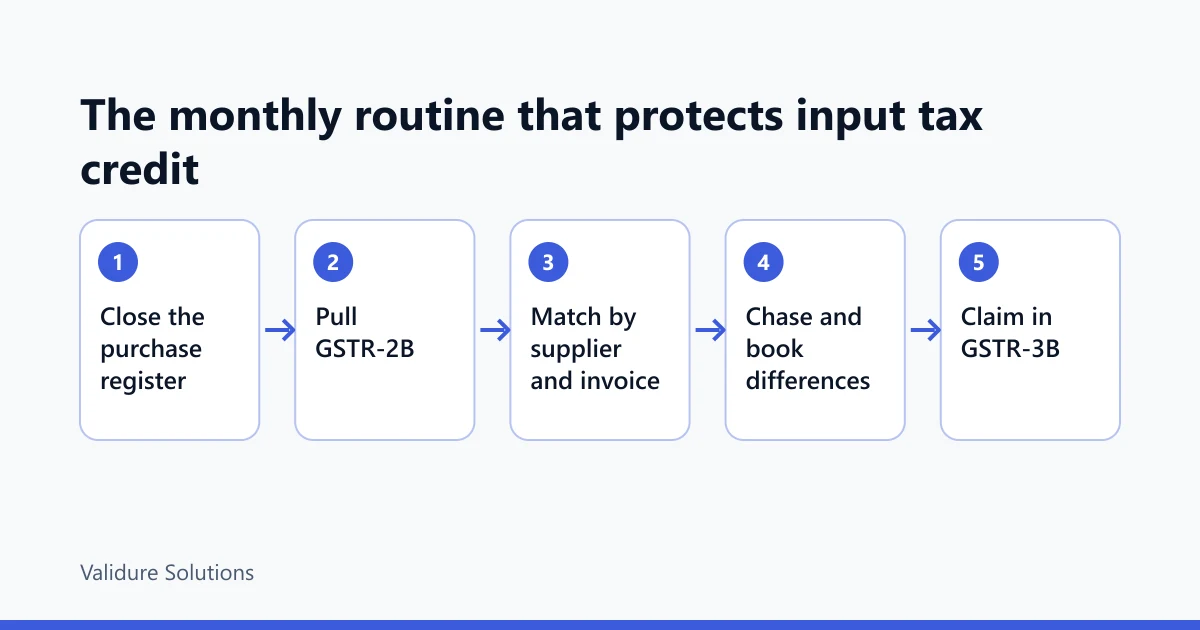
Put the purchase register in one sheet and the 2B lines, exported from the portal, in another. Then:
- In both sheets, add a key column: the supplier's GSTIN, then the invoice number with spaces, hyphens and slashes stripped out and the letters in capitals. This is what makes F-310 and F310 the same invoice.
- Next to each register row, look up its key in the 2B sheet (XLOOKUP or VLOOKUP). Next to each 2B row, look up its key in the register.
- Read off the result using the table below.
| Check | What to look for | What a hit means |
|---|---|---|
| Missing in 2B | Key is in the register, not in 2B | Don't claim. Chase the supplier |
| In 2B, not in books | Key is in 2B, not in the register | Find the bill and book it, or reject it |
| Value mismatch | Key is in both, but the GST differs by more than 1 rupee | Claim the lower figure and ask for a correction |
| Matched | Key is in both and the GST agrees within a rupee | Claim |
The one-rupee tolerance absorbs rounding. Keep the supplier's GSTIN in the key, because two suppliers can issue "INV-1".
Match on tax amounts, then also compare taxable value and the split between CGST, SGST and IGST. A supplier who charged IGST where CGST and SGST was due produces the same total and a different credit ledger. Run a second pass for that.
Then compare the totals back to the books, so the exercise proves itself. The books side of your results (matched, mismatched and missing) must add up to the register total, and the 2B side (matched, mismatched and in 2B but not in books) must add up to the 2B total. If either doesn't, rows were dropped or counted twice.
The supplier follow-up routine
Matching finds the problem. Fixing it needs a person and a calendar. A routine that works for a mid-sized purchase volume:
On the 12th, after 2B is generated, run the match. The same day, send each supplier with a "missing" or "mismatch" result a list of their own invoices, not a general reminder. Say the invoice number, date and tax amount, and ask whether it was reported in GSTR-1 or IFF. On the 16th, escalate the unanswered ones to whoever owns that supplier relationship, because a purchasing manager gets an answer faster than accounts does. On the 19th, decide what you claim and what waits. Anything missing for two consecutive months goes on a watch list with the amount at stake, and payment to that supplier is a conversation worth having.
Don't hold payment just because a supplier's filing is late: the 180-day rule runs against you regardless of whose fault it is. A supplier who's genuinely not filing is a Rule 37A problem: as I read the sources, if a supplier hasn't filed the GSTR-3B by 30 September after the financial year in which you took the credit, you reverse it by 30 November, without interest if you do so in time. The detail is an area where commentators disagree, so check the rule text and portal advisories.
Booking timing differences
Most mismatches are timing, not errors: the supplier files GSTR-1 a month late, so an invoice dated 29 September lands in October's 2B. The books should not wait for 2B, because the purchase and the liability exist on the invoice date. Only the credit is on hold.
A clean way to keep that visible is a separate ledger account for tax you're entitled to but can't yet claim. On the bill date:
| Entry | Dr | Cr |
|---|---|---|
| Purchase of goods, 50,000 plus GST 9,000 | Purchases 50,000 | Supplier 59,000 |
| Input GST pending 2B 9,000 |
When the invoice appears in 2B and you claim it:
| Entry | Dr | Cr |
|---|---|---|
| Move to claimable credit | Input GST (credit ledger) 9,000 | Input GST pending 2B 9,000 |
The balance on "pending" is your reconciliation to-do list in rupee terms. It should equal the sum of your missing-in-2B rows. If it grows month after month, you have suppliers to chase. At the year-end deadline (30 November after the financial year, as above), anything still sitting in pending is written off to expense, because the claim is gone.
Where a system helps, and where it doesn't
Validure ERP records purchases, expenses and input tax credit alongside sales invoices and the GSTR-1 and GSTR-3B summaries, so the register you match against is the same one your credit is computed from. The matching itself, in the way described above, you can do with a spreadsheet and the query pattern here. I wouldn't claim our software does your supplier chasing; that's a person with a phone.
You probably don't need any of this tooling if you buy from a handful of suppliers and your register has a few dozen invoices a month. A sheet, the 2B download and a careful hour on the 12th is enough. The case for a system grows with invoice volume, with multiple GSTINs, and with how many people enter purchases, because that's where the invoice number typed as "F-310" in one place and "F310" in another starts costing money.
Sources and checks
GST law and rules change by notification and the facts above come largely from professional commentary and vendor blogs, which I cross-checked against each other but not against the gazette. Please verify against the official sources before relying on any rule, rate or date: the GST portal for returns, advisories and GSTR-2B, the GST Council for notifications and circulars, and CBIC for the CGST Act and Rules text. The worked examples use round numbers and are illustrations, not advice. Check anything that affects a large amount of credit with your chartered accountant.
Frequently asked questions
Can I claim input tax credit if the invoice isn't in my GSTR-2B?
Generally no. Since 1 January 2022 the rule is that credit can be claimed only on invoices that show in your GSTR-2B. If it appears in a later month's 2B, claim it then, before the Section 16(4) deadline.
What is the last date to claim ITC for a financial year?
As described in sources I checked, it is the earlier of 30 November after the financial year ends and the date you file the annual return. Confirm the current text on the CBIC site.
What happens if I don't pay my supplier within 180 days?
You reverse the credit proportionate to the unpaid amount, with interest, and can claim it again after you pay. Reversal goes in GSTR-3B Table 4(B)(2). The start date for interest is debated, so take advice on a large amount.
Is credit available on the car, food or club fees my company pays for?
Usually not. Section 17(5) blocks motor vehicles for carrying persons (generally 13 seats or fewer), food and beverages, outdoor catering and club or fitness memberships, with exceptions that depend on your business. Check the exception before you decide.
My supplier hasn't filed their return. Am I at risk?
Yes, if the tax isn't paid to the government. Chase the supplier early, keep track of the amount at stake, and read Rule 37A for the reversal date if they never file.
How often should I reconcile purchases with GSTR-2B?
Monthly, as soon as 2B is generated, with a follow-up pass a few days before the return is due. A small business with few suppliers can do it by hand. A larger one should run it as a query.
