Is Tally enough for my business? What you give up either way
By Validure team · · 11 min read
A contested question with both sides at full strength: why Tally holds up for many Indian businesses, where it genuinely stops, and the arithmetic for deciding between staying on it and moving to a full system.

A trader in a mid-size town files every GST return from Tally on time. The CA is happy. Three months ago he started selling to two large retailers who need monthly credit notes, delivery notes and invoice numbers that link to their purchase orders, and now a junior spends every last working day of the month matching his Tally data against a spreadsheet so the filing matches what the customers got. Nobody in the office has ever asked "is Tally enough". They've just been living with the answer.
That's the real shape of this question. It's not "Tally or ERP, which is better software". It's "where does my business stop fitting inside the tool I already have". And that's why it gets argued: the two sides are usually describing different businesses, calling them the same thing.
We build business software and we run our own books, so we have an interest here. We say so up front, and we'll try to argue both sides at full strength before we say where we'd draw the line.
The case for staying: what Tally genuinely does well
The strongest argument for staying is the one most switchers never make: Tally's centre of gravity is exactly where most Indian small and mid-size businesses have their centre of gravity. Double-entry books, GST-structured invoices, GSTR-1 and GSTR-3B returns, e-invoicing where applicable, TDS on payments, and a file structure that a CA can open in the last week of the year without retraining. (Check the current feature set against Tally's official materials, which move between TallyPrime and Tally.ERP 9 releases.)
That's a real thing. Most "ERP" systems spend their first year in India doing a worse job of exactly this: the GST return is a template, not a native object, and the CA still ends up exporting to Excel to fix it. If your whole need is books plus compliance, Tally is not a compromise, it is the point.
The second strength is the ecosystem. An accountant who knows Tally can run your company without you explaining your business to them. Every audit firm expects a Tally file. Your CA, your banker, your auditor all read the same format. That network effect is worth real money and most cost comparisons leave it out.
The third is cost. A Tally deployment is a small annual number compared with a full system, and the number of businesses in India that only ever needed a ledger and a GST filing machine is large. For those, the honest answer to "is Tally enough" is yes, and the money you'd spend moving is better spent on inventory or a person.
So when is Tally enough? Three conditions: your operations fit in one place and one set of books, your volume is below the point where hand-glue between systems starts costing full days, and your compliance needs (GST, TDS, possibly e-invoicing) end at the return. If all three hold, stay. Don't move on sentiment.
The case for leaving: what Tally genuinely does not do
The other side is equally real, and it usually shows up not as "Tally is bad" but as "I have built a second system next to Tally and nobody's told us which one is true".
The gaps, with their consequences:
| Gap | What it means in practice |
|---|---|
| No operational flow | Tally records what happened. It does not run the sale-to-payment flow: quote to delivery to invoice to receipt, each step feeding the next. Those steps happen in Excel, WhatsApp and the head's memory, and Tally is updated from all three. |
| Reconciliation is by hand | Bank matches, credit notes against invoices, customer balances against what the customer thinks they owe you. Each is a manual join between Tally and something else, done by a person, done monthly, done imperfectly. |
| Reporting is books-shaped | "What is my cash next month" needs more than trial balance. Tally's reports stop at the ledger. Forecasting, margin by customer, ageing with reasons, none of that is a native question. |
| One book, one site, one process | A business with two warehouses, a service arm and a trading arm wants consolidated, inter-company reconciled, auditable books. Tally's strength (a simple single ledger set) becomes a constraint. |

The last one is the quiet killer. A business that outgrows Tally doesn't usually break. It gets two truths: the books say one thing, and the operational spreadsheet says another, and the gap between them grows a bit every month until a dispute or a banker's query forces the question.
If you're shopping for what comes after Tally, including our own: Validure ERP is built around exactly this gap. The operational flow (quotations to GST tax invoices, purchases and expenses with input credit) and the books (double-entry, receipts, banks, GSTR-1 and GSTR-3B summaries) live in one place, so the matching work described above is done by the system instead of by a person every month end.
A worked crossover, with real numbers
This is a made-up example, and I'll say so, but the arithmetic is the part to keep. Say a 14-person trading business that files 400 invoices a month, and 80% of them need a manual match against a customer statement, a delivery note, or a bank entry because the operational data never lived inside Tally.
That's 320 matches a month. If each takes four minutes of a person's time, the manual reconciliation is 320 x 4 = 1,280 minutes, about 21 hours a month, just under 2.5 working days. At a fully-loaded cost of 6,000 a day, that is roughly 15,000 per month, or 1,80,000 a year, spent doing work that a system with operational data would not need a person to do at all.
Now compare. Tally's own annual cost is a small number, call it 25,000. A mid-market SaaS system of the kind that covers the operational flow on top of books runs, in this example, about 12,000 a month, 1,44,000 a year. The crossovers worth writing down:
| Threshold | What it tells you |
|---|---|
| 1,80,000 a year of hand-glue > 1,44,000 a year of the system | In this example the system pays for itself in its first month. The margin is 36,000 a year, before counting the errors the hand-glue used to produce. |
| Tally licence + CA ~ 60,000 a year vs system ~ 1,44,000 a year | The system is more expensive on paper. The question is whether the 84,000 difference is a cost or the price of stopping to do 21 hours of matching a month by hand. |
The formula underneath is simple: (manual reconciliation hours a month) x (your fully-loaded daily cost) vs (the system's monthly cost). When the left side stops being smaller, you have crossed the line, and the answer to "is Tally enough" has quietly become no, even if nobody announced it.
If your numbers are smaller than the crossover, stay. The honest position for a very small business is that the system's cost exceeds the hand-glue's cost, and Tally plus a spreadsheet and a disciplined month-end is the cheaper and often the correct choice.
What you give up either way
This is the part the argument usually skips. Choosing is not free in either direction.
| Staying on Tally means giving up | Moving to a full system means giving up |
|---|---|
| Operational visibility. You will always have a second truth next to the books. | The Tally-shaped file your CA and auditor know. Expect a period where your CA learns a new format, and a period where reports are wrong in new ways. |
| Any forecasting or "what if" questions. You will answer them in Excel, by hand. | A few weeks of double work, where both systems run and the migration is being checked. |
| Comfortable, familiar, boring. | The migration itself: opening balances, customer ledgers, pending invoices, and a clean cut. Do it badly and you have a new truth that's wrong in subtle ways. A system that takes Excel and CSV imports for that opening data, like the ERP products do, makes this step a lot less of a gamble than retyping a year of ledgers. |
| The discipline the system forces. A lot of businesses that outgrew Tally also outgrew their own process, and the system will make that visible. |
The second column is the under-sold side of "just stay where you are". The migration cost is not only rupees. It is the week when everything is wrong and you have to trust a process you don't understand yet, and the CA and the banker both being unfamiliar with the new shape.
Where we'd draw the line
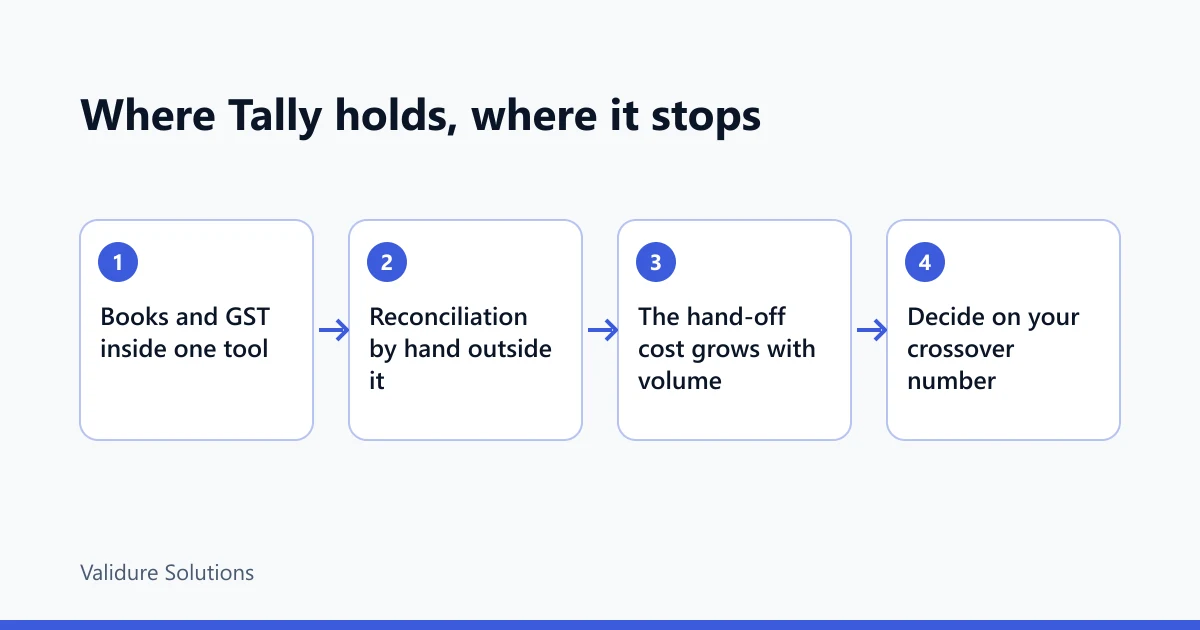
We'd say this. If your whole need is books and returns, and your volume keeps the hand-glue under a day a month, Tally is enough, and moving is a cost with no benefit. Stay.
If your operational data does not live inside your books, and your manual reconciliation is past the crossover we calculated, then "is Tally enough" is a question you are already answering with a spreadsheet every month, and the spreadsheet is the answer. At that point a system that puts the operational flow and the books in one place is worth the migration pain.
The decision is not "buy better software". It is "find the hour you are currently paying for, in a person, to do what a system would do free, and compare it to the system's price". That one number answers most of the argument. Everything else is taste.
What you do not need, under any of this, is a system that runs your compliance but not your operation, or the reverse. That is the shape that produces the two truths.
Sources and checks
Capability claims about Tally move with its releases. Before relying on any of them, check Tally's own current materials for what TallyPrime and Tally.ERP 9 cover today. The worked numbers in the middle of this post are a made-up example, and the arithmetic is shown so you can recompute it with your own figures: replace 320, 4 minutes, 6,000 a day and 12,000 a month with yours, and the crossover moves with you.
Frequently asked questions
Can I run a proper business on Tally and a spreadsheet without a bigger system?
Yes, up to a point. The spreadsheet's role is to be the operational layer Tally doesn't cover. The point where that stops being cheap is when the spreadsheet is a job, not a tool, and it keeps needing a person's time to stay true to Tally.
When does the CA start to matter in this decision?
When the file you hand over is not the one they can work in without rebuilding your data. If your CA regularly reconstructs part of your books from outside Tally, that is an early signal the operational data and the books have drifted, and it is worth asking them directly what they wish your system did.
Is cloud TallyPrime meaningfully different for this question?
The question is less about where the file lives and more about whether the file is the full truth. A cloud-hosted Tally file that still doesn't hold your operational flow has the same gap as a desktop one. The "cloud" in the middle of it is about access, not about closing the gap between your books and your operation.
What's the minimum that should happen before I consider moving?
You have a recurring, quantified cost of glue work, your operational volume is past the crossover, and you can state your opening balances and customer ledgers cleanly. If any of those three is missing, moving now is a bet you are not ready to make.
Does "Tally is enough" change once I add a second site or a service arm?
Usually yes, because the single-book strength turns into a constraint. Two sites, or a service arm with its own cost logic, is the point where one ledger set stops describing the business, and you need to decide whether to consolidate by hand or move to a system that can hold both.
Who should make this call, the owner or the accountant?
The owner, with the accountant's numbers. The accountant tells you what the tool can and cannot express, and what the migration would cost in their process. The owner owns the "what my business actually needs in three years", which is the only input that decides it.