The PF wage ceiling is now 25,000. What changes in your payroll
By Validure team · · 11 min read
The EPF wage ceiling moved from 15,000 to 25,000 on 17 September 2026. Worked examples of what it does to employee and employer contributions, EPS and EDLI, and the checks to run before the next return.

Picture a 40-person company that closed its September payroll in the last week of the month. On the 3rd of October the payroll consultant sends a short message: the PF ceiling changed on 17 September, so some of your people who were not in the provident fund now are, and the ones who are in it have a bigger pension share. Nobody had told the accounts team. The salary sheet was already paid on the old numbers.
If that sounds familiar, this post is for you. It covers what changed, works through the sums for three kinds of employee, and lists what to check before the next return. It's written for HR and accounts people at small and mid-size Indian employers, and for employees who want to understand why a deduction moved.
Two warnings before we start. This area changed twice in 2026 and most of what's published is from consultancies and news sites, not the regulator. Where I rely on those, I say so. And the figures below are examples. Check them against the official notification and your PF consultant before you change a payroll.
What changed
In plain terms there were two changes this year, and people tend to mix them up.
The first is the ceiling. Reports of the Cabinet decision on 16 September 2026, and the consultancy summaries that followed, say the statutory wage ceiling for provident fund went from 15,000 to 25,000 a month, with effect from 17 September 2026, through a notification numbered S.O. 5109(E). The ceiling had stood at 15,000 since September 2014. Government statements put the number of additional workers brought into mandatory cover at about 51 lakh. The same summaries say the change applies to EPF, to the pension scheme (EPS) and to the death-linked insurance (EDLI).
The second is the EPF Scheme, 2026, which law-firm commentary says was notified on 29 June 2026 under the Code on Social Security. As described there, the mandatory part is 12 per cent of wages up to the ceiling from each side. Anything above the ceiling is voluntary, either side can reduce or stop an extra voluntary contribution, and the employer isn't obliged to match it unless a contract says so. The contribution base also moves from "basic wages" under the old Act to "wages" under the Code, which brings in the rule that excluded components can't exceed 50 per cent of total remuneration.
One source I found gave a different notification date for the Scheme, so treat 29 June as "reported", not confirmed.
What each side pays now
Here's the standard split, which is the same shape as before, just on a bigger base. The employee pays 12 per cent of PF wages up to the ceiling. The employer pays 12 per cent too, but it goes in two places: 8.33 per cent to the pension scheme (EPS) and the rest to the provident fund account. The employer also pays 0.5 per cent for EDLI, and an administration charge, which I haven't checked at the new level, so ask your consultant.
At the old ceiling the maximum numbers were round. At the new one they're not, so rounding matters.
| Item | At 15,000 | At 25,000 |
|---|---|---|
| Employee 12% | 1,800 | 3,000 |
| Employer 12% | 1,800 | 3,000 |
| Of which EPS, 8.33% | 1,250 | about 2,083 |
| Of which PF account (balance) | 550 | about 917 |
| EDLI, 0.5% (employer) | 75 | 125 |
The check: 8.33 per cent of 25,000 is 2,082.50, which rounds to 2,083. The employer's 12 per cent of 25,000 is 3,000, so the PF account gets 3,000 minus 2,083, which is 917. EDLI at 0.5 per cent of 25,000 is 125. The 2,083 figure appears in consultancy summaries of the EPFO FAQ. The 125 is my own arithmetic from the 0.5 per cent rate, so confirm it on the contribution calculator in your portal.
Three people, three outcomes
Use these as templates for your own staff list. All three are examples.
Someone earning 20,000 in PF wages
Say Meera joined last year at 20,000 in PF wages. Because she was above the old ceiling, her employer contributed on 15,000, or perhaps she wasn't a member at all.
| Old (ceiling 15,000) | New (ceiling 25,000) | |
|---|---|---|
| Employee 12% | 1,800 | 2,400 |
| Employer 12% | 1,800 | 2,400 |
| EPS part, 8.33% | 1,250 | 1,666 (8.33% of 20,000 is 1,666) |
| EDLI | 75 | 100 |
Her take-home falls by 600 a month if she was already contributing at the old ceiling. If she wasn't a member, it falls by 2,400. The summaries of the EPFO FAQ say that existing EPF members in the 15,000 to 25,000 band who were excluded from EPS are to be brought into EPS from 17 September 2026. Whether that applies to your people depends on their exact history, so check each one rather than assume.
Someone earning 40,000 in PF wages
Say Arun's PF wages are 40,000, and until now his employer has paid 12 per cent on the full amount, which is 4,800 from each side.
Under the 2026 Scheme as the commentary describes it, the mandatory part is 12 per cent of 25,000, which is 3,000. The other 1,800 a month is voluntary. That does two things. It means the employer can't be forced to pay the voluntary part, and it means Arun can't be forced to keep paying it either. But he also shouldn't find out from his payslip.
The commentary is clear on the sensible route: if people have been contributing above the ceiling as a long-standing practice or a promise in the offer letter, change it by agreement. Cutting it unilaterally can run into the rule against reducing wages or benefits to avoid contribution liability.
Someone whose basic is low and allowances are high
This is the case where two rules meet. Say a person's total monthly remuneration is 40,000, of which basic is 12,000 and the other 28,000 is allowances. Under the old approach, PF was calculated on 12,000.
If the 50 per cent rule applies as summarised earlier in the year, wages can't be less than 50 per cent of remuneration, which is 20,000. PF at 12 per cent of 20,000 is 2,400, against 1,440 on 12,000. That's 960 more from the employee, and 960 more from the employer.
How the Code's wage definition is applied in EPFO's own procedures was still being clarified as I wrote this, so use this as a way to estimate the order of magnitude, not as a figure to deduct.
What it costs a small employer
Say a company has ten people with PF wages averaging 20,000 who weren't contributing before. This is an example only.
| Per month | Calculation | Amount |
|---|---|---|
| Employer PF, 12% | 10 x 2,400 | 24,000 |
| EDLI, 0.5% | 10 x 100 | 1,000 |
| Total, before admin charge | 25,000 |
That's 3,00,000 a year, before the administration charge and before any back-dating questions. Each of those ten employees also sees 2,400 less in hand. If you quote offers in CTC terms, the employer's 24,000 may sit inside the number you already promised, which means take-home falls, or it may sit on top, which means your cost rises. Decide which before the conversation, not after.
The September wrinkle
The ceiling changed mid-month, and that matters for the return. Summaries of the EPFO FAQ say employers file one return for September 2026 (a single ECR) and don't need two, with the first 16 days under the old ceiling and the last 14 under the new. The sources I found don't agree on exactly how the wages are split across the two periods, and one reports a circular of 13 October 2026 that extended the due date, which I haven't been able to check.
My advice: read the illustration in the EPFO FAQ itself, run your own sum for one employee, and compare it with what the return generates. If the two differ, ask before you file.
A checklist before the next payroll
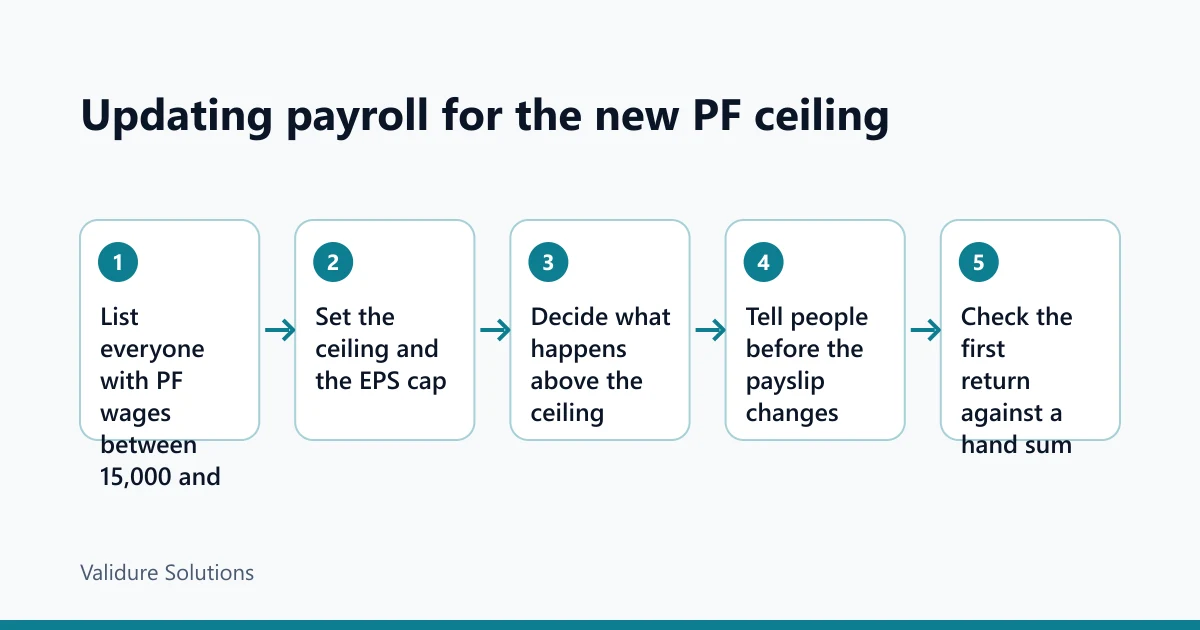
Do these once, in order, then repeat the first check every month.
| Check | What to look for | What a hit means |
|---|---|---|
| PF wages between 15,000 and 25,000 | Filter the salary sheet for everyone in that band, member or not | Someone who now needs enrolling or a bigger contribution |
| Existing members excluded from EPS | Anyone in the band whose EPS share is zero | They are meant to be brought into EPS from 17 September 2026 |
| Above the ceiling | Everyone with PF wages over 25,000 and what you deduct for them | A voluntary amount that needs a written election |
| Offer letters and CTC templates | Whether they say PF is on actual basic or on the ceiling | A promise you may have to honour or renegotiate |
| September return | One employee's contribution by hand against the generated return | A rounding or proration mismatch |
Two more items. Decide who tells the staff, and when. A deduction that moves without notice is a morale problem even when it's legal. And decide who owns the question of what the rule says: a named person, not "whoever handled it last time".

Where a system helps, and where it doesn't
The part that goes wrong is rarely the sum. It's that the ceiling lives in one place, the employee's election in another and the offer letter in a third.
If you run payroll in a system, you want the ceiling stored as a dated setting, not a number typed into a formula, so a run for September can use the old value for days before 17 September and the new one after. You want salary structures that show PF wages as their own line, so a person can see why it moved. And you want the payslip to show the split, so there's no argument about what was deducted.
Validure HR keeps payroll with salary structures, payslips and salary sheets, and that's where we'd put the ceiling and the voluntary election. Whether a given statutory rule is configured the way you need is something to test on a sample month before you rely on it.
You may not need any of that. With under ten people and a consultant who files the return, a careful sheet and the checklist above are enough. The case for a system grows with headcount and with how many people sit near a threshold, because that's where a manual list goes stale.
What I'd do this month
I'd start with the list of people in the 15,000 to 25,000 band, because that's where the legal and cost effects are largest and the least obvious. I'd set the ceiling in payroll as a dated value. And for anyone above 25,000, I'd write down what happens to the voluntary part and get a signature, rather than leave it to habit.
I wouldn't change anyone's above-ceiling contribution on my own authority this month. The Scheme commentary says it is permissible, but the practical guidance from EPFO was still arriving, and an agreed change is cheaper than a disputed one.
This is general information, not legal advice. Your PF consultant, or the regional PF office, is the right person for a specific case.
Sources and checks
Verify every figure here against the official sources before relying on it: the EPFO site for notifications, FAQs and the contribution calculator, the Ministry of Labour and Employment for the labour codes and the notification of the ceiling.
The ceiling date and notification number come from news reports and consultancy summaries of the EPFO FAQs. The EPF Scheme, 2026 description comes from law-firm commentary. The 125 figure for EDLI and the rounded splits are my own arithmetic.
Frequently asked questions
Did the PF wage ceiling really go up to 25,000?
Reports and consultancy summaries say yes, from 15,000 to 25,000 a month with effect from 17 September 2026. Confirm the notification on the EPFO or Ministry of Labour site.
Do I have to contribute on my full basic salary if it is above 25,000?
As the 2026 Scheme is described, the mandatory part is 12 per cent of the ceiling. Anything above is voluntary and can be stopped by either side. If your offer letter promised more, speak to your employer and your consultant before changing it.
How much does the employer's pension share rise?
The EPS part is 8.33 per cent of wages up to the ceiling. At 25,000 that's about 2,083 a month, up from 1,250.
Will my take-home pay fall?
If your PF wages sit between 15,000 and 25,000 and you were contributing on 15,000 or not at all, yes. At 20,000 of PF wages the employee share goes from 1,800 to 2,400.
Was the September 2026 return different?
The summaries I found say a single return covers the month, with the two ceiling periods taken into account. They differ on the exact proration, so check the EPFO FAQ illustration.
Does a very small company need to do anything special?
Check the list of people in the 15,000 to 25,000 band. If you have none and nobody above 25,000, nothing changes for you.