
5 questions to ask a software vendor before you sign
By Validure team · · 10 min read
Five questions that expose the costs a demo hides, for a small business buying SaaS in India. Getting your data out, deletion and the DPDP Act, what an uptime figure really allows, year-three pricing with the maths, and who tells whom after a breach.

Say two partners at a 20-person trading firm have sat through three software demos in a week. All three looked fine. All three salespeople said the data is safe, uptime is excellent and pricing is flexible. The partners now have to pick one, and nothing they've seen so far tells the three apart.
The demo is the wrong place to look. What separates vendors is what happens after you sign: when you want to leave, when the system is down on payroll day, when the renewal quote arrives, when something leaks. Those answers are in the contract, or they're nowhere. Here are the five questions we'd ask, what a good answer sounds like, and the sums behind them.
This is for a business choosing software it will run on for years: accounts, HR, inventory, a hotel system. If you're buying a 500-rupee tool for two people that you could replace in an afternoon, skip most of this. And we sell software ourselves, so put every one of these questions to us too.
1. Can you show me a full export of my data, today?
Every vendor says you can export. The question is whether the export is complete and whether you can do it without asking anyone. Ask for it during the trial, on an account with realistic data in it, and look at what comes out.
A good answer is a self-service export of everything: master records, transactions, attachments, history and audit logs, in a documented format such as CSV, JSON or a database dump. A weak answer is "reports can be exported to Excel", which gets you summaries, not records. A bad answer is a fee for exports, or a format only their software can read.
Then test it. Open the files and count rows against what the live screens show for the same thing, customers or invoices. If the screen says 1,240 invoices and the file has 1,198, the export is lossy and you've found out cheaply. Check that every invoice's customer ID exists in the customer file too; an invoice whose customer is missing came across without its context. We went through this round-trip test in more detail in our build versus buy post.
The other direction matters as well: how do you get your existing data in? Validure ERP, for example, imports existing data from Excel and CSV, which is the step that decides whether you start with history or an empty ledger. Ask every vendor how they'll load yours, and who does the work.
2. When we leave, when is our data deleted, and how will we know?
This used to be a nice-to-have. In India it's now close to a legal duty for anything holding personal data, which includes your employees, customers and guests.
Under the Digital Personal Data Protection Act, 2023, your business is the "Data Fiduciary" and the vendor processing data for you is a "Data Processor". Section 8(1) says you stay responsible for compliance for processing done on your behalf, whatever your agreement says. Section 8(2) lets you use a processor only under a valid contract. Section 8(5) makes you protect the data with reasonable security safeguards, including where a processor handles it. And section 8(7)(b) says you must cause your processor to erase the personal data you gave it, once the purpose is over or consent is withdrawn, unless a law requires you to keep it.
The DPDP Rules, 2025 were notified in November 2025, and the government's own release says they come with an eighteen-month period for phased compliance. So the main obligations are being phased in through 2027. Check the current dates with your adviser rather than relying on this post, but don't wait for the deadline to fix your contracts. A contract you sign today will still be running then.
What a good answer covers:
| Ask | Good answer | Warning sign |
|---|---|---|
| Is there a written data processing agreement? | Yes, attached to the contract, naming what they process and why | "Our privacy policy covers it" |
| How long after termination can we still export? | A fixed window, often 30 to 90 days, stated in the contract | "Contact support" |
| When is our data deleted after that, including backups? | A stated period, and a written confirmation of deletion on request | No answer on backups |
| Where is the data stored, and who else processes it? | A named hosting region and a list of sub-processors | "In the cloud" |
Your own retention duties still apply. Books of account, GST and payroll records have their own keeping periods, so make sure you've exported what you must keep before you ask for deletion. That's a question for your accountant, not the vendor.
3. What does your uptime figure actually allow, and what do I get when you miss it?
An uptime percentage sounds like a promise. It's really a budget for downtime. Here's what common figures allow in a 30-day month, which has 720 hours:
| Uptime promised | Downtime allowed per 30-day month | Worked out as |
|---|---|---|
| 99% | 7.2 hours | 720 x 0.01 |
| 99.5% | 3.6 hours (3 hours 36 minutes) | 720 x 0.005 |
| 99.9% | 43.2 minutes | 720 x 0.001 |
Then read the exclusions. If "scheduled maintenance" doesn't count, and maintenance runs four hours every Sunday night, that's about 16 hours a month outside the promise. That may be fine for an office that closes on Sunday. It isn't fine for a hotel front desk or a factory on night shift. Ask when maintenance happens, how much notice you get, and whether it's counted.
Next, ask what a miss is worth. A typical remedy is a service credit, a percentage off next month's bill. As an example, a 10 per cent credit on a 30,000-rupee monthly fee is 3,000 rupees. If the system is down for a day while you're running payroll or closing GST returns, that credit doesn't touch the real cost. So treat credits as a signal, not compensation. The clause that actually protects you is the right to terminate without penalty after repeated misses, say three months in any twelve, plus the export window from question 2.
Finally, ask for the status page and incident history for the last few months. A vendor with a public record of incidents and fixes is usually more trustworthy than one claiming none.
4. What will this cost us in year three?
The first-year price is the one everyone negotiates. Renewals are where the money goes. Ask for a written cap on annual increases and do the sum both ways.
Here's an example. Twenty users at 1,500 rupees each per month is 30,000 a month, or 3,60,000 a year.
| Year | No cap, 15% rise each year | Capped at 7% a year |
|---|---|---|
| 1 | 3,60,000 | 3,60,000 |
| 2 | 4,14,000 | 3,85,200 |
| 3 | 4,76,100 | 4,12,164 |
| Three-year total | 12,50,100 | 11,57,364 |
The checks: 3,60,000 x 1.15 = 4,14,000, and 4,14,000 x 1.15 = 4,76,100. With the cap, 3,60,000 x 1.07 = 3,85,200, and 3,85,200 x 1.07 = 4,12,164. The cap saves 92,736 over three years, before you add a single user. The 15 per cent is only an example, not a typical figure; the point is that without a cap, the number is whatever the vendor decides when you're least able to leave.
Ask three more things while you're on price. What does the base plan leave out that you'll need in month four (more storage, an API, a second company, extra branches)? What does it cost at double your current headcount? And how much notice does the contract give before an auto-renewal, so you can put that date in the calendar now?
5. If there's a breach, who tells whom, and within how many hours?
Something will go wrong at some point. What matters is whether you hear about it from the vendor quickly, or from a customer weeks later.
Two sets of rules are worth knowing. CERT-In's directions of 28 April 2022 require service providers, intermediaries, data centres, body corporates and government organisations to report cyber incidents of the listed kinds to CERT-In within 6 hours of noticing them, and to keep logs of their ICT systems for a rolling 180 days within India. And under section 8(6) of the DPDP Act, when there's a personal data breach, you as the Data Fiduciary must inform the Data Protection Board and each affected person, in the manner the Rules prescribe. You can't do that if your vendor tells you late.
So get these into the contract: the vendor notifies you of any security incident affecting your data within a stated number of hours; it names a contact on its side and asks for one on yours; it keeps logs and gives you the ones relevant to your account; and it cooperates with any notice you have to send. Ask too who at the vendor can see your data, and whether that access is logged.
Your own records are the other half. Validure ERP keeps a full audit trail of who changed what and when, which is the first thing you'll want when you're working out what an incident touched. Whatever you buy, check that it has one and that you can export it.
How to use the answers
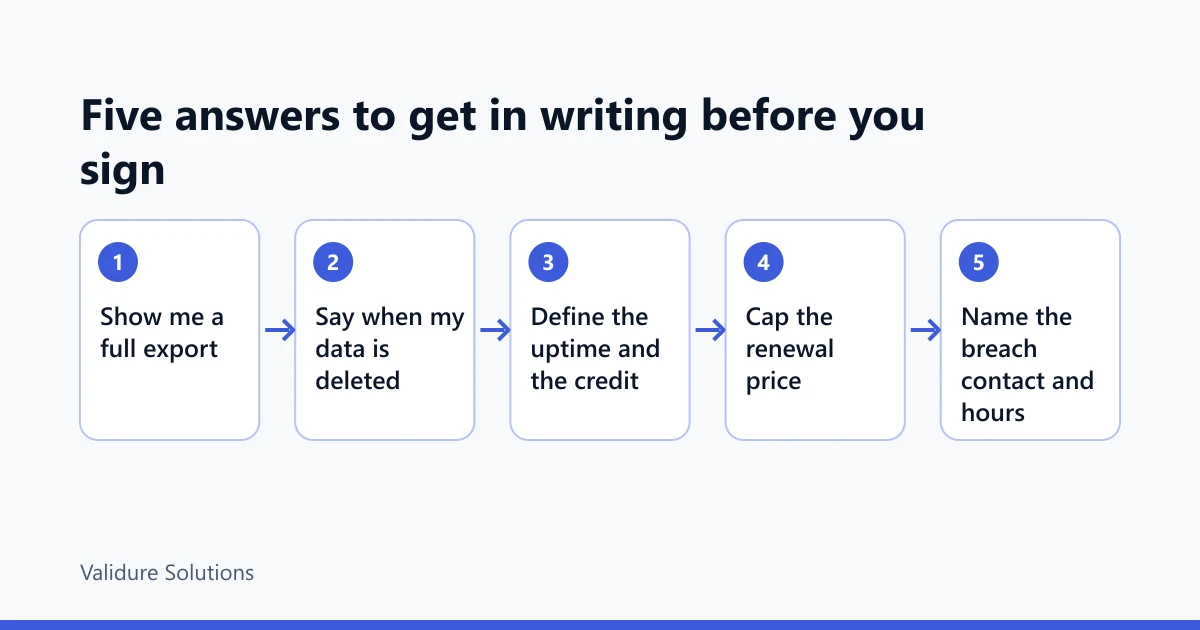
Send the five questions in writing to every shortlisted vendor, before the final demo. Put their answers side by side. You'll learn as much from how they answer as from what they say: a vendor that replies in a day with documents is different from one that says "let's discuss on a call".
Then make the answers part of the contract. A good answer in an email that isn't in the signed agreement is a good intention. And if the contract is large, or the data is sensitive, have a lawyer read it. This post is information, not legal advice.
Sources and checks
- Digital Personal Data Protection Act, 2023, sections 2 and 8, from the Ministry of Electronics and Information Technology. meity.gov.in
- Press Information Bureau release on the DPDP Rules, 2025, including the eighteen-month phased compliance period. pib.gov.in
- CERT-In directions under section 70B(6) of the IT Act, 28 April 2022: 6-hour incident reporting and 180-day log retention. cert-in.org.in
Checked against the official texts on 6 November 2026. DPDP commencement dates are phased; confirm the current position before relying on any date.
Frequently asked questions
Do these questions matter for a small business?
Yes, once the software holds your accounts, payroll or customer records and would take more than a week to replace. Below that, a quick export test and a look at the renewal terms are enough.
Is a service credit enough compensation for downtime?
Rarely. A credit is usually a small percentage of one month's fee. The terms that protect you are a clear uptime definition, counted maintenance windows and the right to leave after repeated misses.
Does the DPDP Act apply to my vendor or to me?
Both have roles, but section 8(1) puts responsibility on you, the Data Fiduciary, including for processing your vendor does on your behalf. That's why the contract with the vendor matters.
What is a reasonable renewal cap?
There's no legal figure. Many buyers ask for a fixed maximum percentage or a link to inflation. Whatever you agree, put it in the signed contract and work out year three before you sign.
Should I ask for the vendor's security certificates?
You can, and a certificate is a useful starting point. It doesn't replace the five questions: a certified vendor can still have a weak export or an uncapped renewal.
What if the vendor refuses to put answers in the contract?
Then you have your answer. Weigh it against the price and the alternatives, but don't treat a verbal promise as a term.
