Running several hotel properties from one system: what to demand, with the numbers
By Validure team · · 15 min read
What a 30 to 80 room hotel chain should ask of a property system. The multi-property data model, role scoping, guest matching rules, GST on room tariffs, folio settlement, night audit cut-off, and why averaging RevPAR across hotels gives the wrong answer.

Say an owner runs three hotels: 40, 60 and 30 rooms. On the 3rd of each month the managers send occupancy and revenue, each in a slightly different format. The owner pastes the three numbers into one sheet, averages the occupancy, and is pleased with 63.3 per cent. The real figure for the group is 63.85 per cent, and the revenue per available room is off by far more than that. Nobody lied. The averaging was wrong.
That gap is a good test of a property system. If it can't answer "how is the chain doing" with arithmetic you'd defend to an auditor, the rest of the feature list doesn't matter much.
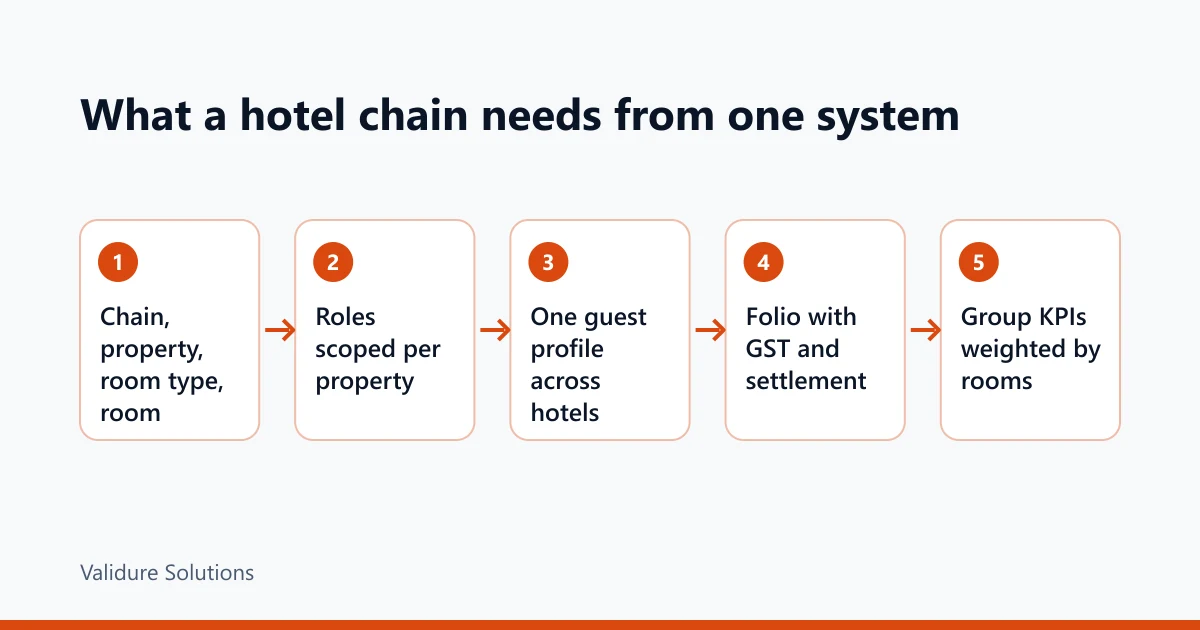
This post is for owners and operations heads of small chains, roughly 30 to 80 rooms per property, who are deciding what a property system must do once there is more than one hotel. It covers the data model, who should see what, how guests get matched across hotels, the chain numbers and how to compute them, GST on the folio, and what to ask a vendor about moving your data.
Start with the data model
Most multi-hotel pain comes from a model that was built for one hotel and then copied. Four levels cover it:
| Level | Entity | What it holds |
|---|---|---|
| Chain | chain | The owner's group; owns guests and reporting |
| Property | property | One hotel, with its own GSTIN, address and check-in time |
| Room type | room_type | Deluxe, Suite; a base rate and a count |
| Room | room | Room 204; its housekeeping status |
| Chain-wide | guest | Belongs to the chain, not to a property |
| Chain-wide | booking | property_id, room_type_id, room_id, guest_id, dates |
| Chain-wide | folio | booking_id; the running bill |
Two things matter here. First, guest sits at the chain level and booking sits at the property level. That is what lets a returning guest be recognised at the second hotel without anyone retyping. Second, every row that is operational carries a property_id. That column is what makes permissions, reports and tax work later. If a vendor can't show you where property_id lives, ask again.
Also check that a room belongs to a room type and that the room type owns the count. Availability is rooms of the type minus bookings that overlap the dates minus rooms out of order. If the system allows two bookings on the same room and night, it isn't doing that subtraction at the room level, and you'll find out on a busy weekend.
Who should see what
A chain has three kinds of users with different needs. The rules are simple to state and surprisingly often wrong in practice.
| Action | Owner | Property manager | Front desk or housekeeping staff |
|---|---|---|---|
| See all properties | Yes | Only their own | Only their own |
| Group dashboard and comparisons | Yes | No | No |
| Create or edit bookings | Yes | Yes, own property | Yes, own property |
| Post a charge to a folio | Yes | Yes | Yes |
| Void a charge or give a discount | Yes | Yes, up to a limit you set | No, needs approval |
| Change room rates and room types | Yes | Own property, if you allow | No |
| Add or remove users | Yes | Own property staff only | No |
| Export guest list | Yes | Own property | No |
| Close the day (night audit) | Yes | Yes | Only if you delegate |
Treat this as a starting point, not a standard. A 30-room hotel owned by the family might let the manager do almost everything. A hotel run by a hired manager might want the owner to approve every discount. What matters is that the permission is attached to a person and a property together. A manager of the hotel in Pune should not see the Goa hotel's bookings just because they hold the same role title.
The ones to test hardest are voids and discounts. These are where money leaks, and where you need a log that says who did it and when. Ask to see it.
One guest, several hotels: matching and merging
Guest profiles shared across properties are the feature everybody wants and the one that quietly creates a mess. If matching is too loose you merge two different people. If it is too tight you end up with three profiles for the same regular.
A workable rule set has two tiers. Auto-match on strong keys. Suggest, don't merge, on weak ones.
| Situation | Action |
|---|---|
| Same mobile number after cleaning, same name | Auto-match |
| Same government ID number on file (stored per your policy) | Auto-match |
| Same email, different name spelling | Suggest, human confirms |
| Same name, different phone, different city | Do not match |
| Same phone, clearly different names | Suggest, human confirms |
Phone numbers are the usual key in India, so clean them first: strip spaces and dashes, drop a leading +91 or 0, and keep the last ten digits. Then you can search for duplicates:
-- possible duplicate guests, by cleaned phone
SELECT RIGHT(REGEXP_REPLACE(phone, '[^0-9]', ''), 10) AS phone10,
       COUNT(*)                                       AS profiles,
       GROUP_CONCAT(id)                               AS guest_ids
FROM   guest
WHERE  chain_id = :chain
GROUP  BY phone10
HAVING COUNT(*) > 1;
An example. Ravi Kulkarni stays at your Pune property with a mobile number, and six months later "R. Kulkarni" books the Nashik property using the same number. The rule above auto-matches them, and Nashik sees the earlier stay, the preference for a quiet room and the fact that he settled by UPI last time. Now a different case: a travel agent books ten rooms under their own phone number for ten different guests. A phone-only rule would fold ten people into one agent. That is why bookings made by an agent should carry the agent as the booker and the guest as a separate person, and why weak matches should wait for a human.
When two profiles are merged, three things have to survive: the stay history from both, any notes or preferences (combined, not overwritten), and an audit entry saying who merged what. A merge with no undo is a risk. Ask the vendor what happens if you merge the wrong two.
One more point. A shared profile means personal data crosses properties. Decide, and write down, which fields are visible chain-wide (name, preferences, past stays) and which stay at the property (ID document images, for instance). India has a data protection law, the DPDP Act, so check your current obligations with your advisor rather than relying on this post.

The chain numbers, and how averaging goes wrong
Three measures cover most of what an owner asks for.
| Measure | Formula |
|---|---|
| Occupancy | rooms sold / rooms available |
| ADR (average daily rate) | room revenue / rooms sold |
| RevPAR (revenue per available room) | room revenue / rooms available, which also equals occupancy x ADR |
"Rooms available" means room-nights: rooms times days in the period. A 40-room hotel in a 30-day month has 1,200 available room-nights. Whether you deduct rooms that were out of order for repairs is a policy choice. Pick one, apply it to every property, and write it down. The examples below don't deduct any.
The mistake is to compute these per property and then average the three results. Say this is a 30-day month (an example, not real data):
| Rooms | Available room-nights | Sold | Occupancy | ADR | Room revenue | RevPAR | |
|---|---|---|---|---|---|---|---|
| Property A | 40 | 1,200 | 960 | 80.0% | 3,000 | 2,880,000 | 2,400 |
| Property B | 60 | 1,800 | 1,080 | 60.0% | 2,500 | 2,700,000 | 1,500 |
| Property C | 30 | 900 | 450 | 50.0% | 4,000 | 1,800,000 | 2,000 |
| Group | 130 | 3,900 | 2,490 | 63.85% | 2,963.86 | 7,380,000 | 1,892.31 |
Group figures come from adding the raw counts first, then dividing:
| Measure | Formula | Result |
|---|---|---|
| Occupancy | 2,490 / 3,900 | 63.85% |
| ADR | 7,380,000 / 2,490 | 2,963.86 |
| RevPAR | 7,380,000 / 3,900 | 1,892.31 |
Check: 0.6385 x 2,963.86 = 1,892.3.
Now the naive way, an unweighted average of the three rows:
| Measure | Averaged across properties | Correct group figure | Error |
|---|---|---|---|
| Occupancy | 63.33% | 63.85% | understated |
| ADR | 3,166.67 | 2,963.86 | overstated by about 203 |
| RevPAR | 1,966.67 | 1,892.31 | overstated by about 74 |
Property C is the smallest hotel and has the highest rate and the lowest occupancy. A plain average gives it a third of the vote when it has under a quarter of the rooms. ADR should be weighted by rooms sold, and occupancy and RevPAR by rooms available. Adding the numerators and denominators does both without you having to remember.
Ask the vendor to reproduce this three-property month by hand. If the group RevPAR on screen is 1,966.67, you have your answer.
Use the same room-revenue definition in every property: before or after tax, with or without breakfast. Mixing them is a worse problem than the averaging.
The business date and the night audit
A hotel's day doesn't end at midnight. A guest checking in at 01:30 is, for the books, arriving on the previous night. A late dinner charge posted at 00:40 belongs to yesterday's trading day. So hotels use a business date, and a cut-off ritual called the night audit that closes it.
The concept is plain. At the cut-off, say 03:00, someone (or the system) does four things: confirms every in-house guest has the night's room charge posted, flags arrivals who didn't show, checks that cash, card and UPI totals match what the desk collected, and closes the date so edits go through an adjustment, not an overwrite.
For a chain, each property closes on its own date, and the group dashboard reports from closed dates. In pseudocode:
for each property P:
    D = P.current_business_date
    post_room_charge(every in-house booking, D)
    mark_no_shows(arrivals due on D with no check-in)
    reconcile(P, D)        # settlements by method vs desk totals
    if reconcile ok: close(P, D); D = D + 1 day
And a revenue query should use that date, not the timestamp:
SELECT property_id, business_date, SUM(amount) AS room_revenue
FROM   folio_charges
WHERE  charge_type = 'room'
  AND  business_date BETWEEN :from AND :to
GROUP  BY property_id, business_date;
If a vendor reports by created_at timestamps, your late-night check-ins and charges will land on the wrong day, and no two reports will agree with the register. Ask what the cut-off is, whether it can differ by property, and what happens to a charge posted after close.
Folios, GST and settlement
The folio is the running bill for a stay. Room charges, extras and tax land on it, payments settle it, and the balance must be zero at checkout.
GST on room tariffs is where checking matters, because the rules changed recently and plenty of what's written online is out of date or from software vendors. As reported across several sources, in force since 22 September 2025 under notification 15/2025-Central Tax (Rate): accommodation priced below 7,500 rupees per room per day carries 5 per cent GST without input tax credit, and accommodation at or above 7,500 carries 18 per cent with input tax credit. Accommodation below 1,000 is reported to be exempt. The old 12 per cent slab is gone. Sources disagree about whether the slab is chosen on the amount actually charged or on a declared tariff, and whether a hotel can opt into 18 per cent. I could not verify the operative wording, so read the notification and ask your CA before you configure anything.
A worked example of how a folio should treat it, assuming the slab test uses the room's charged value per night (confirm that with your CA):
| Room at 6,000 per night | Room at 8,000 per night | |
|---|---|---|
| Room charge | 6,000 | 8,000 |
| GST rate | 5% | 18% |
| CGST | 150 | 720 |
| SGST | 150 | 720 |
| Folio total | 6,300 | 9,440 |
Check: 6,000 x 5% = 300, split in two gives 150 each; 8,000 x 18% = 1,440, split gives 720 each. Within a state the tax splits into CGST and SGST. A stay billed across states, or to a company with a GSTIN in another state, may need IGST instead, which is worth testing explicitly.
What the folio should do with this, in my view:
- Take the rate from the charge, not from a hotel-wide setting. A single stay can have a room at one rate and food at another.
- Print the property's own GSTIN on the invoice, because each hotel may be its own registration.
- Keep tax as separate lines, not baked into the rate, so a revenue report can show either view.
- Make the rate configurable by date, so a rule change next April doesn't rewrite old invoices.
Then there is settlement. A folio should accept more than one method and show the split:
| Step | Amount | Method |
|---|---|---|
| Advance at booking | 3,000 | UPI |
| Part payment at checkout | 4,000 | Card |
| Balance | 2,440 | Cash |
| Total settled | 9,440 | matches the 8,000 room folio above |
Cash, UPI, card and payment links are the four you'll see daily. What you want is that the sum of settlements equals the folio total (3,000 + 4,000 + 2,440 = 9,440), that a refund is its own entry rather than an edit, and that the night audit can total each method per property. That is how you find the 500 missing from the cash drawer.
Where Validure HMS fits, and where it doesn't
We built Validure HMS for exactly this: hotel chains with properties of 30 to 80 rooms. It has a multi-hotel chain with owner, manager and staff roles, rooms and room types with housekeeping status, bookings with double-booking blocked, guest profiles shared across properties, folio billing with GST and cash, UPI, card or link payments, and a live dashboard for occupancy, arrivals and revenue. It's in early access, which means you should expect to talk to us about your setup rather than click through a checkout.
If you have one hotel with a handful of rooms, you don't need a chain system. A good booking register and a daily cash reconciliation will do. The case starts when you have two or more properties, a manager you can't watch daily, and guests who come back to more than one of them.
Questions to ask any vendor before you migrate
Whichever product you pick, migration is where good systems and bad ones separate.
- Can you import our past guests and bookings, and what happens to duplicates?
- Can the system run next to our old register for a fortnight before we switch?
- What is the cut-off for the business date, and is it per property?
- Can we export all our data, in a usable format, if we leave?
- Who sets up properties, rooms and users, and who answers when something breaks on a Saturday night?
- Can we add a fourth property without a new contract or a project?
Run a trial on one property first, ideally your smallest, and reproduce one closed month by hand against the system's figures. If the system can't match your own month, it won't match the next one.
Sources and checks
GST rates and conditions change often. Verify against the official sources before billing guests: the GST portal, the CBIC GST site for notifications including 15/2025-Central Tax (Rate), and the GST Council. The room and revenue figures are invented examples and the GST amounts are illustrations, not tax advice. For data protection, check the Ministry of Electronics and IT site and your legal advisor.
Frequently asked questions
Do small hotel chains need a property system?
Once you have two or more properties, shared guest data and one view of occupancy and revenue usually justify it. With a single small hotel, a register and a daily reconciliation can be enough.
What is a folio in hotel billing?
It's the running bill for a stay. Room charges, extras and taxes are added to it, payments are applied against it, and it should show a zero balance at checkout.
How do I calculate RevPAR for a group of hotels?
Add room revenue across all properties and divide by the total available room-nights. Don't average each hotel's RevPAR, because that ignores how many rooms each one has.
Can one hotel's staff be kept out of another hotel's data?
They should be. Permissions need to be tied to both the person and the property, so a manager at one hotel sees only that hotel while the owner sees the whole group.
What GST applies to hotel rooms?
Reported figures since 22 September 2025 are 5 per cent without input tax credit for rooms below 7,500 per night and 18 per cent with credit at or above that. Verify the basis and conditions with the official notification and your CA.
What is a night audit?
It's the end-of-day routine that posts room charges, handles no-shows, reconciles settlements and closes the business date, so that reports show what happened on each trading day.