Should you tell customers when AI wrote the reply? Both sides of the disclosure question
By Validure team · · 14 min read
A contested question with both sides at full strength. What the law in India and the EU actually requires today, what the trust research found when people were told AI was involved, the chatbot case that settled who is liable, and a decision table for when to say so and how.

Say a 12-person travel agency in Kochi starts using an AI tool to draft replies to customer emails. A staff member reads each draft, fixes the dates and sends it under their own name. Replies go out in an hour instead of a day, and nobody complains. Then a customer forwards one back with a note: "Was this written by a bot? It called my mother by the wrong name." Now the owner has a question nobody had thought about: should the emails have said AI was involved, and would saying so cost them trust?
One side says hiding a machine behind a human signature is a small lie about who you're talking to. The other says nobody discloses the spellchecker or the junior who drafted the letter, and a label punishes honest firms. Both have evidence. This post separates what the law says from what is opinion, and ends with a rule you can put in a one-page policy.
We build software and use AI tools in our own work, so we have an interest in this answer. Nothing below is legal advice; where the law matters for your business, check with a lawyer who knows the market your customers are in.
Three different things get called "using AI"
The first is AI as a drafting aid. A person gets a first draft, reads it, fixes it and sends it as their own. They're still the author and answer for every word.
The second is AI as the one talking. A chatbot on your website or WhatsApp number answers customers directly, and nobody reads each reply before it goes.
The third is synthetic media: an AI voice on a sales call, a generated photo of a "happy guest", a video of someone who never said those words. The risk here is that it passes for a real person or event.
A policy that treats these the same will be too loose for the chatbot or absurd for the drafting aid.
What the law says today (established)
Rules as we checked them on 7 November 2026. They change every few months.
India
India has no AI-specific statute. The India AI Governance Guidelines released by MeitY in November 2025 say a separate AI law isn't needed at this stage and that existing laws on IT, data protection and consumer protection should govern AI uses. The guidelines are voluntary.
The rule that does bind is narrower than headlines suggest. The IT Rules amendment notified on 10 February 2026 (in force from 20 February 2026) requires "synthetically generated information" to be clearly labelled. The definition covers audio, visual and audio-visual content that could pass for a real person or event, not AI-written text. And the duties fall mainly on intermediaries, the platforms that host content; large social media platforms must ask users to declare whether uploads are synthetic. So an AI-drafted email reply isn't caught by this rule, but a generated video of a "customer testimonial" posted to a platform very likely is.
Two older laws apply to AI as they do to people. The Consumer Protection Act, 2019 treats false or misleading representations made to promote a sale as an unfair trade practice, whoever or whatever wrote them. And the Digital Personal Data Protection Act, 2023, with its Rules notified in November 2025, will require clear notice of what personal data you collect and why, where you rely on consent, once the main obligations start around May 2027. Pasting customer emails into an AI service is processing personal data, so it belongs in that notice and in your vendor contract.
The European Union
If you serve EU customers, Article 50 of the AI Act is the nearest direct rule. It has applied since 2 August 2026; the Digital Omnibus that delayed the high-risk rules didn't delay it. In short: systems meant to interact with people must be built so that people are told they're dealing with an AI, unless it's obvious; generated audio, images, video and text must be marked as artificial by the provider (with a short extension to 2 December 2026 for systems already on the market); and deployers must disclose deepfakes and AI-generated text published to inform the public on matters of public interest, unless a person has reviewed it and taken editorial responsibility.
So even the strictest regime in force treats "a person reviewed this and answers for it" as different from "a machine published this".
Several US states have chatbot disclosure laws too, mostly for bots a reasonable person could mistake for a human.
Who's liable when the bot gets it wrong
In Moffatt v. Air Canada (2024 BCCRT 149), the airline's website chatbot told a bereaved customer they could claim a bereavement fare after travel; the airline's own policy page said otherwise. Air Canada argued the chatbot was responsible for its own words. The British Columbia tribunal rejected that, held the chatbot is part of the airline's website, and awarded CA$650.88 in damages plus interest and fees.
It's a Canadian tribunal, not Indian law, but the reasoning is ordinary: a business answers for what it tells customers, whatever tool produced the words. A chatbot that says "I'm an AI assistant" and then promises a refund you don't offer has still promised it on your behalf.
The case for always telling them
Customers decide based on who they think they're dealing with. If someone believes a person read their complaint, they assume judgement was applied. If nobody read it, you created a false belief, which is close to the plain meaning of misleading.
Disclosure also protects the business. The trust research below found that being caught using undisclosed AI does more damage than disclosing it. If customers will find out anyway (a wrong name, a reply at 3 a.m. from someone who works days), it's cheaper to say so first.
A line like "drafted with AI and checked by Anita" also puts a name on the review, and people read more carefully when their name is on it. And the law is moving one way: the EU and several US states require chatbot disclosure, and India has started with synthetic media.
The case against labelling everything
The best evidence on how people react points the uncomfortable way. In 13 preregistered experiments with more than 3,000 participants, published in Organizational Behavior and Human Decision Processes in 2025, Schilke and Reimann found that people who disclosed using AI for a task were trusted less than people who didn't. It held across tasks from hiring to investing, across wordings, and whether disclosure was voluntary or required. Even "AI helped proofread" lowered trust compared with saying nothing. The authors put it down to lost legitimacy: people still feel using AI isn't quite proper. So the honest firm can lose trust to a quiet competitor.
Then there's authorship. A person who corrects a draft and sends it under their name chose what to say and answers for it. Nobody labels the template library or the colleague who wrote the first version. And labels lose meaning when they're everywhere: if every reply says "AI may have been used", customers stop reading it, including on the unattended bot where it matters.
What the evidence actually settles, and what it doesn't
Both sides lean on the same study. It says disclosure costs trust and exposure costs more. It measured first reactions in experiments, not repeat customers over years as AI drafting becomes normal, so treat it as strong on the first and weak on the second.
The law settles less than either side claims. Neither India nor the EU requires you to label an email a person reviewed and sent under their own name. Both have moved towards requiring disclosure when a machine is the one talking, or when content could pass for a real person. And we found no rule that excuses a business for what its bot promised.
What's genuinely unsettled is the middle: replies that are mostly AI with a light skim, and bots that hand over to a person halfway through a chat.

A position, labelled as opinion
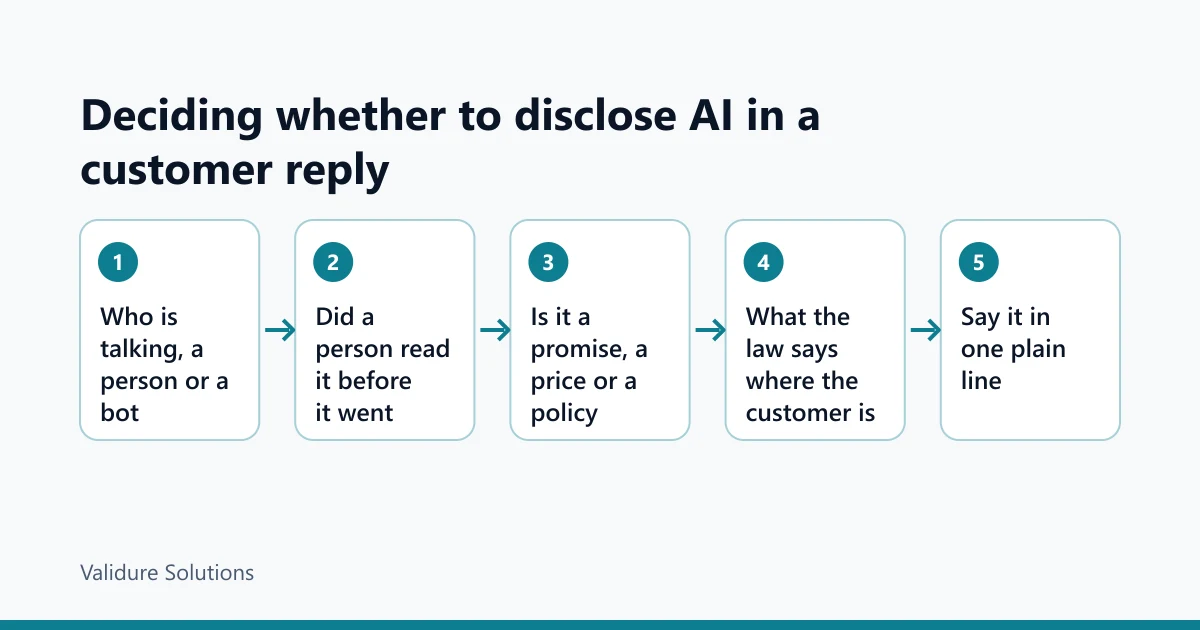
Disclose when the customer could reasonably believe a person is on the other end and no person is. Always. That covers website and WhatsApp bots, automated replies that look personal, and AI voices on calls. The disclosure goes at the start, in the same channel, in one plain sentence, with a way to reach a person.
Don't label routine drafting when a named person reads every reply before it goes and stands behind it. But don't lie about it either. If a customer asks, tell them the truth: "I use an AI tool for first drafts and check every reply myself." Being asked and saying no when the answer is yes is the worst outcome on every measure.
Never use AI-generated faces, voices or "customer" photos in a way that implies they're real. That's where India's rules already bite, and it's where trust breaks fastest.
The reasoning: what customers care about is whether someone with judgement looked at their problem. Where a person did, the label adds little. Where nobody did, the label is the only honest signal they get.
The arithmetic of reviewing every draft
The position above needs a person to read each draft. Does that kill the saving? Take the travel agency as an example. Say it handles 900 customer emails a month. Written from scratch, each takes about 6 minutes. With an AI draft, reading, fixing and sending takes about 2.5 minutes.
| Way of working | Minutes per email | Emails | Hours a month |
|---|---|---|---|
| Written from scratch | 6 | 900 | 90.0 |
| AI draft, person reads and sends | 2.5 | 900 | 37.5 |
| Saving | 52.5 |
The sums: 900 x 6 = 5,400 minutes, which is 90 hours. 900 x 2.5 = 2,250 minutes, which is 37.5 hours. The difference is 52.5 hours a month, kept even with a person reading every reply. The review is what makes the saving safe; it isn't what eats it.
Now the other way. Say the agency skips the review and lets the tool send, and say 2 per cent of drafts contain a mistake that matters (a wrong date, a wrong fare, a promise outside policy). These numbers are an example; measure your own. That's 900 x 0.02 = 18 wrong replies a month, each of which the agency is answerable for, Air Canada style. Skipping review saves the remaining 37.5 hours and sends 18 replies a month nobody saw. Price one wrong fare at your average booking value and the comparison is short. Error rates differ by tool and task, so sample 50 drafts before you decide.
When to disclose: a decision table
| Situation | Disclose? | How |
|---|---|---|
| Website or WhatsApp chatbot answering customers on its own | Yes, at the start | "You're chatting with an AI assistant. Type 'agent' to reach a person." |
| AI drafts, a named person reads, edits and sends | Not required; be honest if asked | Optional line in the signature if your customers care |
| Automated reply with no review that looks personal | Yes | "This is an automated reply" in the first line |
| AI voice on a sales or support call | Yes, before anything else | Say it's an automated voice and offer a person |
| AI-generated image or video in marketing | Yes, and never imply it's real | Label it, keep the label on reposts |
| AI used inside the business (summaries, search, reports) | No customer label | Cover it in your data notice if customer data goes to the vendor |
| Customers in the EU or certain US states | Check the local rule | Follow the stricter rule for those customers |
Checks for your own setup
| Check | What to look for | What a hit means |
|---|---|---|
| Bot opening message | Does the first message say it's an AI and offer a person? | The customer may think they're talking to a human |
| Who sends | For each AI-touched channel, is a named person reading before it goes? | Unreviewed replies with a human signature, the riskiest mix |
| Promise words | Search sent replies for "refund", "guarantee", "free", "we will" | Commitments a model made that you may be bound by |
| Data path | Which AI vendor receives customer emails, and what does the contract say about retention and training? | Personal data processing your notice may not cover |
| Asked and answered | What do staff say when a customer asks "is this a bot"? | A wrong answer here does more damage than any label |
| Generated media | Any AI faces, voices or "customer" photos in ads or posts? | Labelling duties and a trust problem if it looks real |
What about staff?
If an AI tool screens CVs, scores calls or summarises performance, the people affected have a stronger claim to know than a customer reading a drafted email, because the output feeds decisions about them. The DPDP Act allows some employment-related processing without consent, so the legal duty to tell staff may be narrower than for customers; check with a lawyer. Our opinion: tell them anyway, in writing, before it starts, with what it's used for and who sees the results.
Who this doesn't apply to
If nobody in your business uses AI to write to customers, you don't need a policy yet. A two-person shop writing every reply with a grammar checker doesn't need a label. The question becomes real the day a customer can get an answer no person read.
Sources and checks
Rules here change fast; check current versions. India's rules: the Ministry of Electronics and Information Technology for the IT Rules amendment of February 2026, its FAQs, the DPDP Rules 2025 and the India AI Governance Guidelines, and the Press Information Bureau for the release notes. Consumer law: the Department of Consumer Affairs and the Consumer Protection Act, 2019 on India Code. EU: the text of the AI Act on EUR-Lex and the European Commission's AI Act pages. The chatbot case: Moffatt v. Air Canada, 2024 BCCRT 149, on CanLII. The trust study: Schilke and Reimann, "The transparency dilemma: How AI disclosure erodes trust", Organizational Behavior and Human Decision Processes, 2025, via ScienceDirect. Checked on 7 November 2026. The travel agency figures are an example, not data from a real business.
Frequently asked questions
Is it illegal in India to send customers AI-written emails without saying so?
Not as such, as of 7 November 2026. India's labelling rule covers synthetic audio, images and video, not text, and no Indian law requires a label on an email a person reviewed and sent. What's false or misleading in the email is still your responsibility under consumer law.
Do we have to tell people they're talking to a chatbot?
For customers in the EU, the AI Act expects people to be told they're dealing with an AI unless it's obvious, and several US states have similar rules. India has no specific chatbot rule yet. We'd disclose anyway: one line at the start costs nothing and the trust research suggests being found out costs more.
Does disclosing AI use make customers trust us less?
Controlled experiments say it can, at least at first, and that being exposed for hiding it is worse.
If our chatbot promises something wrong, are we bound by it?
Very likely you're answerable for it. The Air Canada tribunal held the airline responsible for its chatbot's wrong answer and rejected the idea that the bot was separately liable. We found no Indian ruling on an identical case, so check with a lawyer, but plan as if the bot speaks for you.
What should a disclosure line actually say?
Keep it short and in the same channel: "You're chatting with an AI assistant. Type 'agent' for a person." For reviewed emails, if you choose to say anything: "Drafted with an AI tool and checked by Anita." Avoid vague lines like "AI may have been used", which tell the customer nothing.
Do we need to tell staff if we use AI on their data?
The legal answer depends on whether the processing needs their consent, and the DPDP Act exempts some employment purposes, so ask a lawyer. We'd tell them before you start either way.