
Switching accounting software mid-year, with a cutover plan that keeps your audit trail
By Validure team · · 15 min read
How to move your books to new accounting or ERP software in the middle of the financial year in India. Picking the cutover date, loading opening balances with checked sums, the GST invoice series, and keeping the old audit trail your auditor has to report on.

Say it's the third week of September. A 22-person trading company has decided its old accounting software has to go: the licence renewal has gone up again, the stock module can't handle its two godowns, and the one person who understood the setup has left. The owner wants the new system live "from October". The accountant nods, and then quietly wonders what that means for the six months of entries already sitting in the old system, the invoice numbers already issued this year, and the auditor who will ask in May whether the edit log ran all year.
You can switch in the middle of the year. Plenty of firms do. But a mid-year switch has more moving parts than a 1 April switch, and most of the pain comes from three places: opening balances that were never reconciled, invoice numbers that clash, and an audit trail that stops on the day the old software is switched off.
This post walks through a cutover the way an accountant would actually run it, with a worked example and the checks that catch mistakes before the auditor does. It's general information on the rules as I could check them on 12 November 2026, not professional advice. Your statutory auditor or CA should sign off the plan for your company.
If you can wait until 1 April, wait
On 1 April the financial year, the GST invoice series, the depreciation year and most registers restart together. You carry balance sheet balances only, and the old system keeps a clean, complete year.
Mid-year, you carry everything: balance sheet balances, income and expense totals for the months already done, open invoices, unreconciled bank items and stock by item. The auditor works across two systems for one year. Is the old system costing you enough to justify that? Six months of a stock module that can't track two godowns probably is. A renewal that's ₹20,000 dearer than you'd like probably isn't. If you're a small proprietorship with forty invoices a month, wait for April.
Pick a cutover date and make it a hard line
The cutover date is the first day on which every new transaction goes into the new system and nothing goes into the old one. Most migration messes come from a week when some people posted to the old system and some to the new.
Pick the first day of a month, so the old system holds whole months and your GST returns for the last old month can be filed from the old system. For the example company, that's 1 October 2026: the old system holds 1 April to 30 September, and the new one holds 1 October onwards. The first few days of October can wait on paper while you load; posting them in the old system "just for now" can't.
Then decide what comes across. There are three real options.
| Option | What you load in the new system | Good for | The catch |
|---|---|---|---|
| A. Full trial balance at the cutover date | Every ledger balance at 30 September, including income and expense totals for April to September | Most firms. One system produces the year-end accounts | Monthly detail for April to September stays in the old system |
| B. Balance sheet only | Assets, liabilities and capital, with H1 profit as one line | Firms that will prepare year-end accounts outside the software anyway | The new system can't produce a full-year profit and loss account on its own |
| C. Re-enter every transaction since 1 April | All vouchers from April to September, keyed or imported again | Rarely worth it | Months of work, new chances for error, and a second audit trail for the same entries |
I'd pick A for almost everyone. One system then produces the full year.
Close the old books before you take anything out
Unreconciled opening balances carry every old mistake into the new system. Before you export the 30 September trial balance from the old system, reconcile every bank account to the 30 September statement and agree the debtors and creditors ledgers to their control accounts, invoice by invoice. Count stock, or at least the fast-moving items, and post the adjustments. Post September's depreciation if you book it monthly, and the GST and TDS liabilities for September. Any suspense or "difference in opening balance" account should be at zero.
Then lock the period in the old system, if it allows that, and export the trial balance. This export is the single source for every number you load.

Worked example: the trial balance that comes across
Here's the example company's trial balance at 30 September 2026, taken from the old system. The figures are an illustration, not a real company.
| Ledger | Debit (₹) | Credit (₹) |
|---|---|---|
| Bank, current account | 8,42,300 | |
| Cash in hand | 18,500 | |
| Sundry debtors | 23,65,400 | |
| Stock | 31,20,000 | |
| Fixed assets at cost | 14,80,000 | |
| Accumulated depreciation | 4,62,000 | |
| GST input tax credit not yet used | 1,12,600 | |
| Purchases and expenses, April to September | 1,46,30,000 | |
| Sundry creditors | 18,74,300 | |
| GST output payable for September | 2,36,800 | |
| TDS payable | 41,200 | |
| Bank loan | 9,00,000 | |
| Sales, April to September | 1,62,40,000 | |
| Capital and reserves | 28,14,500 | |
| Total | 2,25,68,800 | 2,25,68,800 |
Check the totals yourself before you load anything. The debits add to ₹2,25,68,800. The credits other than capital add to ₹1,97,54,300, which leaves ₹28,14,500 for capital and reserves. If the old export doesn't agree, stop: something was posted late, or a ledger group was left out.
Agreeing in total isn't enough. Three of these lines hide detail the new system needs, and fixed assets need a per-asset register too.
Debtors and creditors come across as open invoices
The new system needs to know which invoices are unpaid, not just the total, or your ageing and payment reminders will be useless. The example company has 47 open customer invoices. When the accountant imports them, the list adds to ₹23,48,900, which is ₹16,500 short of the ledger.
The ₹16,500 turns out to be a customer advance received in August and never matched to an invoice. In the old system it sat inside the debtors balance as a credit. In the new system it has to come in as an on-account receipt for that customer, so the customer's balance and the control account both agree. Do the same for creditors: open bills, plus advances paid to suppliers.
The rule: the sum of open items must equal the control ledger to the rupee, for each side, before you go live.
The bank balance comes with its open items
The bank ledger says ₹8,42,300. The bank statement for 30 September says ₹9,05,800. The difference is two items in transit: cheques issued but not yet presented, ₹78,500, and a deposit made on 30 September that the bank credited on 1 October, ₹15,000.
₹9,05,800 − ₹78,500 + ₹15,000 = ₹8,42,300. That agrees.
Load the ₹8,42,300 as the opening bank balance, and load the cheques and the deposit as individual uncleared items. If you load only the net figure, the October bank reconciliation in the new system will show a difference nobody can explain, because the cheques will clear against nothing.
Stock comes across by item, at a value that adds up
The ledger says ₹31,20,000. The new system needs quantities and rates by item and by godown. Say the count, valued at the old system's rates, shows three item groups:
| Item group | Quantity | Rate (₹) | Value (₹) |
|---|---|---|---|
| Group 1 | 1,850 | 960 | 17,76,000 |
| Group 2 | 420 | 2,400 | 10,08,000 |
| Group 3 | 1,120 | 300 | 3,36,000 |
| Total | 31,20,000 |
17,76,000 + 10,08,000 + 3,36,000 = 31,20,000, so the item list agrees with the ledger. If it doesn't, post the stock adjustment in the old system before cutover, not in the new one, so the difference is explained where it arose.
Set the new system to the same valuation method as the old one (weighted average, FIFO) unless you and your accountant mean to change it.
The GST invoice series
The CGST Rules let you run more than one invoice series. Rule 46(b) asks for a consecutive serial number of up to sixteen characters, in one or multiple series, using letters, numbers, hyphens and slashes, that is unique for the financial year.
For a mid-year switch, that means you can start a new series in the new system on 1 October, as long as it can never produce a number already used between April and September. The easy way is a different prefix. If the old series was INV/26-27/0001 onwards, start the new one at something like B/26-27/0001. Count the characters, including slashes: that one is 12, inside the limit of 16.
Two related points. If you generate e-invoices, connect the new system to the e-invoice portal before 1 October and test it, because the portal rejects a document number the same GSTIN has already reported for that year. And in GSTR-1 for the year, the documents-issued summary will list both series, which is fine.
File September's GSTR-1 and GSTR-3B from the old system. October's come from the new one. The GST input credit in your electronic credit ledger doesn't move; it lives on the GST portal, not in your software. What you load is your books' figure for credit not yet used, ₹1,12,600 here, and you check it against the portal's ledger at 30 September.
The audit trail: the part most migrations miss
Since the financial year starting 1 April 2023, the proviso to Rule 3(1) of the Companies (Accounts) Rules, 2014 requires every company that keeps its books in accounting software to use software that records an audit trail of each transaction, with an edit log of every change and the date it was made, and where the audit trail can't be disabled.
Your statutory auditor then has to report on it. Under Rule 11(g) of the Companies (Audit and Auditors) Rules, 2014, the audit report states whether the software had the feature, whether it operated throughout the year for all transactions, whether it was tampered with, and whether the audit trail has been preserved as the record-retention rules require.
Section 128(5) of the Companies Act, 2013 requires books of account to be preserved for at least eight financial years. Practitioners and ICAI's guidance read the audit trail as part of those books, so it carries the same retention.
For a mid-year switch, the auditor will look for an edit log covering 1 April to 30 September in the old system, an edit log from 1 October in the new one, and evidence that the April to September log will still be available years from now. If you cancel the old subscription on 1 October and the vendor deletes your data in 90 days, you've lost the first half of the year's trail.
What to do, in order:
- Before cutover, confirm the old software's audit trail has been on since 1 April and can't be turned off.
- Export the full edit log for 1 April to 30 September in a readable format, and keep the export with the books.
- Keep read-only access to the old system for as long as you can, ideally the full retention period. Ask the vendor in writing what read-only or archive options exist and what they cost.
- Record the opening balance entry in the new system as a single, documented journal, with the old trial balance attached or referenced. The new system's edit log will then show where every opening figure came from.
- Confirm the new system's audit trail was on from the first entry on 1 October.
LLPs, partnerships and proprietorships aren't covered by the Companies Act rule. They still need to keep GST records: section 36 of the CGST Act requires records to be kept for 72 months from the due date of the annual return for that year, and longer if an appeal or proceeding is pending. Keeping the old system readable is sensible for everyone.
Should you run both systems in parallel?
Posting everything twice for a month sounds safe. Say two people spend two extra hours a day for 22 working days. That's 2 × 2 × 22 = 88 hours of duplicate entry, and the two systems drift apart anyway because someone fixes a mistake in one and not the other.
I'd do a dress rehearsal instead. Two weeks before cutover, take the 31 August trial balance and open items, load them into a test company in the new system, and run every check below. You find the mapping problems and missing ledgers while there's time, then repeat the same steps with the 30 September figures.
Validure ERP's Excel and CSV import for existing data suits this: the rehearsal and the real load can use the same files.
The checks before you call it done
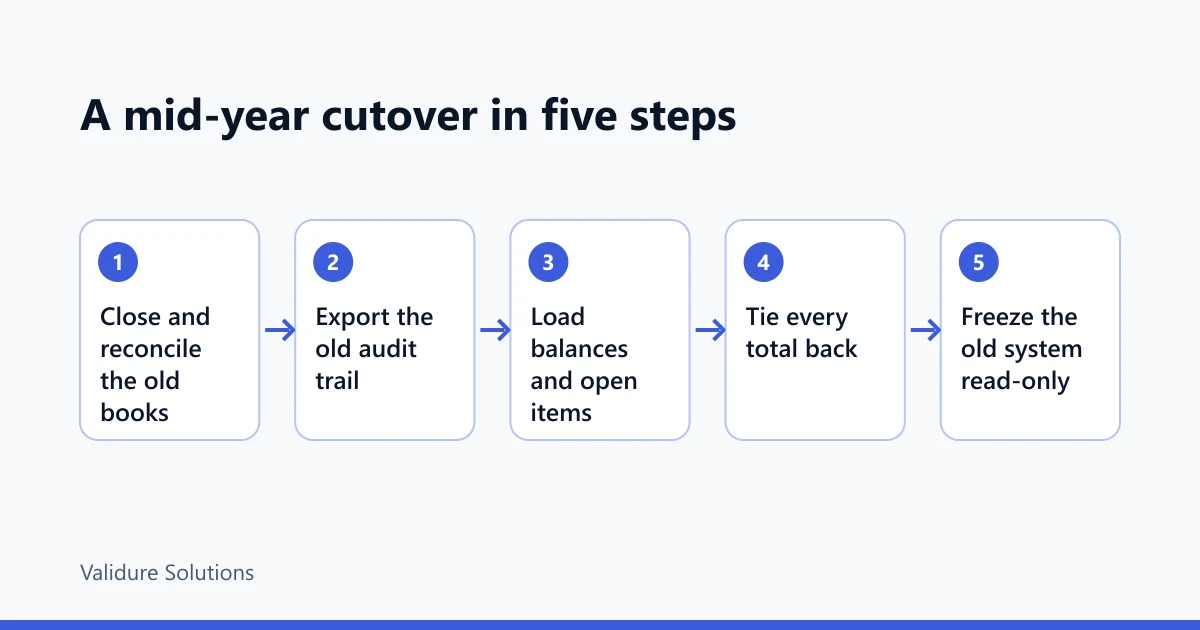
Run these on the new system before you post the first October entry, and keep the results with the year's working papers.
| Check | What to look for | What a hit means |
|---|---|---|
| Trial balance totals | New system's 1 October trial balance equals the old system's 30 September export, ledger by ledger | A ledger was missed, mapped to the wrong group, or entered with the wrong sign |
| Suspense or opening difference | Any balance in a "difference in opening balance" or suspense ledger | The load doesn't balance; don't go live until it is zero |
| Debtors open items | Sum of open invoices and advances equals the debtors control ledger | Unmatched receipts or credit notes, like the ₹16,500 in the example |
| Creditors open items | Sum of open bills and advances equals the creditors control ledger | Same problem on the purchase side |
| Bank | Opening balance plus uncleared items reproduces the 30 September statement balance | Uncleared items loaded as a net figure, or missing |
| Stock | Item quantities times rates add to the stock ledger, per godown | Count adjustment not posted in the old system, or wrong rates |
| Fixed asset register | Register totals equal cost and accumulated depreciation ledgers | Assets merged or missing; depreciation will be wrong from October |
| GST | Books' unused credit matches the portal's electronic credit ledger at 30 September; new invoice series can't repeat an old number | Unclaimed or over-claimed credit; duplicate invoice numbers |
| Audit trail | Old system's log exported for 1 April to 30 September; new system's log on from 1 October | The auditor can't report a complete trail for the year |
The last row is the one people skip, and it's the one that shows up in the audit report.
Validure ERP keeps a full audit trail from the first entry, and its GSTR-1 and GSTR-3B summaries let you check October's figures against the portal in the first month, which is when a mapping mistake is cheapest to fix.
Sources and checks
Check these against the official texts before relying on them; I checked them on 12 November 2026. The audit trail requirement is the proviso to Rule 3(1) of the Companies (Accounts) Rules, 2014, and the auditor's reporting duty is Rule 11(g) of the Companies (Audit and Auditors) Rules, 2014, both at the Ministry of Corporate Affairs. Section 128(5) of the Companies Act, 2013 is on India Code. ICAI's implementation guide on Rule 11(g) is at icai.org. Rule 46 of the CGST Rules and section 36 of the CGST Act are on the CBIC tax information portal at cbic.gov.in; the GST portal has the electronic credit ledger and return filing. Much of the commentary I read on mid-year switches came from software vendors and CA firm blogs; I've used only the points that rest on the rules above. All figures in the example are illustrations.
Frequently asked questions
Can I change accounting software in the middle of the financial year?
Yes. Nothing in the Companies Act or GST law stops you. Load a reconciled trial balance at the cutover date, bring open invoices, bank items and stock by item, and keep the old system's records and audit trail for the retention period.
Do I have to keep paying for the old software?
You need its data readable for as long as the retention rules require: eight years for a company's books under section 128(5), and 72 months from the annual return due date for GST records. That might be a cheap read-only licence, a full export in a usable format, or both. Ask the vendor before you cancel.
Can I restart invoice numbers from 0001 in the new system?
Only if the new numbers can't match any number already issued this financial year. Rule 46(b) allows multiple series but each number must be unique for the year. A new prefix is the simplest way.
Does the audit trail rule apply to my partnership or LLP?
The Rule 3(1) proviso is in the Companies (Accounts) Rules, so it applies to companies. Partnerships, LLPs and proprietorships still have GST record-keeping duties and may have others. Ask your CA what applies to your entity.
