Who owns the code you paid an agency to build? What Indian copyright law says, and the clauses that fix it
By Validure team · · 14 min read
Paying for software doesn't make you its owner. How sections 17 to 19 of India's Copyright Act decide who owns custom code, the five-year and India-only defaults, a worked exit cost, and a contract checklist for code, data and accounts.

Say a 40-person distributor in Nagpur paid a local agency 14 lakh in 2024 for an order and dispatch app. It works. Two years on, the agency raises its yearly maintenance fee from 2.4 lakh to 4.2 lakh. The owner decides to move the app to another vendor and asks for the source code. The reply is polite: the code was never part of the deal, but the agency can "transfer the IP" for 6 lakh.
The owner's first thought is that this is a shakedown. He paid for it. Surely it's his.
Under Indian law, probably not. Paying for a piece of software doesn't make you the owner of its copyright. Who owns it depends on who wrote it, under what kind of contract, and what was signed. This post walks through the rules that decide it, works the numbers on the Nagpur example, and ends with the clauses and checks that settle ownership before the first invoice. It's general information, not legal advice; for your own contract, a lawyer who drafts technology agreements is worth the fee.
The default: whoever writes the code owns it
India's Copyright Act, 1957 treats a computer program as a literary work. Section 17 says the author of a work is the first owner of its copyright, and then lists exceptions. Two matter for software.
The first is clause (c). If the work is made in the course of the author's employment under a contract of service or apprenticeship, the employer is the first owner, unless they've agreed otherwise. That's why a company owns the code its own salaried developers write at work.
The second is the one people assume exists and doesn't. Clause (b) gives first ownership to the person who commissions a work, but only for photographs, paintings, portraits, engravings and cinematograph films. Software isn't on that list. Commissioning and paying for code doesn't make you its first owner.
Put those together and the default for outsourced work looks like this:
| Who wrote the code | Their relationship | First owner by default |
|---|---|---|
| Your salaried developer, at work | Contract of service (employment) | Your company |
| A freelancer you hired directly | Contract for service (independent) | The freelancer |
| An agency's salaried staff | Employed by the agency | The agency |
| A freelancer the agency subcontracted | Independent of both of you | The freelancer, not the agency |
The last row is the one that bites. If the agency itself never got the rights from its subcontractor, it can't pass them to you, however well your own contract is written.
Transfer only happens in writing, and the gaps have defaults
Ownership moves from the author to you by assignment. Section 18 allows an owner, or the prospective owner of a future work, to assign copyright wholly or partly, for the whole term or part of it. Section 19 sets the form, and its subsections are where most outsourcing contracts fall short:
- The assignment must be in writing and signed by the assignor or their authorised agent. A purchase order, a WhatsApp message or a paid invoice isn't one.
- It must identify the work and specify the rights assigned, the duration and the territorial extent.
- It must specify the royalty and any other consideration payable.
- If the assignee doesn't exercise the assigned rights within one year of the assignment, the assignment is deemed to have lapsed, unless the assignment says otherwise.
- If the period isn't stated, it's deemed to be five years from the date of assignment.
- If the territory isn't stated, it's presumed to be India.
Read those last three again with a typical agency contract in mind. Say the contract says "all intellectual property in the deliverables shall belong to the client" and stops there. It was signed on 1 April 2026. Even if a court reads that sentence as an assignment, no duration is stated, so the deemed term is five years: the rights would run back to the agency in 2031. No territory is stated, so the assignment covers India only. If you later sell the app to a buyer in the UAE, that's outside what you hold.
Section 18 adds one more wrinkle for code that doesn't exist yet. An assignment of a future work takes effect only when the work comes into existence. That's fine for a development contract, as long as the clause covers everything written under it, including later change requests.
One caution on these readings. Practitioners and courts have applied the five-year and India-only defaults to software contracts, but how a clause is read depends on its exact words and the facts. Treat the defaults as the risk to draft around, not as a prediction of what a court would do with your contract.

What the Nagpur owner can actually do, with numbers
Back to the example. The owner has three realistic options over the next three years. The figures are illustrative, in lakh rupees, and assume a new vendor would charge 2.4 lakh a year to maintain the app.
| Option | What it costs | Three-year total | Owns the code at the end? |
|---|---|---|---|
| A. Pay 6 lakh for an assignment, move maintenance to a new vendor | 6.0 + (2.4 x 3) = 6.0 + 7.2 | 13.2 | Yes, if the assignment is drafted properly |
| B. Rebuild with a new vendor | 11.0 build + 1.5 data migration and parallel running + (2.4 x 3) | 19.7 | Yes |
| C. Stay and pay the new fee | 4.2 x 3 | 12.6 | No |
On three-year cash, staying is cheapest, by 0.6 lakh. That's the trap. Option C leaves the owner exactly where he started, with the next price rise set by someone who knows he can't leave. Option A costs 0.6 lakh more and buys the exit. Option B is the most expensive and makes sense only if the app needs reworking anyway.
The point of the sum isn't which option wins. It's that every one of them would have been unnecessary if the original contract had carried a proper assignment. At signing, that clause costs a paragraph. Two years later, it costs 6 lakh or more, because the bargaining position has flipped.
A useful habit: before signing, estimate what option B would cost you in year three. That's roughly the most the vendor can extract from you if the contract is silent, and it tells you how much the clause is worth.
Not everything should be assigned to you
Here's the agency's side, at full strength, because it's a fair one. Most agencies don't write every line from scratch. They carry their own libraries, a login module, a reporting engine, deployment scripts, refined across many clients. That reuse is a big part of why their quote is lower than a blank-page build. If every contract assigned all of it to the client, the agency couldn't use it again, and either prices would rise or the reusable parts would be rewritten badly each time.
Open-source components complicate it further. Nobody in the deal owns them. They're used under their authors' licences, and some licences put conditions on how you distribute software that includes them.
So the honest structure is to split the deliverable into parts and treat each one differently:
| Part | Default if the contract is silent | What to ask for |
|---|---|---|
| Code written for you | Agency (or its subcontractor) | Written assignment of all rights, for the full term of copyright, worldwide, with the fee stated as consideration |
| Agency's pre-existing libraries | Agency | A perpetual, irrevocable, royalty-free licence that you can pass to a future vendor maintaining your system |
| Open-source components | Their authors, under their licences | A list of components and licences delivered with the code |
| Designs, screens, documentation | Whoever made them | Included in the same assignment |
| Your business data | Yours in practice, but whoever runs the database controls access | Export on request and at exit, in a documented format, plus deletion afterwards |
| Domain, cloud, app store and payment accounts | Whoever registered them | Registered in your company's name from day one, with the vendor added as a user |
Our position, labelled as opinion: own the code written for you and the data, take a broad licence to the agency's own parts, and keep every account in your name. Escrow arrangements, where the code is deposited with a third party and released if the vendor fails, are a reasonable middle ground when an agency won't assign. They're weaker than holding the repository yourself, because you only find out at release time whether the deposit actually builds.
We build custom software for clients ourselves, so we have an interest in how this is drafted. That's partly why we'd rather the terms are settled in writing at the start than argued about in year three.
The accounts are often worth more than the code
Owners focus on the source code and forget the things around it. In a lot of disputes, the code is the smaller problem.
If the domain is registered in the developer's personal name, he controls your website and email. If the cloud account is on the agency's card, it can switch the servers off. If the Android app is published under the agency's developer account, moving it to yours is a process you can't complete without the agency's cooperation. None of this is copyright. It's plain control, and the fix is administrative: create the accounts yourself, in the company's name, with a company email address, and invite the vendor in with the access they need.
Data needs the same treatment. When personal data of customers or staff is involved, India's Digital Personal Data Protection Act, 2023 treats your business as the data fiduciary and the agency running the system as a data processor, and expects the processor to be engaged under a valid contract. The Act's rules were notified in November 2025 with obligations coming into force in phases, so check the current commencement dates on MeitY's site. Either way, a contract that says how data is exported, how long the vendor keeps it and how it's deleted at exit is what you'd want anyway.
Check your contract before the next renewal
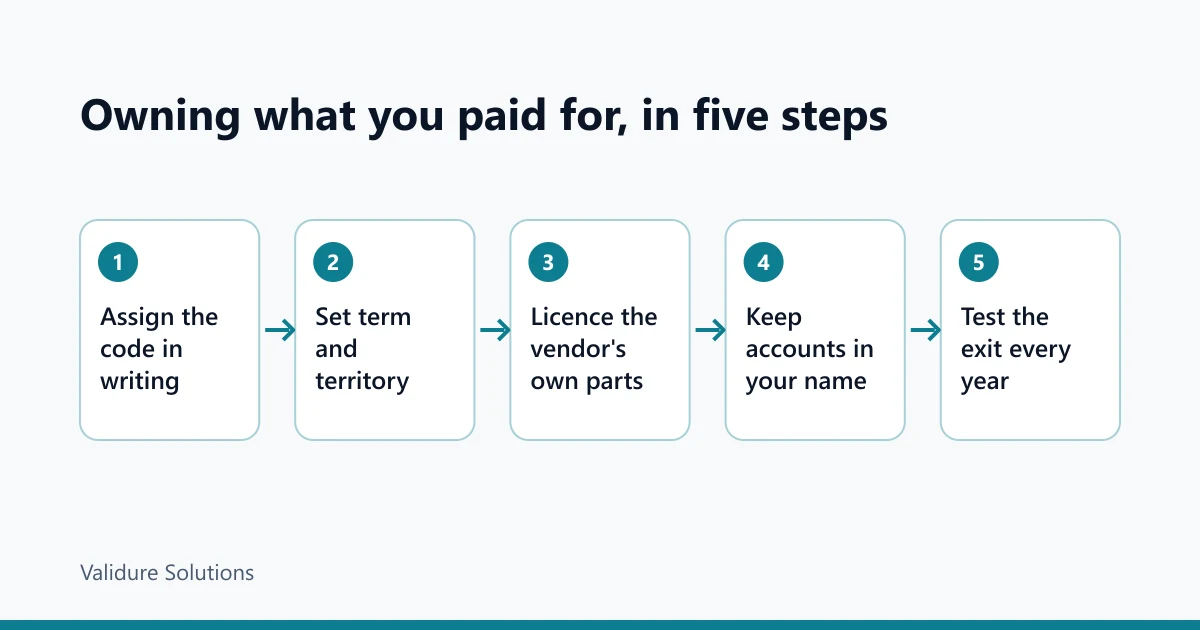
Take your current development or maintenance contract and go through it with this table. It takes about twenty minutes.
| Check | What to look for | What a hit means |
|---|---|---|
| The verb | "Assigns" or "hereby assigns" against "licenses", "grants the right to use" or "shall belong to" | A licence or a vague ownership line is not a clean assignment |
| Duration and territory | "For the full term of copyright" and "throughout the world" | Missing either brings in the five-year or India-only default |
| Consideration | The fee named as consideration for the assignment | Section 19 asks for it; a gap is an argument you don't need |
| Lapse | A line saying the assignment won't lapse for non-exercise | Without it, a project shelved for over a year is exposed |
| Chain of title | A warranty that everyone who worked on it, including subcontractors, has assigned their rights to the agency | Without it, a freelancer may still own part of your app |
| Source and build | Code in a repository your company owns, with build and deployment notes | Holding a zip of code you can't build is not much better than nothing |
| Accounts | Domain, cloud, app stores and payment gateways in the company's name | Anything in a personal or agency name is a hostage |
| Exit | A handover period, data export format and the rates for help during transition | No exit terms means the exit is priced on the day |
If you find gaps in a live contract, don't wait for a dispute. Ask for a short deed of assignment covering the code delivered so far, with the terms above. Agencies agree more readily while the relationship is good and the next invoice is pending.
When you hire developers directly
If you employ developers on salary, section 17(c) makes the company the first owner of what they write in the course of employment. Two edges are worth covering in the appointment letter anyway. Code written outside work on personal time may not be "in the course of employment", so define what counts. And people engaged as "consultants" on a monthly retainer are often independent contractors, not employees, which puts them back in the freelancer row of the first table. If someone is a consultant on paper, get a written assignment from them as you would from an agency.
Code written with AI assistants raises a newer question: who, if anyone, is the author of generated code. We couldn't find a settled Indian position. Until there is one, ask the vendor to warrant that the delivered code is theirs to assign and doesn't knowingly copy third-party code, whatever tools they used.
Who doesn't need to worry much
If you're buying a standard SaaS product, you were never going to own its code, and this post mostly doesn't apply. What matters there is the data export and the exit terms. And if a custom build is small, cheap to replace and touches no customer data, a short assignment clause plus accounts in your name is enough; you don't need a forty-page agreement.
If you're leaving a custom app because the cost of keeping it has outgrown what it does, it's worth checking first whether a packaged system now covers the job. Validure ERP, for example, imports existing data from Excel and CSV, which makes moving records out of an old custom app less painful. Whether that fits depends on how much of the custom app's logic you actually use.
Sources and checks
The Copyright Act, 1957 (sections 17, 18 and 19) is on India Code, and the Copyright Office covers registration and assignments. The Digital Personal Data Protection Act, 2023 and its rules are on the Ministry of Electronics and Information Technology site. Statutory wording was checked on 6 November 2026. The Nagpur company and its figures are an illustration, not a real client. This is general information, not legal advice; how a clause is read depends on its exact words, so have a lawyer review your contract.
Frequently asked questions
If I paid the full price, don't I own the software?
Not automatically. Under section 17 of the Copyright Act, the author owns the copyright first, and commissioning software isn't one of the cases where the person paying becomes the first owner. You own it only through a signed written assignment.
Does a line saying "all IP belongs to the client" work?
It may be read as an assignment, but if it doesn't state the duration and territory, section 19 fills the gaps: five years and India only. Use "hereby assigns", for the full term of copyright, worldwide, with the fee named as consideration.
Can the agency refuse to give me the source code?
If the contract doesn't assign the code or require delivery of the source, the agency may be within its rights to refuse. That's why delivery of source to a repository you own should be a written obligation, tied to payment milestones.
What about the agency's own reusable code?
It's reasonable for the agency to keep it. Ask for a perpetual, irrevocable, royalty-free licence that a future vendor can use to maintain your system, so the agency's ownership doesn't stop you from leaving.
Is source code escrow a good substitute?
It's better than nothing when a vendor won't assign. It's weaker than holding the repository yourself, because you only learn whether the deposit builds when you need it.
Who owns code written by my salaried developers?
Your company, if it was written in the course of their employment under a contract of service. Consultants on retainer are often not employees, so get a written assignment from them.