
Why your bank balance never matches the books, and the monthly routine that fixes it
By Validure team · · 15 min read
A worked bank reconciliation for a small Indian business, with real numbers. Which differences are only timing, which need an entry in the books, what to do with stale cheques and payment gateway settlements, and the checks that make the month close in an hour.

It's the first week of November. The owner of a small distribution business opens the bank app and sees 5,92,955. The accounts screen says the bank ledger is at 4,82,350. That's a gap of 1,10,605, and the first question anyone asks is whether money has gone missing.
It almost never has. The bank and your books record the same transactions on different days, and each side knows about a few things the other doesn't. The trouble is that a gap made of ten harmless timing items looks exactly like a gap that hides one real error. Unless you take it apart line by line, you can't tell which one you have.
This post takes one month apart with numbers, shows which differences need an entry and which don't, and ends with a routine you can run every month. It's written for whoever keeps the books in a small or mid-size business, and for the owner who has to sign them.
Two ledgers looking at the same money
Your cash book (or bank ledger) is your record of the account. The bank statement is the bank's record of the same account. They disagree for three kinds of reason, and it helps to sort every difference into one of them before you do anything else:
| Kind | Example | Who's behind | Needs an entry in your books? |
|---|---|---|---|
| Timing | A cheque you issued that the supplier hasn't deposited yet | The bank | No. It will clear on its own. List it. |
| Bank-only item | Bank charges, interest credited, a customer's NEFT you didn't know about | Your books | Yes. Post it from the statement. |
| Error | An amount keyed as 8,730 instead of 8,370, an entry posted twice | Usually your books | Yes. Correct it with a dated entry. |
Only the second and third kinds change your books. Timing items sit on the reconciliation statement until they clear, and then they drop off. The single most common mistake in a reconciliation is mixing these up: posting an entry for a cheque that simply hasn't been presented yet, or leaving a bank charge as a "timing difference" for six months.
A worked month, line by line
Here's the example in full. Say a 15-person distributor closes its books for October 2026. On 31 October the bank ledger in its books shows 4,82,350 and the bank statement shows 5,92,955. Going through the statement and the books side by side, the bookkeeper finds seven differences.
| # | What it is | Amount | Effect on the gap |
|---|---|---|---|
| 1 | Two supplier cheques issued on 29 and 30 October, not yet presented (1,20,000 and 35,600) | 1,55,600 | Bank higher |
| 2 | Customer cheque deposited on the evening of 31 October, credited on 3 November | 64,000 | Bank lower |
| 3 | Bank charges for the month, 500 plus 90 GST, not in the books | 590 | Bank lower |
| 4 | Interest credited on the account on 31 October, not in the books | 2,415 | Bank higher |
| 5 | Payment gateway settlement: books show 50,000 received, bank got 48,820 after a 1,000 fee plus 180 GST | 1,180 | Bank lower |
| 6 | A customer's NEFT of 18,000 on 31 October, not yet identified in the books | 18,000 | Bank higher |
| 7 | A supplier payment of 8,370 keyed in the books as 8,730 | 360 | Bank higher |
Check the gap adds up before you post anything. Starting from the books:
4,82,350 + 1,55,600 − 64,000 − 590 + 2,415 − 1,180 + 18,000 + 360 = 5,92,955
That's the bank figure, to the rupee. If your sum doesn't land on the statement balance, stop. There's an eighth item you haven't found yet, and posting the seven you have will only make it harder to see.
Step one: fix the books
Items 3 to 7 need entries, dated in October:
| Item | Entry | Change to bank ledger |
|---|---|---|
| Bank charges | Bank charges expense 500, input GST 90, credit bank 590 | − 590 |
| Interest | Debit bank, credit interest income | + 2,415 |
| Gateway fee | Gateway charges 1,000, input GST 180, credit bank 1,180 | − 1,180 |
| Customer NEFT | Debit bank, credit the customer once you know who paid | + 18,000 |
| Keying error | Debit bank 360, credit the supplier's ledger 360 | + 360 |
Net change: − 590 + 2,415 − 1,180 + 18,000 + 360 = 19,005. The bank ledger moves from 4,82,350 to 5,01,355.
Step two: prove the rest is timing
Now start from the bank statement and adjust only for the two timing items:
| Amount | |
|---|---|
| Balance as per bank statement, 31 October | 5,92,955 |
| Add: cheque deposited, not yet credited | 64,000 |
| Less: cheques issued, not yet presented | 1,55,600 |
| Balance as per books, after corrections | 5,01,355 |
5,92,955 + 64,000 = 6,56,955, and 6,56,955 − 1,55,600 = 5,01,355. Both sides now agree, and the statement you keep for October is this short table plus the list of the three cheques behind it. That's your bank reconciliation statement.
A note on direction, because it trips people up every month: when you start from the bank balance, you add what the bank hasn't credited yet and subtract what it hasn't paid out yet. When you start from the books, it's the other way round. Pick one direction for your business and never switch.
Cheques clear faster now, but month-end still has timing gaps
Until October 2025, a cheque deposited in India usually took one or two working days to clear. The Reserve Bank's circular of 13 August 2025 moved the Cheque Truncation System to continuous clearing, with phase 1 from 4 October 2025, so cheques presented during the day's session are generally cleared the same day. A second phase with a tighter three-hour window was announced for 3 January 2026 and then postponed by the RBI in December 2025 until further notice. Check the RBI's site for the current position before relying on any clearing time.
What this means for your reconciliation: fewer deposited cheques are still in transit at month-end, but not none. A cheque deposited after the presentation session closes, or on the last evening before a holiday, still lands in the next month. Item 2 in the example is exactly that.
The other side hasn't changed at all. Your supplier decides when to deposit your cheque, and some take weeks. Unpresented cheques are now the bigger and more stubborn timing item for most small businesses.
Stale cheques: the item that sits on the list forever
Say one line on the unpresented list is a cheque dated 12 July 2026 for 9,400 to a transporter. It's still there on 31 October.
Since 1 April 2012, banks in India have been directed by the RBI not to pay a cheque, draft, pay order or banker's cheque presented more than three months after its date. The July cheque became unpayable on 12 October. Your books still show the 9,400 as paid out, but it never will be.
The fix is not to write it off to income. You still owe the transporter. Reverse the payment in the books, dated in the month it went stale: debit the bank 9,400, credit the transporter's ledger 9,400. The liability is back where it belongs, the unpresented list is shorter, and when you issue a fresh cheque or transfer it goes through as a normal payment.
A practical rule: any unpresented cheque older than 90 days gets a phone call to the payee, then a reversal. Don't let the list grow. A list of 40 old cheques is where a real error goes to hide.
Payment gateways settle net, and your books record gross
Item 5 is the one that grows quietly in businesses that take card or online payments. A customer pays 50,000 through a gateway. The gateway keeps its fee and the GST on that fee, and sends you the rest a day or two later, often bundled with other orders into one settlement.
If your books record each sale as 50,000 received in the bank, every settlement leaves a small shortfall. Over a month with hundreds of orders it becomes a large, unexplained difference.
Two habits fix it. First, reconcile against the gateway's settlement report, not order by order: each settlement line lists the orders, the gross, the fee, the GST and the net credit. Second, book each settlement as gross receipts less fee less GST equals the amount that reached the bank, so the bank ledger moves by exactly the net figure. Treat money the gateway has collected but not yet paid you as its own clearing account, not as cash in the bank.
The exact fee depends on your gateway contract and the payment method, so read it from the settlement report rather than assuming a rate.
Bank charges carry GST you can usually claim
Most bank fees in India, from account maintenance to NEFT and RTGS charges, attract GST at 18 per cent. Interest on loans is exempt and isn't part of this. If your business is registered for GST and the bank has your GSTIN on the account, the GST on those charges is normally available as input tax credit and should appear in your GSTR-2B.
Banks often don't issue a separate invoice for each charge. Rule 54(2) of the CGST Rules lets a banking company issue a consolidated tax invoice, or another document in lieu of it, for the month, whether or not it's serially numbered and whether or not it has your address. That's why the monthly GST statement from your bank works as the document behind the claim.
In the example, the 90 on the bank charges and the 180 on the gateway fee add up to 270 of input credit. Small each month, but it's lost for good if the charges only ever appear as a single "bank charges 590" line with no GST split. Check the treatment with your accountant, especially for any charge described as a penalty.
Matching faster: amount first, then date
Most of the time in a reconciliation goes into matching. In a spreadsheet, the method that works is the one auditors have always used: tick off every item that appears on both sides, and whatever is left unticked is your list.
- Export the bank statement and the bank ledger for the month into two sheets, one row per transaction, with date, description and amount (payments negative, receipts positive).
- Sort both by amount.
- Match rows where the amount is equal and the dates are within a few days of each other. Mark both rows with the same match number.
- For the unmatched rows, look for pairs where the digits are the same but in a different order. A difference that divides exactly by 9 is a strong hint of a transposition: in the example, 8,730 − 8,370 = 360, and 360 / 9 = 40.
- Whatever is still unmatched is either timing, a bank-only item or an error. Sort it into the three kinds from the first table.
Step 4 is the old bookkeeper's trick and it still saves time. It doesn't prove a transposition, but when a leftover difference divides by 9, start by checking the entries with those digits.
If you have a developer and your data is in a database, the same matching is one query: join the statement and ledger on amount, with the dates no more than three days apart, and list what's left on either side.
The checks that catch most of it
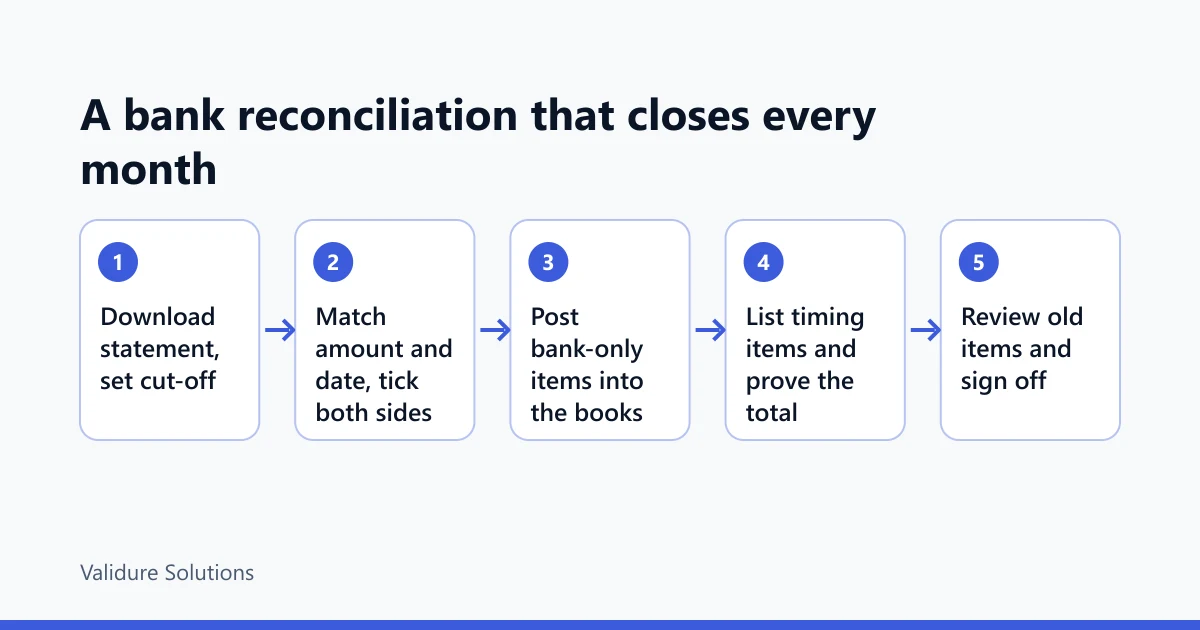
Run these at every close. The order matters: the first catches a wrong starting point, which otherwise breaks every month that follows.
| Check | What to look for | What a hit means |
|---|---|---|
| Opening balance | This month's opening book balance equals last month's reconciled closing figure | Someone edited a closed month. Find the entry before anything else. |
| The gap adds up | Book balance plus or minus every listed item equals the statement balance exactly | An item is missing from your list. Keep looking before posting. |
| Old unpresented cheques | Anything older than 90 days on the list | A stale cheque to reverse, or a payee to chase |
| Unidentified receipts | Credits in the bank you couldn't link to a customer | Usually an advance or a part payment. Park it in a suspense account with a note, and clear it within the month. |
| Duplicates | Two ledger entries with the same amount, party and date | An entry posted twice, often once from a bank import and once by hand |
| GST on charges | Every bank or gateway fee posted with its GST split | Input credit you're about to lose |
Two things make the routine stick. Reconcile every account, including the one you barely use and the overdraft. And have the person who signs off be someone other than the person who prepared it. That second rule is less about suspicion than about tired eyes at month-end.
How often? Monthly is the minimum. If an account sees more than a couple of dozen transactions a day, weekly or even daily matching is less work in total, because a three-day-old item is still in someone's memory and a five-week-old one isn't.
Where software helps, and where it doesn't
A reconciliation is only as good as what's in the books before you start. The biggest source of noise in the example was receipts that never reached the books on the day the money arrived.
That's the part Validure ERP is built around: receipts, bank and cash entries sit in the same double-entry books as your GST invoices, so a customer's payment is recorded against the invoice it pays, not typed into a separate sheet later. Bank charges and other expenses go in as purchases with their input tax credit, and every entry and correction is in a full audit trail with who did it and when. It doesn't download your bank statement for you, and you'll still do the matching, but the side you're matching against is clean.
You may not need it. A business with one bank account, forty transactions a month and an accountant who closes the books regularly can do all of this in two sheets and an hour. The case for a system grows with the number of accounts, the number of daily receipts and the number of people entering them.
Sources and checks
Verify any rule here against the official source before relying on it, and check with your accountant how it applies to your business. The worked example uses made-up but consistent figures to show the method.
Cheque validity comes from the Reserve Bank of India circular of 4 November 2011 on payment of cheques, drafts, pay orders and banker's cheques, effective 1 April 2012. Cheque clearing times come from the RBI circular of 13 August 2025 on continuous clearing and settlement in the Cheque Truncation System, and its December 2025 deferral of phase 2; checked on 10 November 2026, so look for any later notice. For GST on bank charges and Rule 54(2) of the CGST Rules, see the CBIC site and the GST portal. The 18 per cent rate on most bank charges was confirmed from secondary sources, so confirm it against the current rate notification.
Frequently asked questions
Why doesn't my bank balance match my books even when nothing is wrong?
Because the bank and your books record the same money on different days. Cheques you've issued but the payee hasn't deposited, deposits not yet credited, and charges or interest you haven't posted all create a gap that is real but harmless. The reconciliation proves that's all it is.
What's the difference between a timing item and an item that needs an entry?
A timing item is already correctly in your books and will reach the bank soon, so you only list it. A bank-only item, such as a charge, interest or a customer transfer you didn't know about, is missing from your books, so you post it from the statement.
What should I do with a cheque that was never presented?
If it's more than three months past its date, the bank won't pay it. Reverse the payment in your books so the amount shows as owed to the payee again, contact them, and pay afresh. Don't write it off to income.
How do I reconcile payment gateway receipts?
Use the gateway's settlement report. Record each settlement as gross receipts less the fee and the GST on the fee, so the amount hitting the bank ledger equals what the bank received.
Can I claim GST charged on bank fees?
Usually yes, if your business is registered and the bank has your GSTIN, since most bank charges carry GST at 18 per cent and banks issue a monthly consolidated invoice or statement. Check that the credit shows in GSTR-2B and confirm any doubtful charge with your accountant.
How often should a small business reconcile its bank account?
Every month for every account, as a minimum. Busy accounts are easier to reconcile weekly or daily, because recent items are still easy to identify.
