Are employment bonds and non-competes enforceable in India? What the courts have actually said
By Validure team · · 13 min read
A plain reading of section 27 and section 74 of the Contract Act and the Supreme Court cases on service bonds, training bonds and non-compete clauses. Worked bond arithmetic for the employee and the small employer, both sides of the argument, and what to do next.

Say a 23-year-old software tester joins a mid-size company in Pune. On day one, between the PF form and the laptop receipt, there's a two-page document: a two-year service bond of 2,00,000 rupees, and a clause saying that for a year after leaving, she won't work for any client or competitor of the company. Fifteen months later she gets a better offer. HR replies to her resignation with a reminder about the bond and a line about "legal action".
Two questions sit in that story, and they have different answers. Can the company make her pay for leaving early? Sometimes, and usually less than the figure on the paper. Can it stop her joining a competitor after she leaves? Almost never.
This is information, not legal advice. The law here comes mostly from the Indian Contract Act, 1872 and a line of court decisions, not from the labour codes, and a judge looks at the exact clause and facts. For a real dispute, talk to a lawyer who handles employment matters in your state. What follows is checked against the Act and the Supreme Court judgments named below, as of 4 November 2026.
Two sections of a 150-year-old Act do most of the work
Section 27 of the Contract Act says that every agreement restraining anyone from exercising a lawful profession, trade or business is void to that extent. The only exception written into the section is for someone who sells the goodwill of a business and agrees not to compete within reasonable local limits. Employment isn't that exception.
Indian courts have read section 27 more strictly than English courts read the common-law rule. In England, a reasonable restraint can survive. Under section 27, courts have generally held that reasonableness doesn't rescue a restraint after the contract ends. That strictness is why post-exit non-competes fare so badly here.
Section 74 is the other half. When a contract names a sum payable on breach, the injured party can get reasonable compensation not exceeding that sum. It's a ceiling, not an automatic award. In Kailash Nath Associates v DDA (2015), the Supreme Court said that where loss can be proved, it has to be proved, and the named sum is awarded without proof only where loss is genuinely hard or impossible to prove and the sum is a genuine pre-estimate.
So for any bond, the two questions are: does it restrain trade in a way section 27 forbids, and if not, how much of the named sum is reasonable compensation under section 74?
What the courts have said, case by case
During employment, a promise not to work elsewhere is generally enforceable. In Niranjan Shankar Golikari v Century Spinning (1967), the Supreme Court upheld a covenant that stopped an employee working for anyone else during the agreed term. A negative covenant that operates while the contract runs isn't a restraint of trade in the section 27 sense, because it only gives effect to the contract itself.
After employment, it's the opposite. In Superintendence Company of India v Krishan Murgai (1980), the Court treated a restriction on the employee's work after leaving as void under section 27. In Percept D'Mark v Zaheer Khan (2006), a clause that reached beyond the end of a three-year contract was struck down on the same reasoning, though that was a promotion contract rather than ordinary employment.
On service bonds, the most recent word is Vijaya Bank v Prashant B. Narnaware, decided on 14 May 2025. A bank's appointment letter required three years of service and an indemnity bond of 2,00,000 rupees. The officer left early, paid under protest, and the High Court ruled for him. The Supreme Court reversed that. It held that a minimum-service clause operating during employment isn't a restraint of trade under section 27, and that this one wasn't against public policy either. The Court took into account that the employee was a senior, well-paid officer, that the bank had a real attrition problem, and that the amount wasn't unconscionable.
Read that judgment carefully before quoting it either way. It upholds a bond as a type of clause. It doesn't say any amount in any bond is payable, and it didn't remove section 74. A bond on a fresher earning 25,000 a month, with a sum several times their annual savings and no real training cost behind it, sits on different facts.
Training bonds are where section 74 does the most work. In Sicpa India v Manas Pratim Deb (2011), as reported, the Delhi High Court awarded the employer only a proportion of the actual training cost for the unserved period, a small fraction of the bond figure. Courts in such cases have tended to ask what the employer actually spent and how much of the bond period was served.

The clauses, side by side
| Clause | During employment | After you leave | What usually decides it |
|---|---|---|---|
| Minimum-service bond with a named sum | Can be valid (Vijaya Bank, 2025) | The sum is claimed after exit, but limited to reasonable compensation | Whether the sum is a fair pre-estimate of real loss, and the employee's position |
| Training-cost bond | Valid in principle | Recovery usually limited to proven, unrecovered cost | Receipts for the training, and how much of the period was served |
| No moonlighting or exclusivity | Generally enforceable (Golikari, 1967) | Not applicable | Whether the term is in the contract |
| Non-compete after exit | Not applicable | Ordinarily void under section 27 | Courts rarely enforce it, whatever the duration |
| Confidentiality | Enforceable | Generally enforceable, as it protects information rather than barring work | Whether the information is genuinely confidential |
| Non-solicitation of clients or staff | Enforceable | Contested; decided case by case | How it's drafted and whether it is really a non-compete in disguise |
Garden leave, where the employer keeps paying you through notice but tells you not to work, is a during-employment arrangement and is usually treated like the Golikari situation. It can't stretch past the end of employment.
The arithmetic of a bond, worked
Example: back to the tester. Her bond is two years, 24 months, with a named sum of 2,00,000. She leaves after 15 months. Suppose the company paid an outside institute 60,000 for a certification course in her first month and has the invoice.
| Measure | Working | Amount |
|---|---|---|
| Named sum in the bond | 2,00,000 | |
| Months not served | 24 - 15 | 9 |
| Training cost proved | 60,000 | |
| Unrecovered training cost, pro rata | 60,000 x 9 / 24 | 22,500 |
| Named sum as a multiple of that | 2,00,000 / 22,500 | about 8.9 times |
The 22,500 line is the kind of figure courts have reached for in training-bond cases. It isn't a prediction. A court might allow something for recruitment cost or the disruption, or might allow nothing if the "training" was ordinary on-the-job learning. But the table shows why a named sum nearly nine times the provable loss is hard to defend as a genuine pre-estimate.
Now flip it to the employer. Say a 12-person firm hires a fresher, pays 45,000 for an external course, and sets a one-year bond of 45,000. The fresher leaves after 8 months. Pro rata, 45,000 x 4 / 12 = 15,000. If the firm's bond says the sum reduces month by month in exactly that way, and it holds the invoice, it has a claim that's easy to explain to the employee and to a court. Many employers find that a clear tapering clause recovers more in practice than a large flat figure, because the employee is far more likely to just pay it.
A second point for employers: recovering a bond from the final salary isn't the same as having a valid claim. The Code on Wages, 2019 allows only listed deductions from wages and caps the total in a wage period, and whether a bond recovery fits that list is doubtful. We went through the deduction rules and the two-day payment rule in our post on final settlements. The cleaner route is to pay wages in full and pursue the bond separately, or agree the amount in writing.
The strongest case for each side
What's established: post-exit non-competes are ordinarily void; during-employment restrictions and service bonds can be valid; any named sum is subject to reasonable compensation. What's contested is how far a bond can go, and that's where the argument is.
The employer's case, at its strongest: a company that spends months and real money bringing someone up to speed, especially on client projects or expensive certifications, carries a loss when that person leaves at the point they become productive. Attrition in some sectors is high enough to make training uneconomic without a commitment. Clients sometimes demand named staff stay on a project. A bond that matches the actual investment is a fair exchange, and the Supreme Court in 2025 accepted that retention is a legitimate aim.
The employee's case, at its strongest: bonds are signed on day one, often by first-job candidates with no bargaining power, and the figures are set to deter rather than to compensate. The threat of a legal notice works whether or not the clause would survive in court, so the real effect is to hold people in jobs they'd otherwise leave. Non-competes that everyone knows are void still appear in offer letters for the same reason. And "training" is often ordinary induction that any employer gives.
Our opinion, labelled as such: bonds tied to a documented, specific cost, tapering over a reasonable period, are fair to both sides and are what the law tends to support. Large flat sums and post-exit non-competes mostly work through fear, which is a poor basis for keeping people, and employers who rely on them are taking a legal risk they may not have priced. We build HR software and employ people ourselves, so we have a stake on both sides of this.
Before you sign, or before you draft
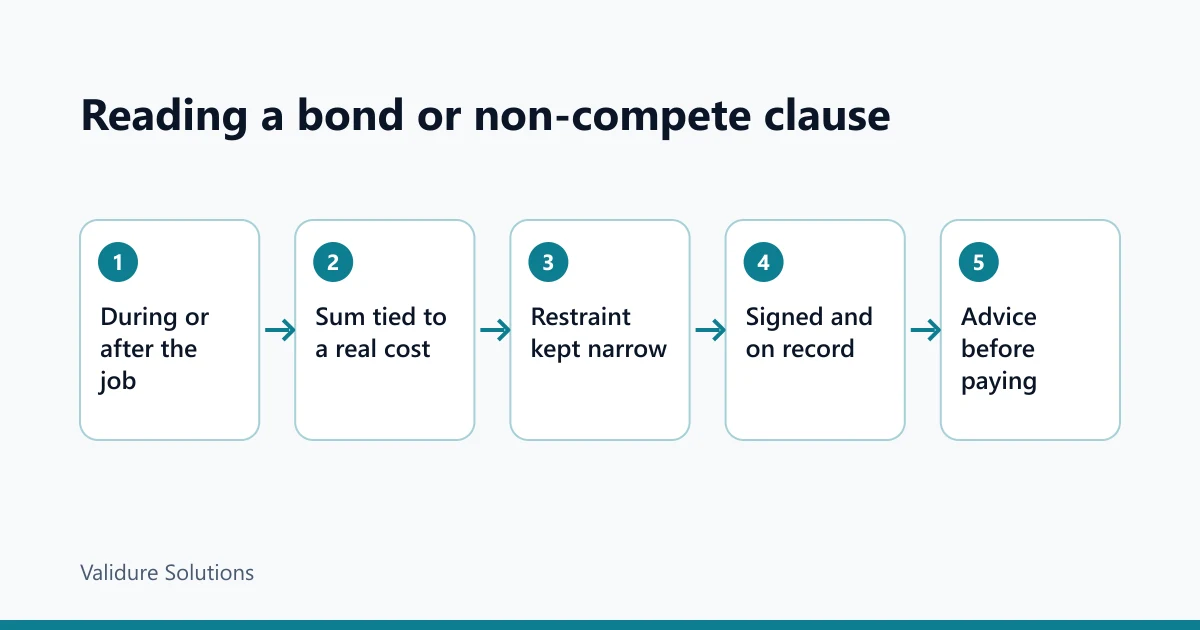
| Check | What to look for | What a hit means |
|---|---|---|
| When it applies | Does the restriction run only during employment, or after you leave? | After exit, a bar on working for others is likely void |
| How the sum is set | Is the amount tied to a stated cost, or a round figure? | A flat figure far above any real cost is vulnerable under section 74 |
| Tapering | Does the sum reduce with months served? | No taper makes the amount harder to justify |
| What counts as training | A named course, provider and cost, or just "training provided" | Vague training is hard to prove as a loss |
| Who holds originals | Does the clause let the company keep your degree certificates? | A pressure tactic; take copies, keep originals with the employee |
| Exit by the employer | Does the bond still apply if the company ends the job? | A bond payable even on dismissal or layoff looks punitive |
For an employer, the same table is a drafting list. Keep the signed bond, the training invoice and the attendance record of the course together, because those are what you'd have to produce. In Validure HR, offer letters, payslips and policies sit in one document store per employee, so the signed bond and the training invoice can live on the same record instead of in someone's inbox.
What to do next
If you're the employee:
- Keep a copy of the signed bond, the offer letter, any training records you were given, and every email about the bond.
- Don't pay a demanded sum on the spot. Ask in writing for the basis of the amount and the cost it represents.
- If you receive a legal notice, reply through a lawyer or at least in writing; ignoring it doesn't make it go away. The District Legal Services Authority offers free legal aid to eligible people.
- If your final salary or documents are being withheld because of the bond, that's a wages question; the route is your state's labour commissioner office, as set out in our final settlement post.
If you're the employer: decide whether you need a bond at all. For most roles, a reasonable notice period does the job. Where you do need one, tie it to a named cost, taper it, apply it only to resignations, and drop the post-exit non-compete in favour of a confidentiality clause you can actually enforce.
Who this isn't for: senior executives with negotiated contracts, sellers of a business, and shareholders bound by a shareholders' agreement. Different rules and exceptions apply there, and the goodwill exception in section 27 can matter.
Sources and checks
Primary texts, which you should read yourself:
- India Code, for the Indian Contract Act, 1872 (sections 23, 27 and 74) and the Code on Wages, 2019.
- Supreme Court of India, for the judgment in Vijaya Bank v Prashant B. Narnaware (14 May 2025), Kailash Nath Associates v DDA (2015), Niranjan Shankar Golikari v Century Spinning (1967), Superintendence Company of India v Krishan Murgai (1980) and Percept D'Mark v Zaheer Khan (2006).
- National Legal Services Authority, for free legal aid and your district legal services authority.
- Ministry of Labour and Employment, for the labour codes and grievance routes.
I checked the holdings through the judgments and summaries of them; the Sicpa amounts are from reports of the case rather than the judgment itself, so I've described the result without exact figures. I found nothing in the four labour codes that deals directly with bonds or non-competes. State-level variations in how courts apply these cases weren't checked.
Frequently asked questions
Is a non-compete clause valid in India after I leave a job?
Ordinarily no. Section 27 of the Contract Act makes a restraint on working in a lawful trade void, and the Supreme Court has applied that to restrictions after employment ends. Confidentiality obligations are a different matter and generally survive.
Can my employer make me pay the full bond amount?
Not automatically. Under section 74, the employer can get reasonable compensation up to the named sum, and where loss can be proved it has to be proved. Courts have often limited training bonds to the unrecovered cost.
Did the Supreme Court make employment bonds legal in 2025?
It held in Vijaya Bank (May 2025) that a minimum-service bond operating during employment isn't a restraint of trade and upheld the bank's 2,00,000 bond on those facts. It didn't make every amount in every bond payable.
Can a company deduct the bond amount from my final salary?
That's doubtful. The Code on Wages allows only listed deductions and caps them per wage period. An employer is on safer ground paying wages and claiming the bond separately.
Can I be stopped from working elsewhere during my notice period?
Usually yes, because you're still employed. A clause against working for others while employed, including garden leave during notice, is generally enforceable.
What should a small employer use instead of a bond?
A sensible notice period, a confidentiality clause, and, only where you pay for specific training, a tapering bond tied to the documented cost.