Can your employer cut your salary for late marks? What the Code on Wages allows, with the maths
By Validure team · · 14 min read
Three late marks, half a day's pay gone. What the Code on Wages, 2019 actually allows for late coming, how to work out the most that can be deducted for minutes missed, when a cut becomes a fine, and a fair late-mark policy for both sides. Checked against the Code and the central rules on 16 November 2026.

Say an accounts assistant earning 26,000 a month is late three times in November: 12 minutes on a Monday when the bus broke down, 20 minutes on a rainy Thursday, 8 minutes the week after. Forty minutes in all. Her payslip shows a "late mark deduction" of half a day. She asks HR how 40 minutes became four hours. HR says it's company policy, everyone knows the rule, three lates make a half day.
Both of them have a point, and neither has the whole picture. The short answer: an employer can deduct pay for time you weren't at work, but under the Code on Wages, 2019 the deduction can't be bigger, in proportion, than the time you actually missed. Anything above that is no longer a deduction for absence. It's a fine, and fines have their own rules: a notice approved in advance, a chance to explain, and a cap of 3 per cent of your wages for the period.
This post works through what the law says, the sums for the usual policies, and a late-mark rule that a small employer can defend and an employee can check. It's general information, not legal advice. Rules for your establishment depend on your state's rules under the Code, any standing orders, and your contract, so for a specific case talk to the labour department or a labour lawyer.
What changed on 21 November 2025
Until last year most of this sat in the Payment of Wages Act, 1936. That Act is now repealed by section 69 of the Code on Wages, 2019, which came into force on 21 November 2025. The deduction rules moved across almost word for word, with one difference that matters for offices.
The old Act only protected people below a wage ceiling. The Code's definition of "employee" in section 2(k) covers anyone employed on wages to do skilled, semi-skilled, unskilled, manual, operational, supervisory, managerial, administrative, technical or clerical work. So a manager on 90,000 a month is now inside the same deduction rules as a packer on 15,000. Many late-mark policies predate this.
The three sections you need are short. Section 18 says no deduction can be made from wages except those the Code allows, and lists them. Fines are one item. Deductions for absence from duty are another. Total deductions in a wage period can't go above 50 per cent of wages.
Section 19 covers fines: only for acts and omissions listed in a notice the employer has specified with the previous approval of the government or a prescribed authority, only after the employee has had a chance to show cause, capped at 3 per cent of wages for the wage period, never on anyone under 15, not recovered in instalments or after 90 days, and recorded in a register.
Section 20 covers absence. Absence can be "for the whole or any part of the period" you were required to work, so being late counts. But the deduction "shall in no case bear to the wages payable" a larger proportion than the time absent bears to the total time you were required to work in that wage period.
That last sentence is the whole argument in one line. Read it twice.
The proportion rule as a formula
Section 20(2) turns into simple arithmetic:
Most that can be deducted for absence = wages for the period x (time absent / total time required to work in the period)
You can count the time in minutes, hours or days, as long as both parts use the same unit. Here's the November example worked through. This is an example; your own shift and month will give different numbers.
| Item | Working |
|---|---|
| Monthly wages | 26,000 |
| November 2026 working days (Monday to Saturday, five Sundays off) | 30 - 5 = 25 days |
| Required hours per day (9:30 to 6:30 with a one-hour lunch) | 8 hours |
| Required time in the month | 25 x 8 = 200 hours = 12,000 minutes |
| Time absent through late arrival | 12 + 20 + 8 = 40 minutes |
| Most that can be deducted | 26,000 x 40 / 12,000 = 86.67 |
Now the half-day rule. Half of an 8-hour day is 4 hours, and at 26,000 / 200 = 130 an hour that's 520. Some companies work a half day out as monthly pay divided by 30 and halved instead, which gives 26,000 / 30 / 2 = 433.33.
Either way, the policy takes 433 to 520 for 40 minutes when the proportion rule allows 86.67. The gap, 346.66 to 433.33, has no footing as a deduction for absence. The only place it could sit is as a fine under section 19.
Could the extra be a valid fine?
Possibly, if the employer has done the paperwork. Three per cent of 26,000 is 780, so a fine of a few hundred rupees fits under the cap. What it needs comes from section 19 and the rules under it. Late attendance has to be one of the acts and omissions listed in a notice that the employer specified with the previous approval of the appropriate government or prescribed authority, and that notice has to be displayed at the workplace.
The employee has to get a chance to show cause before the fine is imposed. The Code on Wages (Central) Rules, 2026, notified on 8 May 2026, describe a written or electronic intimation and seven days to reply. States make their own rules for establishments in their sphere, and most private offices, shops and factories fall to the state, so check yours.
Then the fine goes into a register, and the money collected can only be spent on purposes beneficial to the staff that the prescribed authority approves. It doesn't go back into the company's revenue.
A one-line "three lates = half day" in an employee handbook usually meets none of these. Where the employer's position is stronger: if the late-mark policy only ever takes the actual time missed, it's a plain section 20 deduction and needs no fine procedure at all.
Leave instead of pay: the softer route, and its limits
The other common rule is "three late marks = half a day of casual leave debited". Plenty of HR teams prefer it because no salary is cut, and it's often described as the safe option.
It's safer, not settled. Debiting leave isn't a deduction from wages, so sections 18 to 20 don't apply to it directly. But leave is an entitlement. Leave granted by your state's shops and establishments law, by the Occupational Safety, Health and Working Conditions Code where it applies, or by your contract can't simply be taken away as a penalty if the rule that grants it doesn't allow that. Whether a 40-minute shortfall can be converted into half a day of leave depends on your leave rules and state law, and it's argued about on both sides.
Two things make it worse in practice. When the leave balance hits zero, the policy usually flips to "half day loss of pay", and at that point it's a wage deduction again and the proportion rule bites. And if the conversion isn't written in the appointment letter or leave policy that the employee accepted, it's hard to defend at all.
If you use it, keep it proportionate: debit leave in the units your leave rules allow, and never convert into a loss of pay larger than the minutes missed.
Four policies compared
Same employee, same 40 minutes over three days, 26,000 a month.
| Policy | What she loses | Legal footing (our reading, as of 16 November 2026) |
|---|---|---|
| Half day pay for every three lates | 433 to 520 | Weak unless the excess is run as an approved, notified fine with a show-cause step |
| Half day casual leave for every three lates | Half a day of leave | Better, but depends on leave rules and state law; becomes a pay cut when leave runs out |
| Deduct actual minutes late | 86.67 | Strong: a section 20 deduction within the proportion |
| Grace window, then actual minutes | 86.67 or less (see below) | Strong, and easier to live with |
Our view: the last row is the one to choose. It's the cheapest to defend, the easiest to explain on a payslip, and it doesn't punish the person whose bus broke down more than it punishes the person who overslept. Habitual lateness is a conduct problem, and conduct problems belong in the disciplinary process, not hidden in payroll arithmetic.
A grace window, worked through
A grace window says the first few minutes don't count. A common version is 10 minutes, up to three times a month. Here's how that changes the example:
| Day | Minutes late | Inside 10-minute grace? | Minutes counted |
|---|---|---|---|
| Monday | 12 | No | 12 |
| Thursday | 20 | No | 20 |
| Following week | 8 | Yes, first use of grace | 0 |
| Total | 40 | 32 |
Deduction: 26,000 x 32 / 12,000 = 69.33.
Decide in writing whether the grace forgives only the minutes inside it or the whole late arrival up to the limit. The version above counts the full 12 and 20 minutes, because those arrivals went past the grace. Some policies forgive the first 10 minutes of every late arrival, which would give 2 + 10 + 0 = 12 minutes and a deduction of 26.00. Either is lawful. Switching between them from month to month is what starts disputes.

The same rule on a bigger salary
Take a manager on 90,000 a month, same shift and same month, late for a total of 40 minutes.
- Proportion limit: 90,000 x 40 / 12,000 = 300.
- Half day by hours: 90,000 / 200 x 4 = 1,800.
- 3 per cent fine cap: 2,700.
Under the old Act this person was outside the deduction rules entirely. Under the Code the 1,800 half-day cut is six times the time missed, and the same question applies: is the extra 1,500 an approved fine, or not?
Where the late mark itself is wrong
Before arguing about the deduction, check the late mark itself.
| Check | What to look for | What a hit means |
|---|---|---|
| Device clock | Compare the attendance device time with a phone on network time, at the start of each month | A clock running fast marks people late who weren't |
| Shift on the record | The shift start used for the late mark matches the shift the person was actually rostered on that day | Wrong shift, so a false late mark |
| Rounding | Late minutes are counted as recorded, not rounded up to 15 or 30 | Rounding up inflates the time absent and the deduction |
| Employer-caused delay | Company transport late, gate queue, device down | Time that isn't the employee's absence and shouldn't be counted |
| Total deductions | All deductions in the month, including any late-mark amount, stay within 50 per cent of wages | A breach of section 18(3) whatever the reason |
We wrote about clock drift and duplicate punches in biometric versus self-service punch. A device three minutes fast will hand out late marks all month to people who arrived on time, and the payroll deduction inherits the error.
This is also where a system earns its keep. Validure HR takes attendance from self-service punch or a biometric device and feeds the same record into payroll, so the minutes on the late report are the minutes that reach the salary sheet, and you can review the sheet before payslips go out. With a few people on one site you don't need that; a register and the formula above will do.
For employees: what to do next
- Ask HR, in writing, for the late-mark policy and the working of your deduction: minutes counted, required time in the month, and the amount.
- Do the sum yourself with the formula. If the deduction is bigger than the proportion, ask whether the excess is a fine, and if so for the notice and the show-cause intimation you should have received.
- Keep your payslips, your appointment letter, any policy you signed and your own record of arrival times.
- If it isn't sorted internally, the Code lets you file a claim before the authority the government appoints under section 45, within three years. The authority can order compensation of up to ten times the amount found due. Your state labour department or the Inspector-cum-Facilitator for your area is the first stop for the right office.
Being late is still a real problem for the business, and the employer can deal with repeated lateness as misconduct through a warning and the disciplinary process in your standing orders or service rules. What the law limits is turning it into an outsized pay cut.
For employers: a policy that holds up
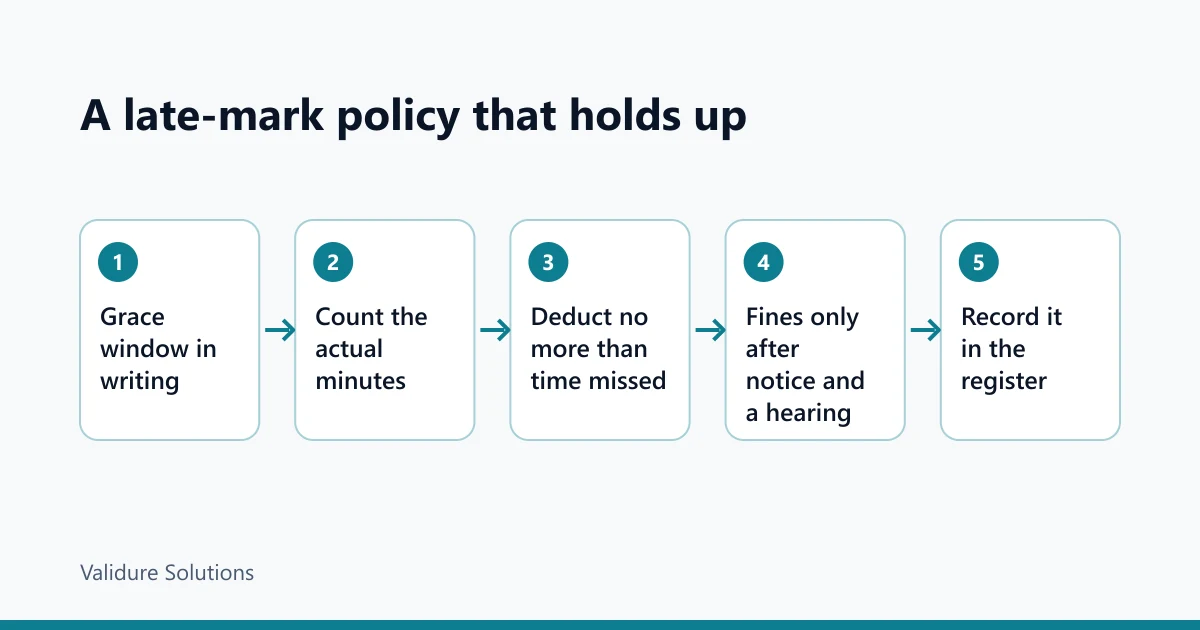
Put the grace window and the counting method in the appointment letter or attendance policy, and get it acknowledged. Deduct for actual time missed, using the proportion formula, on the shift the person was rostered for. Keep the attendance record and the working of each deduction, and close attendance on a fixed date before payroll.
If you also want a penalty for lateness, run it as a fine with the approved notice, the show-cause step, the 3 per cent cap and the register. Or treat it as conduct, not money, which is usually simpler.
And review the policy now if it predates the Code. If it was drafted for the old wage ceiling, it was never written with managers in mind.
Sources and checks
Checked on 16 November 2026. Rules under the labour codes were still being notified by states during 2026, so look for your state's rules under the Code on Wages before relying on any procedure described here.
- The Code on Wages, 2019 (Act 29 of 2019), sections 2(k), 18, 19, 20, 45 and 69, text as on 21 November 2025: India Code
- Ministry of Labour and Employment, labour codes and the Code on Wages (Central) Rules, 2026: labour.gov.in
- Official Gazette notifications: egazette.gov.in
The worked sums are examples with round numbers. The seven-day show-cause step comes from the central rules as summarised by several compliance publishers; check the rule text that applies to your establishment, which may be your state's. Whether converting late marks into leave is lawful depends on your leave rules and state law, and we found no official text that settles it in general.
Frequently asked questions
Can my company deduct half a day's salary for three late marks?
It can deduct for the time you actually missed. A half-day cut for 40 minutes goes beyond what section 20 of the Code on Wages allows for absence, so the extra can only stand as a fine, which needs an approved notice, a chance to explain and a cap of 3 per cent of your wages.
How do I work out the maximum late deduction?
Monthly wages x minutes late / total minutes you were required to work that month. For 26,000 a month, 200 required hours and 40 minutes late, that's 86.67.
Is it legal to deduct casual leave for coming late?
It isn't a wage deduction, so the Code's deduction limits don't apply directly, but it depends on your leave rules, contract and state law. Once your leave runs out and it becomes loss of pay, the proportion rule applies again.
Do these rules apply to managers and senior staff?
Yes. The old Payment of Wages Act had a wage ceiling. The Code on Wages covers employees doing managerial and supervisory work too.
Can an employer fine me for being late?
Only for acts listed in a notice made with the prior approval required under section 19, displayed at the workplace, after you've had a chance to show cause, and capped at 3 per cent of your wages for the period.
Where do I complain about an unfair late deduction?
Raise it in writing with HR first. If that fails, your state labour department can point you to the authority that hears claims under section 45 of the Code on Wages. Claims can be filed within three years.