Is a fixed-price software contract a trap? Fixed price vs time and materials, with the maths
By Validure team · · 14 min read
Both sides of the fixed price vs time and materials argument for custom software, with a worked 12 lakh example run three ways, what India's Contract Act does to delay penalties, and a contract checklist for either model.

Say a 35-person spare-parts distributor wants a stock and billing app to replace three spreadsheets. Two agencies quote. The first says 12 lakh, fixed, for the feature list attached. The second says it works on time and materials at 1,000 an hour, thinks the job is "around 1,000 hours" and won't promise a total. The owner's accountant has an easy answer: take the fixed price, because then the risk is the agency's.
Is it, though? A fixed price moves some risk to the vendor and hands a different risk back to you, and which one is bigger depends on something the quote doesn't show: how sure you are about what you want.
This post makes both cases at full strength, works through the numbers on that 12 lakh quote, looks at what Indian contract law does to the delay penalty you were planning to add, and ends with a checklist for whichever contract you sign. One interest to declare up front: we build custom software ourselves, and we've been paid under both models. Where we give our own view, it's labelled as ours.
What you are actually paying for in a fixed price
A fixed price isn't the agency's cost. It's the agency's cost estimate plus a buffer for being wrong, and the buffer is the price of the certainty you're buying.
Take the first agency. Example figures, not a real quote:
| Line | Hours | Rate | Amount |
|---|---|---|---|
| Estimated effort for the feature list | 1,000 | 1,000 | 10,00,000 |
| Risk buffer at 20 per cent | 2,00,000 | ||
| Fixed price quoted | 12,00,000 |
GST at 18 per cent goes on top of either quote, so it doesn't change the comparison. All figures below are before GST.
So the real question is whether 2 lakh is a fair price for the agency carrying the estimating risk. That depends on how big the estimating risk actually is, and on whether it really stays with the agency once the work starts.
The same project, three ways it can go
Run the example forward. The time-and-materials agency is at 1,000 an hour. The fixed-price agency prices changes at 1,300 an hour, which is common, because a change order mid-build costs more to handle than planned work.
Scenario one: the scope holds and the work takes 950 hours. On the fixed price you pay 12,00,000. On time and materials you pay 950 x 1,000 = 9,50,000. You paid 2,50,000 for certainty you didn't end up needing.
Scenario two: the original 950 hours are enough for the original list, but once your staff see the first screens, ten changes come in averaging 30 hours each. That's 300 extra hours. The fixed price becomes 12,00,000 + (300 x 1,300) = 15,90,000. Time and materials comes to (950 + 300) x 1,000 = 12,50,000. Now the gap is 3,40,000 the other way round, and the fixed-price version also cost you ten rounds of change-order paperwork.
Scenario three: the agency underestimated. The original list, unchanged, takes 1,600 hours. On the fixed price you still pay 12,00,000, and the agency, whose cost at its own rate is 1,600 x 1,000 = 16,00,000, loses 4,00,000. On time and materials you pay 16,00,000. With a cap of 13,00,000 you pay 13,00,000 and then face a choice about the remaining work.
Scenario three is where fixed price looks best on paper. It's also where it gets dangerous, and the next sections are about why.
| Scenario | Fixed price | Time and materials | Who came out ahead |
|---|---|---|---|
| Scope holds, 950 hours | 12,00,000 | 9,50,000 | Client on T&M by 2,50,000 |
| 300 hours of changes | 15,90,000 | 12,50,000 | Client on T&M by 3,40,000 |
| Underestimate, 1,600 hours | 12,00,000 | 16,00,000 | Client on fixed price by 4,00,000, if the agency actually finishes |
How likely is scenario three? More likely than most estimates admit. Bent Flyvbjerg and Alexander Budzier looked at 1,471 IT projects for a 2011 Harvard Business Review article and found an average cost overrun of 27 per cent. The average hides a tail: about one project in six had a cost overrun of around 200 per cent and a schedule overrun of almost 70 per cent. Their later work on a larger sample found that IT overruns follow a fat-tailed distribution, which is a formal way of saying the bad cases are much worse than the average suggests. Those were mostly large projects, not small Indian builds, so read them as a warning about shape, not a forecast.
The case for fixed price, at its strongest
Supporters of fixed price aren't naive, and their argument has real weight.
First, budgets in small firms are real limits. A business with 12 lakh set aside can't absorb 16. Knowing the number lets the owner decide whether to do the project at all, and that decision is worth more than a few lakh of theoretical saving.
Second, a fixed price forces both sides to write down what's being built. A lot of failed projects never had a clear scope; fixed price makes that work happen before the money is spent, not halfway through.
Third, it aligns the vendor's incentive with speed. On hourly billing, a slow team earns more. On a fixed price, the agency profits by finishing efficiently, and the client doesn't have to supervise hours.
Fourth, the client usually can't judge whether 1,000 hours is reasonable. Fixed price lets a non-technical owner compare quotes on one number they understand. Time and materials asks them to trust an estimate they can't check.
If your scope really is stable and small, fixed price often is the better deal.
The case for time and materials, at its strongest
The other side's argument starts from the fact that software scope is rarely known in advance, because people discover what they want by using the first version.
First, the buffer is paid every time, and the protection only pays out sometimes. In the example, you pay 2 lakh to insure against scenario three. If changes are likely, you then pay the change-order premium on top.
Second, a fixed price that turns out too low doesn't stay the agency's problem. An agency losing 4 lakh has a few options, and none of them are good for you. It can cut testing, which shows up as bugs after go-live. It can read the spec as narrowly as possible and treat every gap as a paid change. It can move its best people to profitable work. Or it can stop, and in a small Indian agency that's a real possibility, at which point you hold a half-built app and a dispute.
Third, change orders turn every small improvement into a negotiation. Staff stop asking for the field they need because it means another quote. The app ships to spec and fits the business worse.
Fourth, time and materials makes the trade-off visible. Every two weeks you see what was spent and what was built, and you can stop, re-prioritise or cut features. With a fixed price, you often only find out the project is in trouble when a milestone slips.
If you'll learn what you need by building it, time and materials usually costs less and produces a better fit.

Where the evidence actually sits
What's established: IT projects regularly overrun, and the overruns are fat-tailed. GST at 18 per cent applies to software development services either way. Under Indian contract law, a pre-agreed damages figure is a ceiling, not an automatic payout (more on that below).
What's contested: whether fixed price produces better or worse quality on average. There isn't good public data on small Indian projects, and the vendor blogs that argue each side mostly sell the model they recommend. Treat their percentages with care.
Our opinion, labelled as such: the argument is usually framed wrong. The useful question isn't "fixed or hourly?" but "which parts of this project do we understand well enough to price?" Fix the price of those, and buy the rest by the hour with a cap.
The middle options most people should look at
Three structures get most of the benefit of both models.
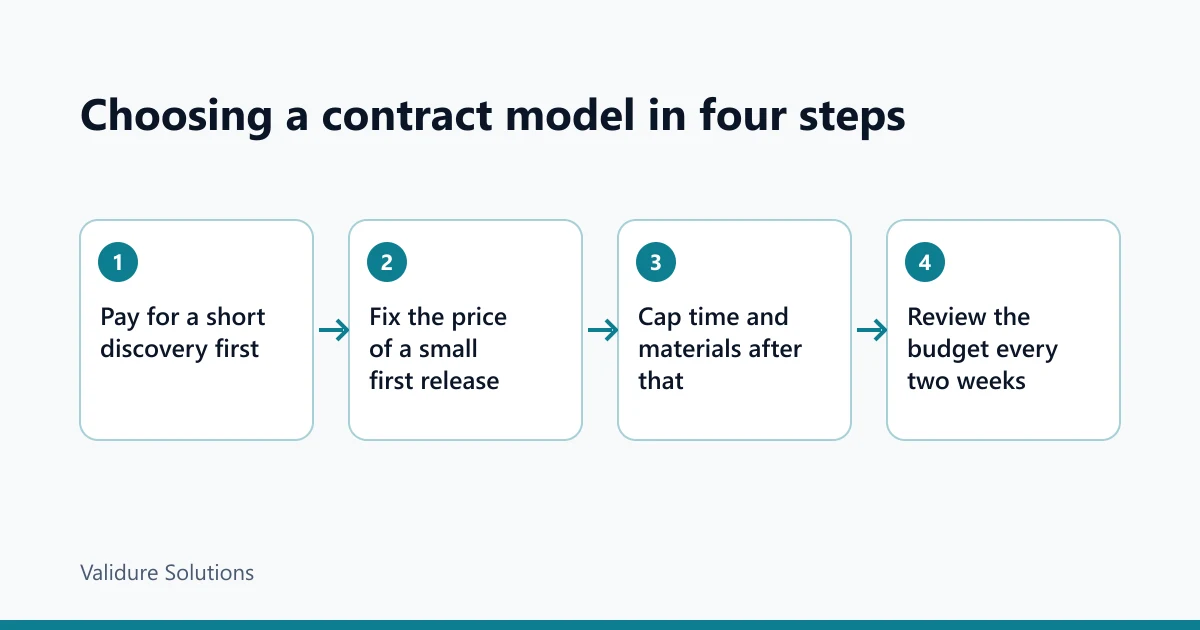
Paid discovery first. Pay for one to three weeks of work that produces screen sketches, a data model and a priced feature list. It's typically a small share of the build cost, and you own the output, so you can take it to another vendor. This is the cheapest way to turn an uncertain project into one you can fix a price for.
Fixed price for a small first release, then time and materials. Fix the price of the smallest version your staff can actually use. After go-live, buy changes by the hour against a monthly budget. The fixed part is small enough to estimate well, and the uncertain part is paid as it happens.
Capped time and materials. Bill by the hour, with a ceiling the vendor can't exceed without your written approval, and a review at 70 or 80 per cent of the cap. You keep the flexibility and you never get a surprise bill. The cap isn't a promise that the work will finish inside it, so pair it with a ranked feature list, so the least important items are the ones that drop.
| Your situation | Model that usually fits | Why |
|---|---|---|
| Small, well-specified job, under about 200 hours | Fixed price | Little estimating risk, so the buffer is small |
| You know the problem but not the screens | Paid discovery, then fixed price for release one | Turns unknowns into a spec before you commit |
| Ongoing improvements after go-live | Capped time and materials, monthly budget | Changes are the work, so pricing each one wastes time |
| Hard budget limit, uncertain scope | Capped T&M with a ranked feature list | You control what drops when money runs out |
| Large build with a board-approved budget | Phased fixed prices, one per release | Each phase is estimated with what the last one taught |
The delay penalty you were going to add
Many clients sign a fixed price and add a penalty, say 1 per cent of the contract value per week of delay up to 10 per cent, and assume it will be paid if the agency is late. Under Indian law it's not that simple.
Section 74 of the Indian Contract Act, 1872 says that when a contract names a sum payable on breach, the injured party gets reasonable compensation not exceeding that sum. It makes no difference whether the contract calls it liquidated damages or a penalty. In Kailash Nath Associates v. Delhi Development Authority (2015), the Supreme Court read this to mean the named sum is a ceiling, that loss or damage must actually have been caused, and that the named sum can be taken as the measure only where actual loss is hard or impossible to prove.
On the example, 10 per cent of 12,00,000 is 1,20,000. That's the most a court would award under the clause, not what you'd get. If the delay cost you little, you may recover little.
What this means in practice: a delay clause works better as a lever in negotiation than as a source of money. Make it believable by writing down why delay hurts you (staff kept on spreadsheets, a migration date tied to a year end) so the figure looks like a genuine pre-estimate. And remember the other side of it: if the agency is losing money on a too-low fixed price, a penalty clause can push it to stop rather than finish. This is general information, not legal advice. For a contract of any size, have a lawyer read the damages and termination clauses.
A checklist for whichever contract you sign
| Check | What to look for | What a hit means |
|---|---|---|
| Scope document | A numbered feature list with acceptance criteria, attached to the contract | Without it, "done" is an argument, under either model |
| Change process | Who can request a change, how it's priced, a turnaround time for quotes | Missing on fixed price means every change becomes a dispute |
| Rate card | Hourly rates by role, and the rate used for changes | A change rate far above the base rate makes changes expensive by design |
| Cap and review | A ceiling, plus a review point before it's reached | Missing on T&M means no limit on the bill |
| Timesheets | Weekly hours by person and task, visible to you | Missing on T&M means you can't check what you're paying for |
| Milestone payments | Payments tied to working software you've accepted, not to dates | Date-based payments pay for time passing |
| Source and accounts | Code in a repository you own, cloud accounts in your name | Missing means you can't leave if the relationship fails |
| Exit clause | Termination for convenience, with payment for work done and handover | Missing means stopping a bad project is a legal fight |
The source-and-accounts row matters most when a fixed-price project goes wrong, because that's when an agency is most likely to stop work. We covered the ownership side, including the copyright clauses, in who owns the code you paid for.
When none of this matters
If what you need is mostly standard (payroll, accounts, a hotel front desk), a custom build may be the wrong starting point, and the contract model is a second-order question. Buying a product and paying for setup removes most of the estimating risk this whole post is about. If you're unsure, our earlier post on custom software vs off the shelf works through that choice. And for a job of a few days, don't overthink it: a fixed quote on a clear brief is fine.
Where our interest shows: when we take on custom work, we usually suggest a paid discovery, a fixed price for the first release and capped hours after that, for the reasons above. You should still compare that with a plain fixed quote from someone else, using the three scenarios as your test.
Sources and checks
Section 74 of the Indian Contract Act, 1872 is on India Code. The Supreme Court's judgment in Kailash Nath Associates v. Delhi Development Authority (2015) can be found through the Supreme Court of India judgments search. The 18 per cent GST rate on IT design and development services comes from rate notification 11/2017-Central Tax (Rate), as amended, on the CBIC GST portal. Overrun figures are from Flyvbjerg and Budzier, "Why Your IT Project May Be Riskier Than You Think", Harvard Business Review, September 2011, with a preprint on arXiv, and their 2022 paper on IT cost overruns in the Journal of Management Information Systems. Legal and tax positions were checked on 14 November 2026. The distributor, the quotes and every figure in the scenarios are examples, not real clients or real prices.
Frequently asked questions
Is a fixed price always cheaper for the client?
No. It's cheaper only when the agency underestimated and still finishes the work properly. When scope holds or changes, you usually pay more, because the price includes a risk buffer and changes are billed at a premium.
What's a reasonable risk buffer in a fixed quote?
There's no standard figure, and agencies rarely show it. Ask for the hours estimate behind the quote and the rate. If the quote is far above hours times rate, the gap is the buffer, and you can judge whether it's worth paying.
How do I stop a time-and-materials project running forever?
Put a cap in the contract, require your written approval to go over it, and review spend against a ranked feature list every two weeks. If the cap is close and the important features aren't done, you find out early enough to decide.
Will a court enforce my late-delivery penalty?
Only up to the sum named, and only as reasonable compensation for loss you actually suffered, under section 74 of the Contract Act as the Supreme Court read it in 2015. Check your clause with a lawyer before relying on it.
Can I switch from fixed price to hourly halfway through?
Yes, if both sides agree in writing. It's often the sensible move once the first release is live. Settle what counts as finished under the fixed part before the hourly billing starts.
Does GST change the comparison?
No. GST at 18 per cent applies to software development under both models, and a registered business can usually claim it as input credit. Compare quotes before GST, then add it.