
How gratuity is worked out under the labour codes, with the maths
By Validure team · · 15 min read
Gratuity now runs on the Code on Social Security and its wider wage definition. Worked examples of the 15/26 formula, the 50 per cent wage test, fixed-term staff after one year, the ceiling and the 30-day payment rule, plus the checks to run before you pay.

Say an accounts executive resigns after seven years and four months. Her basic is 15,000 a month. HR opens the old gratuity sheet, types 15,000 x 15 / 26 x 7, gets 60,576.92 and puts it in the full-and-final. A week later she writes back with her own number, 66,230.77, and a link to the labour ministry's FAQ.
She's right, and the gap isn't a typo. Since 21 November 2025 gratuity sits in the Code on Social Security, 2020, and the Code measures "wages" differently from the old Payment of Gratuity Act. The formula didn't change. What goes into it did.
Below is how a gratuity figure is built today, with every sum shown, for the person preparing the full-and-final and the employee checking it.
This is general information, not legal advice. Your establishment type and your contract can change the answer, so for a specific case talk to a labour lawyer or the labour commissioner's office.
Who gets gratuity at all
The gratuity chapter of the Code applies, per its First Schedule, to every factory, mine, oilfield, plantation, port and railway company, and to every shop or establishment where ten or more employees work, or worked on any day in the previous twelve months. The government can also notify smaller ones.
Inside a covered establishment, section 53(1) of the Code pays gratuity when employment ends after at least five years of continuous service, on superannuation, retirement or resignation, death or disablement, or the end of a fixed-term contract. The five-year minimum does not apply to death, disablement or the expiry of fixed-term employment.
So there are three routes, and they behave differently:
| Who | Minimum service | How it's paid |
|---|---|---|
| Permanent employee who resigns or retires | 5 years continuous service | 15 days' wages per completed year, part year over six months counts as a year |
| Fixed-term employee | 1 year from start of contract (ministry FAQ) | Pro rata, per section 53(2) |
| Employee who dies or is disabled | None | Pro rata for a death; paid to the nominee or heirs |
"Continuous service" is wider than it sounds. Section 54 counts service interrupted by sickness, accident, leave, lay-off, a strike or lock-out not caused by the employee, and unauthorised absence unless a formal order treated it as a break. Where service wasn't unbroken, a year still counts if the person actually worked 240 days in the twelve months before the calculation date (190 below ground in a mine or where the week is under six days), with paid earned leave, lay-off and up to 26 weeks of maternity leave counted as worked.
The formula, and what "last drawn" means
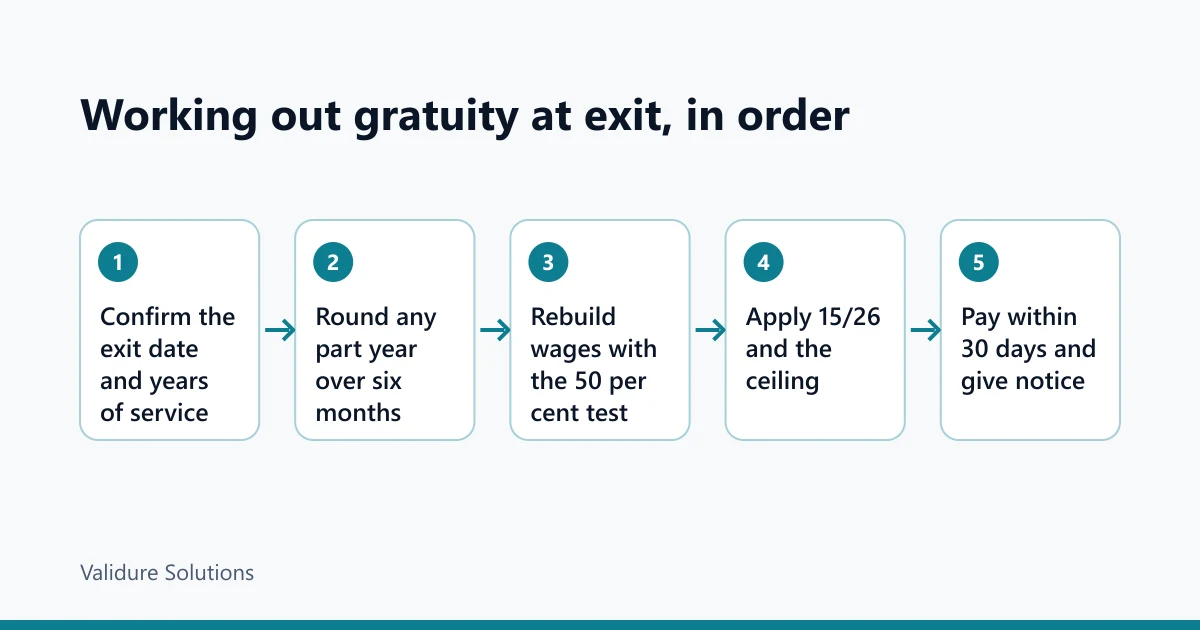
Section 53(2) sets the rate at fifteen days' wages for every completed year, "or part thereof in excess of six months", based on the rate of wages last drawn. Explanation 3 in the same section fixes the arithmetic for monthly-rated staff: divide the monthly wage by 26 and multiply by 15.
gratuity = last drawn monthly wages x 15 / 26 x years of service
The 26 is a statutory divisor, not the days in the month. Don't swap in 30 because your payroll pro-rates salary that way.
Years round only one way. Seven years and four months is 7. Seven years and seven months is 8. Exactly six months over doesn't round up; it has to be "in excess of" six months.
Piece-rated workers use a three-month average, excluding overtime; seasonal establishments pay seven days per season.
The part that moved: what counts as wages
Under the old Act, gratuity wages were basic plus dearness allowance. Under the Code, section 2(88) defines wages as basic pay, dearness allowance and retaining allowance, then lists what's excluded: bonus outside the terms of employment, the value of housing and amenities, employer PF and pension contributions, conveyance and travel concessions, special expense reimbursements, HRA, award or settlement payments, overtime, commission, gratuity and retrenchment compensation.
Then comes the proviso that changes the number. If the excluded items in clauses (a) to (i) add up to more than half of all remuneration, the amount above half is "deemed as remuneration" and added back into wages.
The ministry's FAQ of 16 March 2026 settles two things you need for the sum. "All remuneration" for this test includes statutory items such as employer PF and pension contributions and statutory bonus, but not gratuity or ESI. And overtime allowance sits inside the excluded list, so a heavy overtime month can push someone over the line.
Worked example: the accounts executive
Here's the opening case with her full monthly structure. This is an example; the figures are made up but realistic.
| Component | Monthly | Wages or excluded? |
|---|---|---|
| Basic | 15,000 | Wages |
| HRA | 12,000 | Excluded, clause (f) |
| Conveyance | 4,000 | Excluded, clause (d) |
| Employer PF (12% of 15,000) | 1,800 | Excluded, clause (c) |
| All remuneration | 32,800 |
Half of 32,800 is 16,400. The excluded items come to 12,000 + 4,000 + 1,800 = 17,800. That's 1,400 over the half, so 1,400 is added to wages:
wages = 15,000 + 1,400 = 16,400
Check: 16,400 is exactly half of 32,800, which is what the rule aims at.
Seven years and four months rounds down to 7 years, so:
| Basis | Sum | Gratuity |
|---|---|---|
| Old Act, basic only | 15,000 x 15 / 26 x 7 | 60,576.92 |
| Code, 50 per cent test | 16,400 x 15 / 26 x 7 | 66,230.77 |
The difference is 5,653.85. Had she stayed one more quarter, to seven years and seven months, it would be 16,400 x 15 / 26 x 8 = 75,692.31.
What about service before 21 November 2025?
This is the question most employers asked. Her first six years were under the old Act. Does the old wage figure apply to those years?
The ministry's March 2026 FAQ answers it directly: gratuity for anyone who exits on or after 21 November 2025 is paid on the rate of wages last drawn at the time of exit, as per the Code. There's no split of service into an old-Act part and a Code part. The whole service is multiplied by the new wage figure.
An FAQ is guidance, not a rule or a judgment. But it's the official position today, and an employer paying less would have to defend it.
The grey area: special allowance
Plenty of Indian salary structures have a large "special allowance" that soaks up whatever isn't basic or HRA. It isn't in the included list of section 2(88), and it isn't in the excluded list either. So which side does it fall on?
There are two readings, and I don't think either is settled.
Reading 1: wages are only basic, DA and retaining allowance, so special allowance sits outside wages for the 50 per cent test. The ministry's FAQ leans this way when it says components not listed in section 2(88) "shall not be considered" for gratuity.
Reading 2: wages mean "all remuneration" except what's excluded. Special allowance isn't excluded, so it's wages in full.
Here's what that does to one employee. This is an example.
| Component | Monthly |
|---|---|
| Basic | 24,000 |
| HRA | 12,000 |
| Special allowance | 21,120 |
| Employer PF (12% of 24,000) | 2,880 |
| All remuneration | 60,000 |
Half of 60,000 is 30,000.
| Reading | Wages for gratuity | Gratuity for 10 years |
|---|---|---|
| Old Act, basic only | 24,000 | 1,38,461.54 |
| Reading 1: special allowance outside wages, 50 per cent test applies | 30,000 | 1,73,076.92 |
| Reading 2: special allowance is wages | 45,120 | 2,60,307.69 |
For Reading 1: 12,000 + 21,120 + 2,880 = 36,000 sits outside wages, 6,000 over half, so wages are 24,000 + 6,000 = 30,000. For Reading 2: wages are 24,000 + 21,120 = 45,120, and the excluded items of 14,880 are under half, so nothing is added.
What I'd do: pay at least Reading 1, which the FAQ supports, write down which reading you used and why, and take advice before you rely on it for a large exit. If your structure leans heavily on special allowance, budget for Reading 2 in your provision so a dispute doesn't surprise you. Moving special allowance into basic removes the question, at the cost of a higher PF and gratuity base.
Fixed-term staff after one year
Section 53(1) removes the five-year minimum when fixed-term employment expires, and section 53(2) says fixed-term and deceased employees are paid pro rata. The government's November 2025 announcement put it as gratuity after one year of continuous service for fixed-term employees, and the ministry's March 2026 FAQ is explicit: a fixed-term employee becomes eligible after rendering one year of service under the contract, counted from its start. An 11-month contract does not qualify.
The FAQ also says fixed-term employment covers people engaged directly by the employer. Contract labour supplied by a contractor is a different case; the FAQ says the contractor, as their employer, pays gratuity on five years of continuous service.
How "pro rata" is computed isn't spelled out in the Code itself. Two methods give different answers for the same person. Say a fixed-term analyst on wages of 30,000 a month finishes a contract of one year and three months. This is an example.
| Method | Sum | Gratuity |
|---|---|---|
| Completed years only (3 months is under six) | 30,000 x 15 / 26 x 1 | 17,307.69 |
| Pro rata by months | 30,000 x 15 / 26 x 1.25 | 21,634.62 |
The pro rata proviso exists to pay for the part year, so the second method fits the text better. Check what the rules notified by your appropriate government say before you set a policy, and then apply the same method to every fixed-term exit.
The ceiling and better terms
Section 53(3) caps gratuity at whatever amount the central government notifies. The figure in use is 20 lakh rupees, notified in 2018 under the old Act, and the ministry has said it remains the ceiling. Check the ministry's site for a newer notification before a large payout.
The cap bites at higher salaries. Say a plant head has wages of 2,50,000 a month and 20 years of service. This is an example.
2,50,000 x 15 / 26 x 20 = 28,84,615.38 -> capped at 20,00,000
The ceiling limits what the law forces you to pay, not what you may pay. Section 53(5) protects any better terms in a contract, award or agreement. If your appointment letters promise gratuity "as per company policy" with no cap, that promise still binds you. Tax on gratuity is a separate question with its own limits; check it with your accountant rather than assuming the 20 lakh labour ceiling and the tax limit are the same thing.
When it has to be paid, and what can be withheld
Section 56 of the Code sets the clock. Once gratuity becomes payable, the employer has to work out the amount and give written notice of it to the employee and to the competent authority, whether or not the employee has applied. Payment is due within thirty days of the date it becomes payable. Pay late and simple interest runs from the date it became payable, at a rate not above the one the central government notifies for long-term deposits, unless the delay was the employee's fault and the authority has given written permission.
Holding gratuity until someone "returns the laptop" is a risk; the laptop is a separate recovery. Our post on whether an employer can hold your final settlement covers the rest of the exit payments.
Gratuity can be forfeited only in the cases listed in section 53(6): to the extent of loss caused by an act, wilful omission or negligence that damaged the employer's property, and wholly or partly for termination due to riotous or disorderly conduct, violence, or an offence involving moral turpitude committed in the course of employment. Ordinary resignation without full notice isn't on that list.
What it does to an employer's books
The past-service reading matters most for the provision on your balance sheet. Say a 30-person company has staff averaging six years of service, and their average gratuity wages rise from 20,000 to 25,000 because of the 50 per cent test. This is an example.
| Per person, 6 years | 30 people | |
|---|---|---|
| Old basis, 20,000 | 69,230.77 | 20,76,923.08 |
| Code basis, 25,000 | 86,538.46 | 25,96,153.85 |
| Increase | 17,307.69 | 5,19,230.77 |
That jump lands at once, because past years are now priced at the new wage. Tell your gratuity trust or insurer, and get the actuarial valuation redone on the new base. Section 57 also lets the government make gratuity insurance compulsory from a notified date.
Validure HR keeps salary structures and payslips for every month, so the "last drawn" components are there to rebuild the wage figure at exit, and its salary sheets let you run the 50 per cent test across the whole team before a provision is booked. If you have a handful of people and an accountant who already does this, you don't need a system for it.
Checks before you pay
| Check | What to look for | What a hit means |
|---|---|---|
| Coverage | Ten or more employees on any day in the past twelve months | If yes, the gratuity chapter applies even if you're smaller now |
| Service length | Joining date, exit date, breaks with a formal order | Under five years for a permanent employee: no statutory gratuity unless death or disablement |
| Rounding | Part year strictly over six months | Seven years and six months is still 7 |
| Wage base | Last month's full structure, including overtime and employer PF | Excluded items over half: add the excess to wages |
| Special allowance | Which reading you used | Write it down; provision for the higher one |
| Fixed-term exits | One year from contract start, pro rata method | Same method for every fixed-term exit |
| Ceiling | Formula result above 20 lakh | Pay the cap unless a contract promises more |
| Clock | Notice issued, payment date within 30 days | Interest runs from the date it became payable |
What to do next
If you're the employee, keep your appointment letter, last payslips and relieving letter, and do your own sum. If the employer's figure is lower, ask in writing which components they used. If that fails, the competent authority under the Code, reached through the labour commissioner's office, decides disputes on the amount.
If you're the employer, write a one-page gratuity note: how you count years, which special-allowance reading you use, how you pro-rate fixed-term exits, and when you pay. Disputes come from inconsistency more than from the formula.
Sources and checks
Checked on 8 November 2026 against the text of the Code on Social Security, 2020 as published by the Ministry of Labour and Employment, and the ministry's "Additional FAQs on Labour Codes" dated 16 March 2026.
- Ministry of Labour and Employment, labour codes and FAQs: labour.gov.in
- The Code on Social Security, 2020, sections 2(34), 2(88), 53, 54, 56, 57 and the First Schedule: India Code
- Press Information Bureau release of 21 November 2025 on the four labour codes coming into effect: pib.gov.in
- Gratuity ceiling of 20 lakh rupees: notified in 2018 under the Payment of Gratuity Act and stated by the ministry as current; check labour.gov.in for any newer notification.
I could not verify from an official text the exact method for computing pro rata gratuity for fixed-term employees, so the post shows both methods. Tax treatment of gratuity is left out deliberately; check it with your accountant.
Frequently asked questions
Is gratuity still 15 days' salary for each year of service?
Yes. Section 53(2) of the Code keeps fifteen days' wages per completed year, worked out as monthly wages divided by 26 and multiplied by 15. What changed is the wage figure, which now follows the Code's definition and its 50 per cent test.
Do I get gratuity after one year in a permanent job?
No. Permanent employees still need five years of continuous service, unless employment ends because of death or disablement. The one-year rule is for fixed-term employees whose contract runs at least a year.
Does the new wage definition apply to my years before November 2025?
According to the labour ministry's March 2026 FAQ, yes. Anyone who exits on or after 21 November 2025 is paid on wages last drawn under the Code, multiplied by their whole service.
Is 4 years and 8 months counted as 5 years?
Not by the rounding rule. Rounding up a part year over six months applies when working out the amount for someone who already qualifies; it doesn't create the five-year minimum. If you're close to five years, check the continuous-service rules in section 54 and take advice for your case.
How long can an employer take to pay gratuity?
Thirty days from the date it becomes payable, under section 56(3) of the Code. After that, simple interest is owed from the date it became payable.
