PF deducted from your salary but missing from your passbook? How to check, and what to do
By Validure team · · 15 min read
How to tell a late passbook from an employer who kept your PF, using the EPFO passbook and the public establishment search. A worked month-by-month check, what the Code on Social Security says about unpaid contributions, and the complaint route, for employees and small employers.

Say you work at a 40-person packaging unit. Every payslip since April shows a PF deduction of 1,680. In November you open the EPFO passbook to check your balance before a loan application, and the credits stop at June. July, August and September aren't there. HR says the portal is slow and it'll show up. A colleague says the company has been short of cash since the monsoon.
One of them is right, and you can find out which without waiting. The EPFO gives every member a passbook, and it also publishes, for any covered employer, a list of the months it paid and the names of the people each payment covered. Between the two you can usually tell within ten minutes whether the money is late in the system or was never sent.
This post walks through that check with numbers, explains what the law says when an employer deducts PF and doesn't deposit it, and gives the complaint route. It's written for two readers: the employee who wants to know where their money is, and the small employer who wants to stay on the right side of it. It's information, not legal advice. For a specific dispute, talk to the EPFO regional office, the labour commissioner or a labour lawyer. I checked the provisions below on 12 November 2026.
A payslip deduction is not a deposit
The payslip shows what the employer kept back from your pay. The passbook shows what reached your account. Those are two different events, and the gap between them is where the problem lives.
Here's the normal sequence. At the end of the wage month the employer files an electronic challan cum return (ECR) on the EPFO portal, listing each employee, their PF wages and the contributions. The portal generates a reference called a TRRN. The employer then pays the challan. Only after the payment is credited does EPFO post the amounts to each member's account. The EPFO's own ECR material and most practitioner guides put the due date at the 15th of the following month, so July's contributions are due by 15 August.
Two delays sit inside that sequence, and both are innocent. Some employers file and pay on the last allowed day. And the passbook can take a while to reflect a payment after it's credited. Guides vary on how long that takes, from about a week to a few weeks, so treat one missing month as "check again", not as proof of anything.
Three or more months missing, while the payslips keep showing deductions, is different. That's the pattern to act on.
What your passbook should show, with the arithmetic
To read the passbook you need to know what a correct month looks like. Your contribution and your employer's are both 12 per cent of PF wages, but the employer's 12 per cent is split, so the columns won't match.
Example: say your PF wages (basic plus dearness allowance, for most people) are 14,000 a month.
| Item | Rate | Amount |
|---|---|---|
| Your contribution | 12% of 14,000 | 1,680 |
| Employer's contribution, total | 12% of 14,000 | 1,680 |
| Of which to the pension scheme (EPS) | 8.33% of 14,000 = 1,166.20 | 1,166 |
| Of which to your PF account | 1,680 minus 1,166 | 514 |
So a correct month in the passbook shows 1,680 in the employee column, 514 in the employer column and 1,166 in the pension column. People often panic because the employer column is smaller than theirs. That's expected. The pension share is real money, but it sits in the pension fund, not in your PF balance.
If your PF wages are higher, the sums change and the ceiling comes in. The ceiling for mandatory PF moved from 15,000 to 25,000 a month in September 2026, which we covered in our post on the new PF wage ceiling. For this check you don't need to get the split exactly right. You need to see whether a credit exists for each month at all.
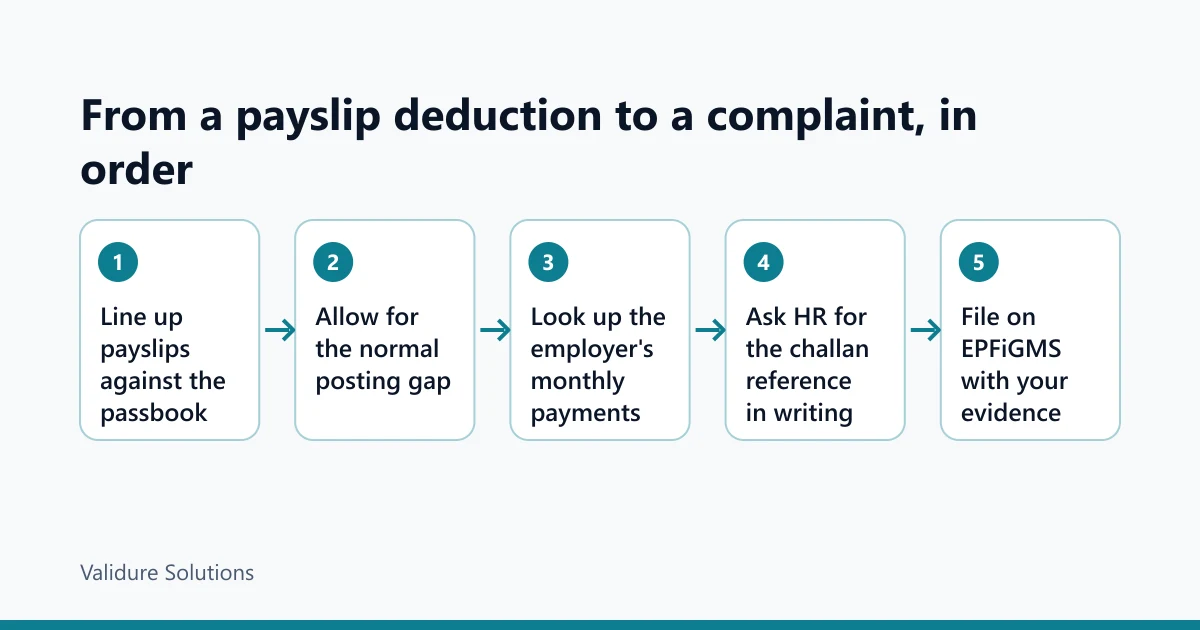
Step one: line up the months
Take your payslips and the passbook and put them side by side. Continuing the example, here's what the 40-person unit's employee would find on 12 November 2026.
| Wage month | Payslip PF deduction | Passbook: employee share | Due by | Status on 12 Nov |
|---|---|---|---|---|
| April | 1,680 | 1,680 | 15 May | Credited |
| May | 1,680 | 1,680 | 15 June | Credited |
| June | 1,680 | 1,680 | 15 July | Credited |
| July | 1,680 | none | 15 August | Overdue about 3 months |
| August | 1,680 | none | 15 September | Overdue about 2 months |
| September | 1,680 | none | 15 October | Overdue about 4 weeks |
| October | 1,680 | none | 15 November | Not yet due |
Count only the overdue months. Here that's July, August and September. Your own deducted share for those three months is 3 × 1,680 = 5,040. The employer's matching share is another 5,040. So for this one person the shortfall is 10,080, before interest. In a company where the same thing happened to 30 people at similar wages, it's about three lakh.
October isn't a problem yet. Leave it out of any complaint, or you hand HR an easy reply.
One more thing to rule out before you go further: a second member ID. If you changed jobs, your UAN may hold more than one member ID, and the passbook shows them separately. Make sure you're looking at the member ID for this employer.
Step two: see what the employer actually paid
This is the check most people don't know about. The EPFO portal has a public establishment search. You look up your employer by name or code, open its payment details, and you get a table of every payment it has made, by wage month, with the TRRN, the date of credit, the amount and the number of employees covered. The EPFO's own help document for the facility says the number of employees is a link, and clicking it lists the names of the members that payment covered.
That gives you three possible answers for each missing month.
| What the establishment search shows for July | What it most likely means | What to do |
|---|---|---|
| No payment for July at all | The employer hasn't paid the month | Ask HR for the challan, then complain if there's no answer |
| A July payment, but your name isn't on the list | You were left out of the return, or filed under a wrong UAN or member ID | Ask HR to file a supplementary return for you |
| A July payment with your name on it | Paid; your passbook is lagging or posting to another member ID | Check your member IDs, then wait two weeks |
The second row is common and often not dishonest. New joiners whose UAN wasn't linked in time, people whose wages crossed into coverage after the ceiling change, and contract staff are the usual cases. It's still the employer's job to fix it.
For a small employer, the same screen is a free audit. Compare the number of employees on each payment with your own count of people who had PF deducted that month. If payroll deducted from 40 people and the July payment covers 31, nine people are about to come knocking.

A note on contract workers. The Code on Social Security lets a principal employer recover PF contributions it pays for a contractor's workers from that contractor, and it says the contractor can't take the employer's share out of the worker's wages. The EPFO's help document also says a principal employer can see its contractors' remittances and the names of the contract workers through the same facility. If you hire through a contractor, look.
Step three: ask in writing, and ask for something specific
Before you complain, ask HR or payroll by email for the TRRN and the date of payment for each missing month. Be specific: "Please share the challan reference and payment date for July, August and September 2026." That's a question with a checkable answer. "The portal is slow" isn't an answer to it.
Give it a short, fixed time. Some guides suggest escalating if nothing is resolved two weeks after you ask, which seems fair. Keep the email thread. It shows you raised it, when, and what you were told.
If you're the employer and the honest answer is that the money hasn't gone, say so and give a date. A late payment carries interest and can carry damages, but it's far cheaper than a complaint, an inquiry and the prosecution risk described below.
What the law says when PF is deducted and not paid
The four labour codes came into force on 21 November 2025, and the Code on Social Security, 2020 replaced the old EPF Act's enforcement sections. Commentary still quotes the old section numbers (7A, 7Q, 14B), so here's how they map. I read these in the text of the Code as passed in 2020; check the current version on India Code before relying on the wording.
| What it covers | Old EPF Act | Code on Social Security, 2020 |
|---|---|---|
| Officer's inquiry to work out what an employer owes | Section 7A | Section 125 |
| Interest on late payment | Section 7Q | Section 127 |
| Damages for default | Section 14B | Section 128 |
| Penalty for not paying contributions | Section 14 | Section 133 |
A few points in plain words.
Section 125 lets an authorised EPFO officer hold an inquiry and decide the amount an employer owes. No such proceeding can start more than five years after the amount became due. That's a long window, but it isn't unlimited, so don't sit on a known gap for years.
Section 127 makes the employer pay simple interest from the date an amount fell due until it's paid, at a rate the central government notifies. The old Act fixed it at 12 per cent a year. I couldn't confirm the rate currently notified under the Code, so I've not used one in the examples.
Section 128 lets the authority levy damages for default, capped at the amount of the arrears, and only after the employer has been given a hearing. Some secondary sources quote monthly damage rates from the EPF Scheme, 2026. I couldn't verify those against the scheme text, so I've left them out.
Section 133 is the one that should worry an employer most. It makes failing to pay contributions an offence, and it treats deducting the employee's share and not paying it more seriously than other defaults. Where the employee's contribution was deducted from wages and not paid, the text sets imprisonment of at least one year and up to three years, plus a fine of one lakh rupees, though the court can impose less for reasons it records. The same section separately makes it an offence to deduct the employer's share from an employee's wages.
So the law draws a line that matches common sense. An employer who couldn't pay its own share is in default. An employer who took the employee's money from the payslip and kept it is in a different category.
There's one exemption to know about. Some large employers run their own PF trust instead of depositing with EPFO. If yours does, the EPFO passbook won't show the full picture, and your first stop is the trust's own statement.
Step four: complain, with evidence
If the written request goes nowhere, the EPFO's grievance portal, EPFiGMS, is the official route. Register as a PF member with your UAN, pick the grievance category for non-receipt or non-deposit of contributions, name the employer and the months, and attach your evidence. You can also go to the EPFO regional office that covers your employer; the establishment search tells you which one that is. If the complaint stalls, the central government's grievance portal, CPGRAMS, is the next step.
What to attach:
- Payslips for each missing month, showing the PF deduction.
- A fresh passbook download for the right member ID.
- A screenshot or note of the establishment search result for those months.
- Your email to HR and any reply.
- Your UAN, member ID, and the employer's establishment code.
Keep the complaint to the overdue months and the numbers. "July to September 2026, 1,680 deducted each month, no credit, no payment shown for July in the establishment search" is easy for an officer to act on.
For the small employer reading this, the check list below is what an EPFO inspector, or a sharp employee, will look at. Run it yourself each month after the return.
| Check | What to look for | What a hit means |
|---|---|---|
| Head count | Employees on the ECR versus employees with a PF deduction on payroll | Someone deducted and not reported |
| Payment status | Each TRRN shows a date of credit, not just a filed return | Return filed but challan unpaid |
| Wage base | PF wages on the ECR match payroll for that month | Under-reporting, or a payroll error |
| New joiners | Every joiner since last month has a UAN on the return | A missing member ID, so no credit |
| Due date | Payment credited by the 15th | Interest is running |
| Contractors | Contract workers appear on the contractor's payment list | Your exposure as principal employer |
The first and third rows are where payroll software actually helps. If deductions, the salary sheet and the PF wage figure all come from one payroll run, the head count and the wage base on the return can be checked against a single source instead of three spreadsheets. That's what the payroll in Validure HR does with salary structures, payslips and salary sheets in one place. It won't pay the challan for you, and it isn't connected to the EPFO portal, so the payment check is still yours to do each month.
Where this check doesn't help
If your employer isn't registered with EPFO at all, there's nothing to find in the establishment search. Whether it should be registered depends on its size and type, and the rules on coverage changed with the Code, so that's a question for the EPFO regional office.
If you're on a salary above the ceiling and your company contributes only on the ceiling, a smaller credit than you expected isn't a default. Check your offer letter for what was promised.
And if you're the employer and everything above is clean every month, you don't need a new system to stay that way. A monthly ten-minute look at the establishment search does the job.
Sources and checks
Verify every point here against the official sources before relying on it. The EPFO site at epfindia.gov.in has the FAQs, the ECR material and the establishment search help document. The member passbook is at passbook.epfindia.gov.in, which also lists the missed-call and SMS balance services and the toll-free help line. Grievances go to EPFiGMS and, if needed, CPGRAMS. The text of the Code on Social Security, 2020 is on India Code, and the labour codes are listed by the Ministry of Labour and Employment.
I read sections 16, 17, 23, 125, 127, 128 and 133 in the text of the Code as passed in 2020. I could not confirm: the interest rate currently notified under section 127, the damages rates in the EPF Scheme, 2026, or whether later amendments changed any wording. The 15th-of-the-month due date comes from the EPFO's ECR material and practitioner guides. The passbook delay range is from secondary guides. The worked numbers are examples and my own arithmetic.
Frequently asked questions
How long after the due date should PF show in my passbook?
Payment is due by the 15th of the following month. After that, allow a week or two for posting. One missing month is often a delay; three or more, with deductions on every payslip, is worth acting on.
Why is my employer's share smaller than mine in the passbook?
Because 8.33 per cent of PF wages from the employer's 12 per cent goes to the pension scheme and shows in its own column. On 14,000 of PF wages that's 1,166 to pension and 514 to your PF account.
Can I see whether my employer paid PF without asking HR?
Usually, yes. The EPFO's public establishment search shows each payment by wage month, and clicking the number of employees lists the names covered.
What happens to an employer that deducts PF and doesn't deposit it?
It owes the money, interest at the notified rate and possibly damages up to the arrears. Under section 133 of the Code on Social Security, not paying a deducted employee share can lead to at least one year's imprisonment and a fine, subject to the court's discretion.
Is there a time limit for complaining?
An EPFO officer can't start an inquiry under section 125 more than five years after the amount fell due. Don't wait that long; evidence and the employer can both disappear.
My company has its own PF trust. Does any of this apply?
The rights are similar, but the EPFO passbook won't show your trust balance. Ask the trust for its statement first, then go to the EPFO regional office if it doesn't add up.