
Your salary crossed 21,000. Why is ESI still being deducted?
By Validure team · · 15 min read
How ESI coverage really works after a raise. The six-month contribution period, backdated hikes, overtime, the labour code wage test that can bring a 28,000 or even 40,000 gross salary into ESI, and worked sums for every case, checked against ESIC and the labour ministry as of 14 November 2026.

Say a store supervisor gets a raise in July, from 19,500 to 23,000 a month. She's pleased, and then she opens her July payslip and ESI is still there. She asks HR why they're deducting for a scheme she's no longer eligible for. HR isn't sure either, and someone suggests just stopping it from August.
Don't. The deduction in July is correct, and stopping it in August would be the mistake. ESI coverage doesn't switch off the month a salary crosses the limit. It runs to the end of a six-month block, and since 21 November 2025 the "salary" being tested isn't even gross pay any more. It's wages as the Code on Social Security, 2020 defines them, which is why some people earning well above 21,000 have just been brought in.
This post works through the rules with the numbers shown, for the person running payroll and the employee checking their payslip. It covers the mid-period raise, the backdated raise, overtime, the new wage test and what the employer actually pays.
This is general information, not legal advice. ESI rules have been moving across from the old ESI Act to the Code during 2026, so for a specific case check with your ESIC branch office or a labour law adviser.
The two numbers that decide everything
Start with what hasn't changed. The wage limit for ESI coverage is 21,000 a month. The labour ministry's FAQ on the labour codes, dated 16 March 2026, says that "at present, Rs 21,000 per month wages notified for ESI coverage will be applicable." ESIC's own pages give the same figure and say it has applied since 1 January 2017. A separate, more generous rule covers employees with a disability; ESIC's pages describe it, so check there if it applies to someone on your rolls.
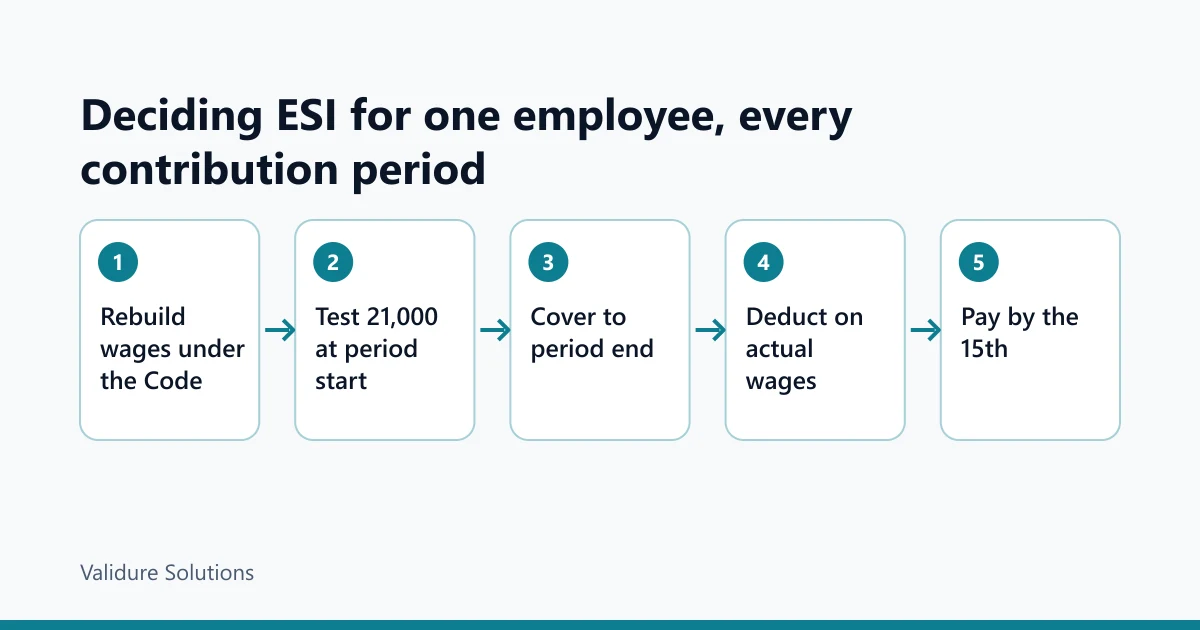
The contribution rates haven't changed either. Since 1 July 2019 the employee pays 0.75 per cent of wages and the employer pays 3.25 per cent, 4 per cent in all. Each share is rounded up to the next higher rupee. The employer pays both to ESIC within 15 days of the end of the month the wages relate to.
What decides whether someone is in or out isn't the payslip month. It's the contribution period.
Contribution periods: why one month's raise doesn't end coverage
ESIC splits the year into two contribution periods:
| Contribution period | Matching benefit period |
|---|---|
| 1 April to 30 September | 1 January to 30 June of the next year |
| 1 October to 31 March | 1 July to 31 December |
The benefit period starts three months after its contribution period ends. Contributions paid in April to September earn the cash benefits paid in the following January to June.
The rule for a raise is in ESIC's FAQ and comes from the old ESI (Central) Rules: if an employee's wages cross the limit at any time after a contribution period has begun, they stay an employee for ESI until the end of that period. Contributions keep being paid, on the full new wage, not on 21,000.
So coverage is tested once, at the start of each period. A raise in May, July or September changes nothing until 1 October. A raise in November or February changes nothing until 1 April.
Worked example: the supervisor's July raise
This is an example with a simple structure where all pay counts as wages.
| Month | Monthly wages | Employee 0.75% | Employer 3.25% |
|---|---|---|---|
| April to June | 19,500 | 146.25, rounded to 147 | 633.75, rounded to 634 |
| July to September | 23,000 | 172.50, rounded to 173 | 747.50, rounded to 748 |
| From October | 23,000 | nil, not covered | nil |
For April to June: 19,500 x 0.0075 = 146.25 and 19,500 x 0.0325 = 633.75. For July to September: 23,000 x 0.0075 = 172.50 and 23,000 x 0.0325 = 747.50. Both are rounded up.
On 1 October her wages are 23,000, above the limit at the start of the new period, so she's out from October. If HR had capped her contribution at 21,000 in July, or stopped it in August, the July to September returns would be short and the employer would owe the difference plus interest.
What she gets for those three months matters too. She contributed for the whole April to September period, so she stays eligible for cash benefits in the matching benefit period, January to June next year. ESIC's FAQ ties sickness benefit to having contributions for at least 78 days in the contribution period; she has far more than that.
Backdated raises: coverage moves later, arrears are spared
Raises in India are often agreed late and paid with arrears. ESIC's FAQ has a specific answer for this. When a raise is announced with a retrospective date and pushes wages over the limit, the effect on coverage starts only after the contribution period in which the raise was announced. Contribution on the higher wage is due from the month of the announcement. No contribution is due on the arrears for months before it.
Worked example: an increment announced in November
Say an accounts assistant earns 20,000. In November 2026 the company announces a raise to 22,000, backdated to April 2026. This is an example.
| Item | Sum | ESI |
|---|---|---|
| Arrears for April to October | 7 months x 2,000 = 14,000 | none due on the arrears |
| November to March wages | 22,000 a month | employee 165, employer 715 each month |
| From 1 April 2027 | 22,000 | not covered, if wages are still above 21,000 |
22,000 x 0.0075 = 165 and 22,000 x 0.0325 = 715, both exact, so no rounding.
Two things to note. The raise was announced in the October to March period, so she stays covered until 31 March even though her new wage technically applied from April. And a common payroll error is to run ESI on the 14,000 of arrears. ESIC's FAQ says that isn't needed.
Overtime is ignored for the test
ESIC's FAQ excludes overtime when deciding whether someone crosses the limit, and gives the reason: overtime is occasional, and counting it would push people in and out of the scheme month to month.
Say a machine operator earns 18,000 and works 4,000 of overtime in a busy month, so the month's pay is 22,000. They're still covered, because the test looks at 18,000. Under the old ESI practice the contribution was then paid on the full 22,000, overtime included, so the person was insured at their real earnings while working the extra hours.
Under the Code, overtime sits in the excluded list of the wage definition, clause (h), and counts only through the 50 per cent test described next. Whether ESI contributions now leave out overtime that the 50 per cent test doesn't pull back is one of the points that hasn't been clearly settled in an official text I could find. If overtime is a big part of your payroll, ask your ESIC branch and write down the answer.
The labour code test: why some higher earners are now in
This is the change most payrolls haven't caught up with. The ministry's FAQ says that from 21 November 2025 "the definition of wages under the CoSS, 2020 shall apply" for ESI coverage.
Section 2(88) of the Code defines wages as basic pay, dearness allowance and retaining allowance, and excludes a list of items. The ones that matter for most salary structures are employer PF and pension contributions, conveyance, house rent allowance, overtime and commission. Then comes a proviso: if the excluded items add up to more than half of all remuneration, the part above half is added back into wages.
Under the old ESI Act, HRA and conveyance counted as wages for ESI. So a salary built mostly from basic, HRA and conveyance used to be measured on its gross. Under the Code it's measured on a much smaller figure.
Worked example: 28,000 gross, now covered
A field sales executive's structure, as an example:
| Component | Monthly | Under section 2(88) |
|---|---|---|
| Basic | 15,000 | wages |
| HRA | 9,000 | excluded |
| Conveyance | 4,000 | excluded |
| Employer PF, 12% of 15,000 | 1,800 | excluded |
| All remuneration | 29,800 |
The ministry's FAQ says statutory items such as employer PF count in "all remuneration" for the half test. Half of 29,800 is 14,900. The excluded items come to 9,000 + 4,000 + 1,800 = 14,800, which is under 14,900, so nothing is added back.
Wages for ESI are 15,000. That's under 21,000, so this person is covered, even though their gross salary of 28,000 would have kept them out under the old test. Contributions on 15,000 are 112.50 for the employee, rounded to 113, and 487.50 for the employer, rounded to 488.
Worked example: 40,000 gross, and the special allowance question
Plenty of structures have a large special allowance. Section 2(88) doesn't list it as wages and doesn't list it as excluded, and that gap decides coverage here. This is an example.
| Component | Monthly |
|---|---|
| Basic | 16,000 |
| HRA | 8,000 |
| Conveyance | 2,000 |
| Special allowance | 14,000 |
| Employer PF, 12% of 16,000 | 1,920 |
| All remuneration | 41,920 |
Half of 41,920 is 20,960.
| Reading | Working | Wages for ESI | Covered? |
|---|---|---|---|
| 1: special allowance sits outside wages | 8,000 + 2,000 + 14,000 + 1,920 = 25,920 outside wages, 4,960 over half, so 16,000 + 4,960 | 20,960 | Yes |
| 2: special allowance is wages | 16,000 + 14,000; excluded items 11,920 are under half | 30,000 | No |
Under the first reading, a person grossing 40,000 is inside ESI. Under the second, they're well outside. We covered the same two readings for gratuity in our gratuity post, and neither has been settled by a court or a clear notification that I could find.
One thing follows from the arithmetic either way. Once the 50 per cent test is applied, wages can't fall below half of all remuneration. So anyone whose all remuneration is above 42,000 a month can't be covered by ESI, whatever the structure. If you're reviewing a payroll, that's the cut-off for who needs a second look.

Small pay, no employee share
At the other end, ESIC exempts employees whose daily average wage is up to 176 rupees from paying their share. The employer still pays its 3.25 per cent.
Say a part-time cleaner is paid 4,500 for a month in which wages were payable for 26 days. 4,500 / 26 = 173.08, under 176, so the employee share is nil. The employer pays 4,500 x 0.0325 = 146.25, rounded to 147. This is an example; work the daily average from the days wages were actually payable.
What it costs the employer
For a small firm the Code test is the item to budget for. Take a 40-person company, as an example, that finds 12 people newly covered after rebuilding wages under section 2(88), each with ESI wages of 19,000.
| Item | Sum |
|---|---|
| Employer share per person | 19,000 x 0.0325 = 617.50, rounded to 618 |
| For 12 people, a month | 618 x 12 = 7,416 |
| For a year | 7,416 x 12 = 88,992 |
| Employee share per person | 19,000 x 0.0075 = 142.50, rounded to 143 |
Against that cost, covered staff get ESIC medical care and cash benefits for sickness, maternity and employment injury. ESIC's pages describe the benefits, including the 78-day contribution condition for sickness benefit.
Late payment costs more. ESIC's FAQ says simple interest at 12 per cent a year runs on contributions paid after the due date, and damages can be levied on top. If you've been leaving out people the Code test now covers, the shortfall runs from 21 November 2025, so the sooner it's fixed the smaller the interest.
Checks to run before the next ESI return
| Check | What to look for | What a hit means |
|---|---|---|
| Rebuild wages under section 2(88) | Basic, DA and retaining allowance, plus any excess of excluded items over half of all remuneration | Anyone at 21,000 or under is covered, whatever their gross |
| All remuneration above 42,000 | Pull everyone below this line for the rebuild | Above it, ESI can't apply; below it, check one by one |
| Mid-period raises | Anyone whose wages crossed 21,000 after 1 April or 1 October | Keep deducting until 30 September or 31 March, on actual wages |
| Capped deductions | ESI worked on 21,000 instead of actual wages | Short payment; correct it and expect interest |
| Arrears | ESI run on backdated arrears | Not needed per ESIC's FAQ; check the arrears month |
| Overtime in the coverage test | Someone dropped from ESI because of an overtime month | Overtime doesn't count for coverage; restore them |
| Daily average up to 176 | Employee share deducted from very low earners | Refund the employee share; the employer share stays |
| Special allowance policy | Which reading you used, written down | Without a note, every audit reopens it |
Most of these are dates and thresholds, so they fail quietly in a spreadsheet when someone copies last period's ESI column forward. A payroll system that keeps the salary structure with an effective date and works the deduction from the structure each month catches the mid-period raise without anyone remembering it. Validure HR's payroll works from versioned salary structures and gives owners reports, which is where the coverage list for each period would come from. It won't decide the special allowance question for you; that's a policy call to make with your adviser and then set once.
If you have fewer than ten people and no ESI registration, much of this won't touch you yet, but check ESIC's applicability rules before you assume so.
For the employee checking a payslip
If ESI is still being deducted after your raise, look at the month the raise started and compare it with the contribution period. If it started after 1 April and you're before October, or after 1 October and you're before April, the deduction is correct and you're still insured. Check that it's 0.75 per cent of your actual wages, rounded up, and not more.
If your gross is above 21,000 and ESI started recently, it's probably the Code test. Ask HR for the wage figure they used under section 2(88). You can see your contributions and your insurance number on the ESIC portal, and your ESIC branch office or the regional office is the place to raise a dispute about coverage.
Sources and checks
Checked on 14 November 2026. The ESI rules were moving from the ESI Act, 1948 and its rules to the Code on Social Security, 2020 through 2026, with the Social Security (Central) Rules notified in May 2026, so look for any newer ESIC circular before you rely on this.
- Ministry of Labour and Employment, "Additional FAQs on Labour Codes" dated 16 March 2026, FAQ 12 on ESI coverage and the FAQ on what counts in all remuneration: labour.gov.in
- ESIC contribution page and FAQ: rates of 0.75 and 3.25 per cent from 1 July 2019, the 176 rupee exemption, the 15-day due date, contribution and benefit periods, the mid-period and backdated raise rules, overtime and the 78-day condition: esic.gov.in
- Press Information Bureau release of 13 June 2019 on the reduction of the ESI contribution rate to 4 per cent: pib.gov.in
- The Code on Social Security, 2020, section 2(88), the definition of wages and the 50 per cent proviso: India Code
I could not find an official text that settles whether ESI contributions under the Code are now worked on section 2(88) wages or on the wider pay that the old ESI Act counted, or how special allowance is treated. The post shows the coverage test the ministry's FAQ describes and labels both open points. Newer notifications under the Code may restate the mid-period rule in different words; check ESIC for the current one.
Frequently asked questions
My salary went above 21,000. When does ESI stop?
At the end of the contribution period in which your wages crossed the limit: 30 September if it happened between April and September, 31 March if it happened between October and March. Until then ESI is deducted on your full new wages.
Is ESI calculated on 21,000 or on my actual salary after the raise?
On your actual wages. ESIC's FAQ says contributions continue on the total wages earned until the period ends, so capping at 21,000 is a short payment.
My gross pay is 30,000. Why am I now covered by ESI?
Because since 21 November 2025 coverage is tested on wages as section 2(88) of the Code defines them, which leaves out HRA, conveyance and employer PF up to half of your total pay. If that figure is 21,000 or less, you're covered.
Is ESI charged on salary arrears?
Not on arrears for the months before the raise was announced, according to ESIC's FAQ. Contribution on the higher wage starts from the month of the announcement.
Does overtime push me out of ESI?
No. Overtime isn't counted when deciding whether you cross the limit, so a heavy overtime month doesn't take you out of the scheme.
When does ESI have to be paid to ESIC?
Within 15 days of the end of the month the wages relate to, so October's contributions are due by 15 November. Late payment attracts interest at 12 per cent a year.
